Education is changing rapidly because students now have access to more learning resources than ever before. In the past, students mainly depended on teachers, printed books, school libraries, and classroom notes. Today, digital technology has opened a much wider world of knowledge. One of the most useful developments in modern education is the digital library.
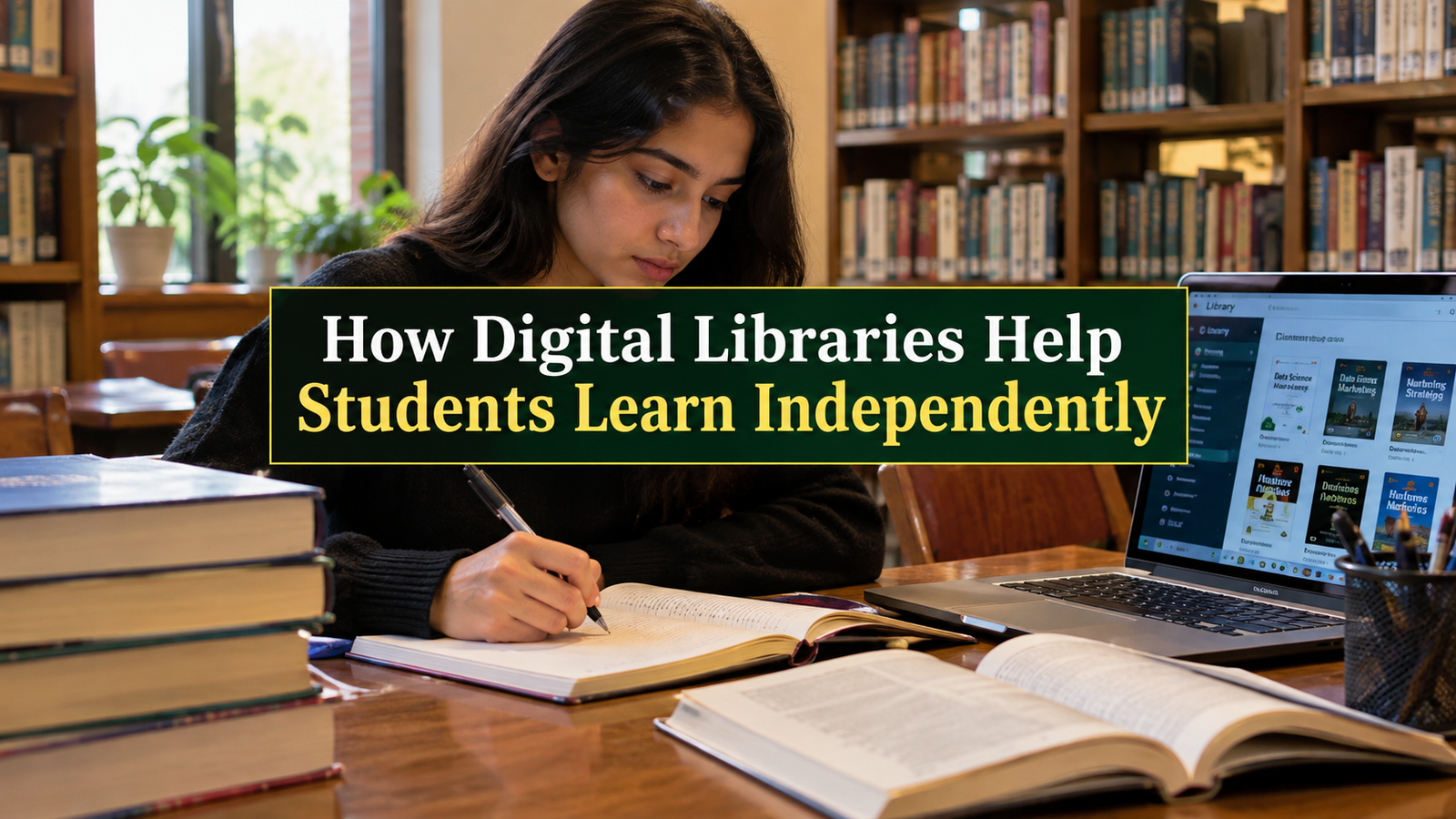
A digital library gives students access to books, research papers, academic journals, reports, educational documents, reference material, and many other learning resources through computers, tablets, or smartphones. Instead of visiting a physical library every time they need information, students can search for useful material from almost anywhere.
After reading about modern learning methods and the growing role of technology in education, I have noticed that digital libraries are especially useful for independent learning. They allow students to explore subjects in their own way, choose what they want to study, and improve their knowledge without depending completely on classroom teaching.
Digital libraries do not replace teachers or traditional libraries. Instead, they give students another powerful way to learn. When used properly, they can encourage curiosity, research skills, self discipline, and lifelong learning.
What Is a Digital Library?
A digital library is an online collection of learning and research materials that can be accessed electronically. These materials may include textbooks, reference books, academic articles, research papers, magazines, newspapers, historical documents, educational videos, and other useful resources.
Traditional libraries contain printed material stored on shelves. Digital libraries store information electronically, which makes searching and accessing information much easier.
Students can usually search a digital library by typing a topic, title, author, subject, or keyword. Within seconds, they may find several relevant resources.
Some digital libraries are operated by universities, schools, government organizations, research institutions, museums, and nonprofit organizations. Others are available through educational platforms and online databases.
The main purpose is the same. A digital library helps people find trustworthy information for learning and research.
Digital Libraries Give Students Greater Access to Knowledge
One of the biggest benefits of digital libraries is easy access to information.
A student who wants to learn about science, history, literature, technology, mathematics, or another subject can explore many sources without having to purchase every book.
This makes independent learning much easier.
For example, imagine a student studying climate change. A classroom textbook may provide a basic explanation, but the student may want to understand the subject in greater detail. Through a digital library, the student may be able to read scientific reports, educational books, research articles, and historical information related to climate and the environment.
This wider access allows students to go beyond the information provided in a single textbook.
As a result, students can build a deeper understanding of the subjects that interest them.
Students Can Learn at Their Own Pace
Every student learns differently.
Some students understand a lesson quickly, while others need more time to read, review, and think about the information.
Digital libraries support both types of learners because students can control their own learning speed.
If a student finds a topic difficult, the student can search for additional explanations and read them slowly. If another student already understands the basics, that student can explore advanced material.
This flexibility is very important in independent learning.
In a classroom, teachers usually follow a fixed schedule because they have to complete the course within a certain period. A digital library gives students the opportunity to continue learning outside the classroom.
They can study early in the morning, during the afternoon, or in the evening depending on their personal routine.
The ability to learn at a comfortable pace can make studying less stressful and more productive.
Digital Libraries Encourage Curiosity
Curiosity is one of the most important parts of learning.
Students often develop questions while reading a book or listening to a lesson. In a traditional classroom, there may not always be enough time to explore every question.
Digital libraries give students the freedom to investigate their curiosity.
For example, a student reading about the solar system may become interested in Mars. After searching the digital library, the student may find books about Mars, information about space missions, scientific articles, and educational reports about planetary exploration.
One question can lead to another question.
This process encourages students to become active learners instead of simply memorizing information for examinations.
Students begin to understand that learning is not limited to the classroom. Knowledge can be explored whenever curiosity appears.
Students Learn How to Search for Information
Independent learning requires good research skills.
Students need to know how to find information rather than waiting for someone else to provide every answer.
Digital libraries help students develop these skills.
When students use a digital library, they learn how to search using keywords, subject categories, authors, titles, and publication information.
For example, searching for a broad word such as education may produce thousands of results. A student gradually learns that using a more specific phrase, such as digital learning in schools, can produce more useful results.
Learning how to search effectively is an important academic skill.
Students who develop strong search skills often become better researchers because they know how to locate information more efficiently.
Digital Libraries Help Students Compare Different Sources
Good learning does not always come from reading one source.
Different authors may explain the same subject in different ways. One book may provide a simple explanation, while another may provide more detailed research.
Digital libraries make it easier for students to compare information from several sources.
Suppose a student is researching renewable energy. The student may read one book about solar energy, another source about wind power, and a research report about future energy systems.
By comparing these materials, the student can develop a broader understanding of the topic.
This habit also encourages critical thinking.
Instead of accepting the first piece of information they find, students learn to examine different explanations and decide which information is most useful and reliable.
Digital Libraries Support Better Research Projects
Students often need reliable information for assignments, presentations, essays, and research projects.
Searching randomly on the internet may provide useful information, but it can also produce inaccurate or poorly researched content.
Digital libraries often contain materials from educational institutions, publishers, researchers, libraries, and academic organizations.
This can make them valuable sources for serious academic work.
Students can use digital library resources to understand their topic before writing an assignment. They can collect facts, compare ideas, study previous research, and develop stronger arguments.
This can improve the overall quality of student work.
It also teaches students an important lesson. Academic writing should be based on proper research rather than personal opinion alone.
Students Can Study Beyond Their Textbooks
Textbooks are important, but they cannot include everything about a subject.
A textbook has limited space and is usually designed around a particular course.
Digital libraries give students an opportunity to explore subjects beyond the limits of their textbooks.
A student studying biology may read the required chapter about the human body and then explore books about genetics, medicine, nutrition, or environmental biology.
A student studying history may read about a historical event in the textbook and later explore original documents, biographies, historical photographs, or research articles.
This deeper learning can make subjects much more interesting.
Students begin to connect classroom lessons with a larger world of knowledge.
Digital Libraries Can Improve Reading Habits
Regular reading plays an important role in education.
However, students may not always have access to a large collection of printed books at home.
Digital libraries can help by providing reading material through electronic devices.
Students can explore educational books, stories, biographies, essays, research material, and reference books.
When students discover topics that genuinely interest them, they may become more willing to read.
A student interested in technology may read books about computers and artificial intelligence. Another student interested in nature may explore material about animals, forests, oceans, and the environment.
Reading becomes more meaningful when students can choose material according to their interests.
Over time, regular reading can improve vocabulary, comprehension, writing ability, and general knowledge.
Digital Libraries Support Learning from Home
One of the strongest advantages of digital libraries is that learning is not limited to a school building.
Students can access educational resources from home if they have a suitable device and internet connection.
This is useful for students who live far from large libraries or educational institutions.
A student in a small town may not have access to the same physical collection as a student studying near a major university. Digital access can reduce some of this difference by making educational resources available online.
Students can continue studying during holidays, weekends, or periods when they cannot attend school.
This helps create a more flexible learning environment.
Students Become More Responsible for Their Learning
Independent learning requires responsibility.
Students need to decide what they want to learn, how much time they will spend studying, and which resources they will use.
Digital libraries encourage this responsibility.
Instead of waiting for a teacher to provide every reading assignment, students can search for useful material themselves.
They may create reading lists, save useful articles, organize research notes, and decide which subjects need additional study.
These habits can gradually make students more confident learners.
The goal is not to remove teachers from education. Teachers remain important because they provide guidance, explanation, feedback, and support.
However, students become stronger learners when they can continue learning even when the teacher is not present.
Digital Libraries Can Save Time
Finding information in a large physical library may take time.
Students may need to search shelves, check different sections, or wait for a particular book to become available.
Digital libraries often make the search process faster.
Students can type keywords into a search box and quickly find relevant material.
Some platforms also allow users to search inside a book or document for specific words.
This can be especially useful when students are conducting research.
Instead of reading an entire document to locate one small piece of information, they may be able to find the relevant section quickly.
The time saved can then be used for reading, understanding, writing, and reviewing the material.
Digital Libraries Help Students Organize Learning Resources
Independent learning becomes easier when information is organized properly.
Many digital library platforms allow students to save documents, bookmark pages, create reading lists, or download permitted resources for later study.
Students can group material according to different subjects or projects.
For example, a student working on a science project may save articles about renewable energy in one folder and material about environmental pollution in another.
Good organization prevents students from repeatedly searching for the same resources.
It can also make research projects easier to manage.
Learning how to organize information is a useful skill that students can continue using in higher education and professional life.
Digital Libraries Support Different Learning Interests
Not every student is interested in the same subject.
Traditional courses usually follow a fixed curriculum, but digital libraries allow students to explore personal interests alongside their formal studies.
A student may be studying business at school but may also be interested in psychology. Another student may be learning science while developing an interest in photography or architecture.
Digital libraries can provide resources for many different interests.
This gives students more control over their intellectual development.
Personal interest often increases motivation. When students are genuinely interested in a topic, they are more likely to read carefully, ask questions, and continue learning.
Digital Libraries Encourage Lifelong Learning
Education does not end when a person finishes school or university.
People continue learning throughout their lives.
Technology changes, industries develop, and new knowledge is constantly produced. Adults may need to learn new skills for their careers or personal development.
Digital libraries introduce students to the habit of searching for reliable information independently.
This habit can remain useful throughout life.
A student who learns how to research topics independently today may later use the same skills to understand new technology, develop professional knowledge, or explore personal interests.
In this way, digital libraries support lifelong learning.
Challenges of Using Digital Libraries
Although digital libraries provide many benefits, they also have some limitations.
Students need access to suitable digital devices and internet connections. In some areas, reliable internet access may still be difficult or expensive.
Another challenge is information overload.
A search may return hundreds or thousands of results. Students need to learn how to identify which sources are most relevant and trustworthy.
Screen time is another issue. Reading from screens for long periods may become tiring for some students.
Students should also understand copyright, citation, and responsible use of information.
Copying material directly from books or articles without proper acknowledgement is not good academic practice. Students should read information, understand it, and explain ideas in their own words while giving proper credit when required.
Teachers and librarians can help students develop these responsible research habits.
How Students Can Use Digital Libraries Effectively
Digital libraries become most useful when students approach them with a clear learning goal.
Before searching, students should decide what they want to understand.
Using specific keywords can make searches more accurate.
Students should also compare several trustworthy sources instead of depending on a single document.
Taking notes while reading can help students remember important ideas.
It is also useful to write short summaries after completing a reading session. Explaining a topic in simple words is a good way to test understanding.
Students can create personal reading lists and return to important resources when preparing for examinations or assignments.
Most importantly, students should use digital libraries for learning rather than simply collecting information.
Reading twenty articles without understanding them is less useful than carefully studying a few reliable sources.
The Role of Teachers in Digital Library Learning
Independent learning does not mean that students should study completely alone.
Teachers can play an important role in showing students how to use digital libraries properly.
They can recommend trustworthy databases, teach effective search methods, explain how to evaluate sources, and help students understand difficult material.
Teachers can also design assignments that require students to explore digital resources independently.
For example, instead of giving students every piece of information about a topic, a teacher may provide a research question and ask students to find reliable sources.
This encourages students to become active participants in their education.
The best learning environment often combines teacher guidance with student independence.
The Future of Digital Libraries in Education
Digital libraries are likely to become even more important as education continues to use technology.
More books, research materials, historical records, and educational resources are being converted into digital formats.
Search technology is also becoming more advanced, which may make it easier for students to discover information related to their interests.
Future digital libraries may provide better recommendations, improved accessibility features, interactive learning material, and stronger connections with online education platforms.
However, the most important purpose of a digital library will remain the same.
It gives people access to knowledge.
For students, that access can create opportunities to explore ideas, answer questions, develop research skills, and learn independently.
Conclusion
Digital libraries have become valuable tools for modern education because they give students easy access to a wide range of learning resources.
They help students learn at their own pace, explore topics beyond textbooks, improve research skills, compare different sources, organize information, and develop stronger reading habits.
More importantly, digital libraries can encourage students to take greater responsibility for their own education.
A teacher may introduce a subject in the classroom, but a curious student can continue exploring that subject through books, academic articles, reports, and other digital resources.
This is what makes digital libraries especially powerful for independent learning.
They do not simply provide information. They give students the opportunity to search, question, read, compare, think, and discover knowledge for themselves.
As education continues to develop, students who know how to use digital libraries effectively may become more confident, curious, and independent learners.
The ability to learn independently is valuable not only for passing examinations but also for personal growth and lifelong education.