
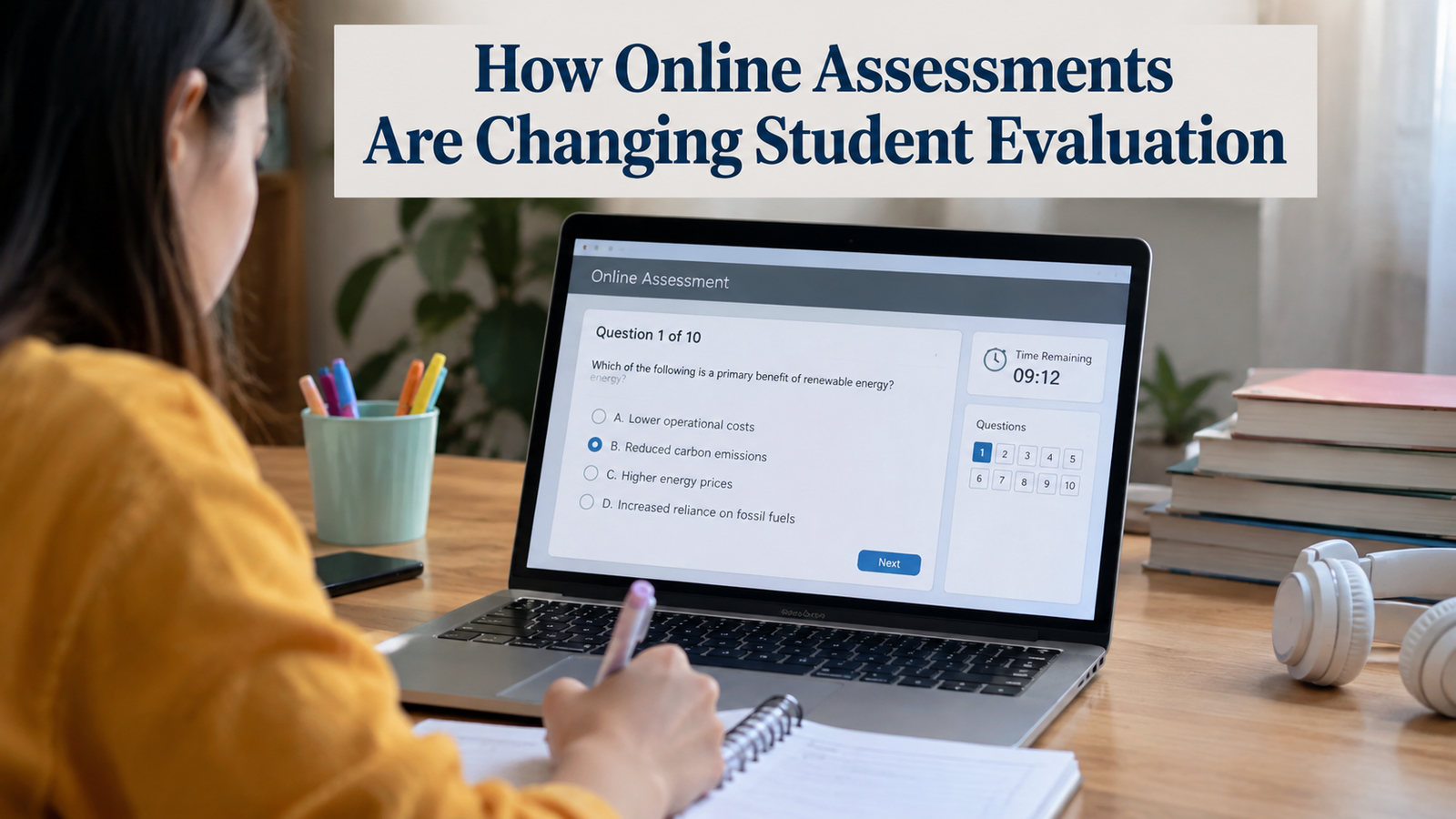
Education has always depended on assessment. Teachers need to understand what students know, where they are struggling, and whether they are ready to move to the next stage of learning. For many years, student evaluation mainly depended on written examinations, classroom tests, homework, and face to face questioning. These methods are still valuable, but technology is changing the way assessment takes place.
Online assessments are now becoming an important part of modern education. Schools, colleges, universities, training centers, and online learning platforms are using digital tools to evaluate student knowledge and skills. Instead of waiting for a traditional examination at the end of a course, teachers can now assess learning regularly through online quizzes, assignments, interactive activities, projects, and digital tests.
This change is not simply about replacing paper with a computer screen. Online assessments can change how teachers collect information, how quickly students receive feedback, and how learning progress is measured. When they are designed carefully, they can make student evaluation more flexible, continuous, and useful for both teachers and learners.
What Are Online Assessments?
Online assessments are tests or learning activities completed through computers, tablets, smartphones, or other digital devices. They may be conducted inside a classroom or completed remotely through an online learning system.
An online assessment can be very simple. A teacher may create a short multiple choice quiz after a lesson to check whether students understood the main ideas. It can also be more detailed, such as an online examination containing different question types, written responses, case studies, problem solving activities, and practical tasks.
Many learning management systems allow teachers to create and manage assessments in one place. Students can log in, complete their work, submit answers, and receive results without using paper.
Online assessment is therefore not one single method. It includes many different ways of checking student learning through digital technology.
Why Student Evaluation Is Changing
Traditional examinations usually evaluate students at specific points during the academic year. A student may study for several months and then complete one major examination. The final score can have a large influence on the student’s grade.
This approach provides useful information, but it does not always show the complete learning process.
A student may understand most of the course but perform poorly because of stress during one examination. Another student may memorize information for the test without developing a deep understanding of the subject.
Modern education is placing greater attention on continuous learning. Teachers increasingly want to understand how students progress over time rather than relying only on one final examination.
Online assessments support this approach because they make frequent evaluation easier to manage.
Teachers can use small assessments throughout a course. These assessments help identify learning gaps before they become serious problems.
Faster Feedback for Students
One of the greatest advantages of online assessments is faster feedback.
In a traditional classroom, teachers may need several days to check a large number of test papers. Students sometimes receive their results long after completing the assessment. By that time, they may already have moved to another topic.
Many online assessments can provide results immediately.
For example, when students complete questions with clearly defined answers, the system can check responses automatically. Students can quickly see which questions they answered correctly and where they made mistakes.
Immediate feedback is useful because students still remember the questions and their thinking process.
A student who receives quick feedback can review the topic while the experience is still fresh. This helps turn assessment into part of the learning process instead of treating it only as a method of giving marks.
Online Assessments Support Continuous Evaluation
Online assessments make it easier to evaluate students regularly.
Instead of giving only one large test, teachers can provide smaller assessments throughout the learning period. These may include weekly quizzes, short knowledge checks, digital assignments, practice questions, and classroom activities.
Regular assessment gives teachers a clearer picture of student progress.
Suppose a mathematics teacher introduces a new concept. After the lesson, students complete a short online quiz. If most students answer one question incorrectly, the teacher immediately knows that the concept may need further explanation.
Without this information, the teacher might continue teaching new material while students are still confused about the previous topic.
Continuous online assessment can therefore help teachers adjust instruction according to student needs.
Better Understanding of Student Progress
Digital assessment systems can collect useful information about student performance.
Teachers can often see more than a final score. They may be able to view which questions caused difficulty, how students performed across different topics, and whether their results are improving over time.
This information can support better educational decisions.
For example, a teacher might notice that a student performs well in reading based questions but struggles with questions that require mathematical calculations. This pattern can help the teacher provide more focused support.
When assessment information is organized clearly, teachers can understand learning patterns that may be difficult to notice through occasional examinations alone.
More Flexibility for Students
Online assessments can make education more flexible.
Depending on the type of assessment, students may be able to complete activities from home, school, a library, or another suitable location. This is particularly useful in online courses and distance education.
Some assessments can also be completed within a wider time period instead of at one fixed moment.
This flexibility can help students manage learning alongside other responsibilities.
However, flexibility should still be supported by clear rules. Students need to know when assessments are available, when they must be completed, and how their work will be evaluated.
A well organized system combines flexibility with responsibility.
Different Types of Questions Can Be Used
Online assessments can include many question formats.
Multiple choice questions remain common because they are easy to understand and can often be checked automatically. However, digital assessment is not limited to multiple choice testing.
Teachers can also use short written answers, longer responses, matching activities, calculations, images, case studies, video responses, practical exercises, and problem solving tasks.
The choice of question format should depend on the learning goal.
If the purpose is to test basic knowledge, a short quiz may be suitable. If the goal is to measure critical thinking, students may need to explain their reasoning or solve a realistic problem.
Good online assessment therefore requires thoughtful question design.
Online Assessments Can Encourage Active Learning
Assessment does not always have to happen after learning. It can also become part of learning itself.
Teachers can use short online questions during lessons to encourage students to think about what they have just learned.
For example, after explaining a science concept, a teacher may ask students to answer three questions using a digital platform. The results can show whether students are ready to continue.
Students also become more involved because they are actively responding instead of only listening.
These small assessment activities can help learners check their own understanding.
When students regularly ask themselves, “Do I really understand this topic?” they become more aware of their learning progress.
Reduced Administrative Work
Teachers spend a considerable amount of time preparing tests, printing papers, checking answers, recording marks, and organizing results.
Online assessment systems can reduce some of this administrative work.
Certain question types can be checked automatically. Scores can be recorded digitally, and reports can be generated without manually entering every result.
This does not mean technology removes the role of teachers.
Written assignments, creative work, presentations, and complex answers still require human judgment. Teachers remain responsible for evaluating the quality of student thinking and providing meaningful guidance.
Technology simply helps manage repetitive tasks so teachers can spend more time on teaching and student support.
Online Assessments and Personalized Learning
One important development in digital education is personalized learning.
Students do not always learn at the same speed. Some understand a topic quickly, while others need additional explanation or practice.
Online assessments can provide information that supports personalized instruction.
If assessment results show that a student already understands a concept, the teacher may provide more challenging work. If another student is struggling, additional learning materials can be offered.
Some digital learning platforms can even adjust questions according to student performance.
For example, a student who answers several questions correctly may receive more difficult questions. A learner who is struggling may receive simpler practice activities before moving forward.
This approach can make assessment more connected to individual learning needs.
The Importance of Formative Assessment
Formative assessment is used during the learning process rather than only at the end.
Its main purpose is to understand how learning is progressing and identify areas that need improvement.
Online tools are particularly useful for formative assessment.
A teacher can create a five minute quiz at the end of a lesson. Students complete it, and the teacher reviews the results. The next lesson can then focus on the areas where students had difficulty.
This creates a cycle of teaching, assessment, feedback, and improvement.
Instead of assessment being something students fear, it becomes a normal part of everyday learning.
Online Assessments Can Improve Record Keeping
Paper based records can be difficult to organize over long periods.
Digital assessment systems can store results in a structured way. Teachers may be able to review earlier assessments and compare them with newer results.
This provides a clearer picture of progress.
For example, a teacher can compare a student’s reading assessment from the beginning of the term with another assessment several months later.
Students can also benefit from seeing their own progress.
When learners can see that their scores or skills are improving, they may feel more motivated to continue working.
Challenges of Online Assessments
Although online assessments offer many advantages, they also create challenges.
Technology access is one important issue.
Not every student has the same quality of computer, smartphone, or internet connection. If an assessment requires reliable internet access, students with technical difficulties may be disadvantaged.
Schools and educational institutions need to consider these differences before making important assessments completely dependent on technology.
Technical problems can also occur during examinations. Internet connections may fail, websites may stop responding, or devices may experience problems.
Teachers should have clear procedures for dealing with such situations.
Academic Honesty and Online Testing
Academic honesty is another important concern.
When students complete assessments outside the classroom, teachers may find it more difficult to know whether they completed the work independently.
Educational institutions use different methods to address this issue.
Some assessments use limited time periods, randomized questions, larger question banks, or different versions of the same test.
However, assessment design can sometimes be more effective than simply increasing supervision.
Questions that require explanation, reasoning, personal interpretation, or practical application are often more difficult to answer through simple copying.
Teachers can therefore improve academic honesty by designing assessments that focus on understanding rather than memorization alone.
Privacy and Student Data
Online assessment systems collect educational information about students.
This may include names, scores, responses, learning progress, and other academic records.
Educational institutions need to handle this information responsibly.
Teachers and administrators should understand which platforms are being used, what information they collect, and how student data is stored.
Students should also receive clear information about how digital assessment tools are being used.
Technology can improve education, but student privacy should remain an important part of responsible digital learning.
The Teacher’s Role Remains Essential
Technology can check answers and organize results, but it cannot replace every part of student evaluation.
Teachers understand the wider context of learning.
A student may receive a low score because the topic was difficult, because instructions were misunderstood, or because the student needs additional support.
Numbers alone cannot always explain these situations.
Teachers use professional judgment to interpret assessment results and decide what should happen next.
For this reason, online assessment works best when technology supports teachers rather than attempting to replace them.
Combining Online and Traditional Assessment
The future of student evaluation does not necessarily mean removing traditional assessment completely.
Different assessment methods measure different skills.
A written examination may be useful for evaluating certain types of knowledge. A classroom presentation may measure communication ability. A project can show creativity and practical understanding. An online quiz may provide quick information about basic concepts.
Using several assessment methods can provide a more complete picture of student learning.
Educational institutions can combine online assessments with classroom observation, projects, practical activities, presentations, written work, and teacher feedback.
This balanced approach helps avoid depending too heavily on one type of assessment.
How Online Assessments Can Improve Learning
The most valuable purpose of assessment is not simply producing a grade.
Assessment should help improve learning.
When teachers receive useful information about student understanding, they can make better teaching decisions. When students receive clear feedback, they can identify what they need to improve.
Online assessment makes this process faster and more frequent.
For example, imagine a student studying a difficult science topic.
The student completes a short online quiz and discovers that several answers are incorrect. The system provides feedback explaining the mistakes. The student reviews the lesson and attempts another set of questions.
This process helps the student learn from mistakes instead of waiting until the final examination to discover weaknesses.
Preparing Students for Digital Learning Environments
Digital skills are becoming increasingly important in education and professional life.
Using online assessments can help students become more comfortable with digital learning environments.
Students learn how to follow online instructions, submit digital work, manage deadlines, read information on screens, and interact with educational platforms.
These are practical skills that can support future learning.
However, students should receive guidance before completing important online assessments.
A student’s academic result should measure subject knowledge rather than simply showing how familiar the student is with technology.
Practice activities can help students understand the platform before formal evaluation begins.
The Future of Online Student Evaluation
Online assessment is likely to remain an important part of education as digital learning tools continue to develop.
Future assessment systems may provide teachers with even more detailed information about learning progress.
Artificial intelligence may also support certain assessment activities by helping organize responses, identify learning patterns, or provide personalized practice.
However, technology should be used carefully.
An advanced system is not automatically a good assessment system. The most important questions are still educational.
What should students learn?
What skills should the assessment measure?
Are the questions fair?
Does the assessment provide useful information?
Will the results help students improve?
These questions should guide the use of technology.
Best Practices for Effective Online Assessments
Effective online assessments should be simple, clear, and connected to learning objectives.
Students should understand what they are expected to do before starting an assessment. Instructions should be written in clear language, and unnecessary technical complexity should be avoided.
Teachers should also use suitable question types.
A multiple choice question may work well for checking factual knowledge, but it may not be suitable for evaluating creativity or detailed reasoning.
Feedback should also be meaningful.
Simply telling a student that an answer is incorrect may not be enough. Good feedback helps students understand why they made a mistake and what they should study next.
Assessment should ultimately guide improvement.
Conclusion
Online assessments are changing student evaluation by making it faster, more flexible, and more connected to everyday learning. Teachers can assess students more frequently, provide quicker feedback, track progress, and identify areas where additional support is needed.
Digital assessment also gives educators access to different question formats and useful information about student performance. When combined with thoughtful teaching, it can support continuous assessment and personalized learning.
At the same time, online assessments are not without challenges. Technology access, internet reliability, academic honesty, privacy, and assessment quality all require careful consideration.
The most effective approach is not to use technology simply because it is available. Online assessment should be chosen when it genuinely improves the learning and evaluation process.
Traditional examinations, projects, classroom discussions, presentations, and teacher observations will continue to have value. Online assessments add another useful method to this wider system.
Student evaluation is gradually moving away from being only a final measurement of learning. It is becoming an ongoing process that can help teachers understand students and help students understand themselves.
When online assessments are designed fairly and used responsibly, they can turn evaluation into something more meaningful. Instead of only asking how many answers a student got right, educators can use assessment to discover what the student understands, what still needs improvement, and what kind of support can help the learner succeed.