
Learning something once does not always mean that we will remember it for a long time. Many students have experienced the same problem. They read a chapter, understand it, and even feel confident about it. A few days later, however, much of the information seems to disappear.
This happens because human memory is not designed to keep every piece of information permanently after a single exposure.
One learning method that can help solve this problem is spaced repetition.
Spaced repetition is a study technique in which information is reviewed several times over increasing periods of time. Instead of repeating the same material continuously in one study session, the learner returns to it after a certain gap.
This simple change in timing can have a powerful effect on long term memory.
After reading about memory, learning science, study habits, and educational psychology, I found that spaced repetition is useful because it works with the natural way our memory strengthens information over time.
In this article, I will explain how spaced repetition improves long term memory, why forgetting happens, how the method works, and how students can use it effectively.
What Is Spaced Repetition?
Spaced repetition is a learning method based on reviewing information at carefully spaced intervals.
For example, imagine that you learn ten new vocabulary words today.
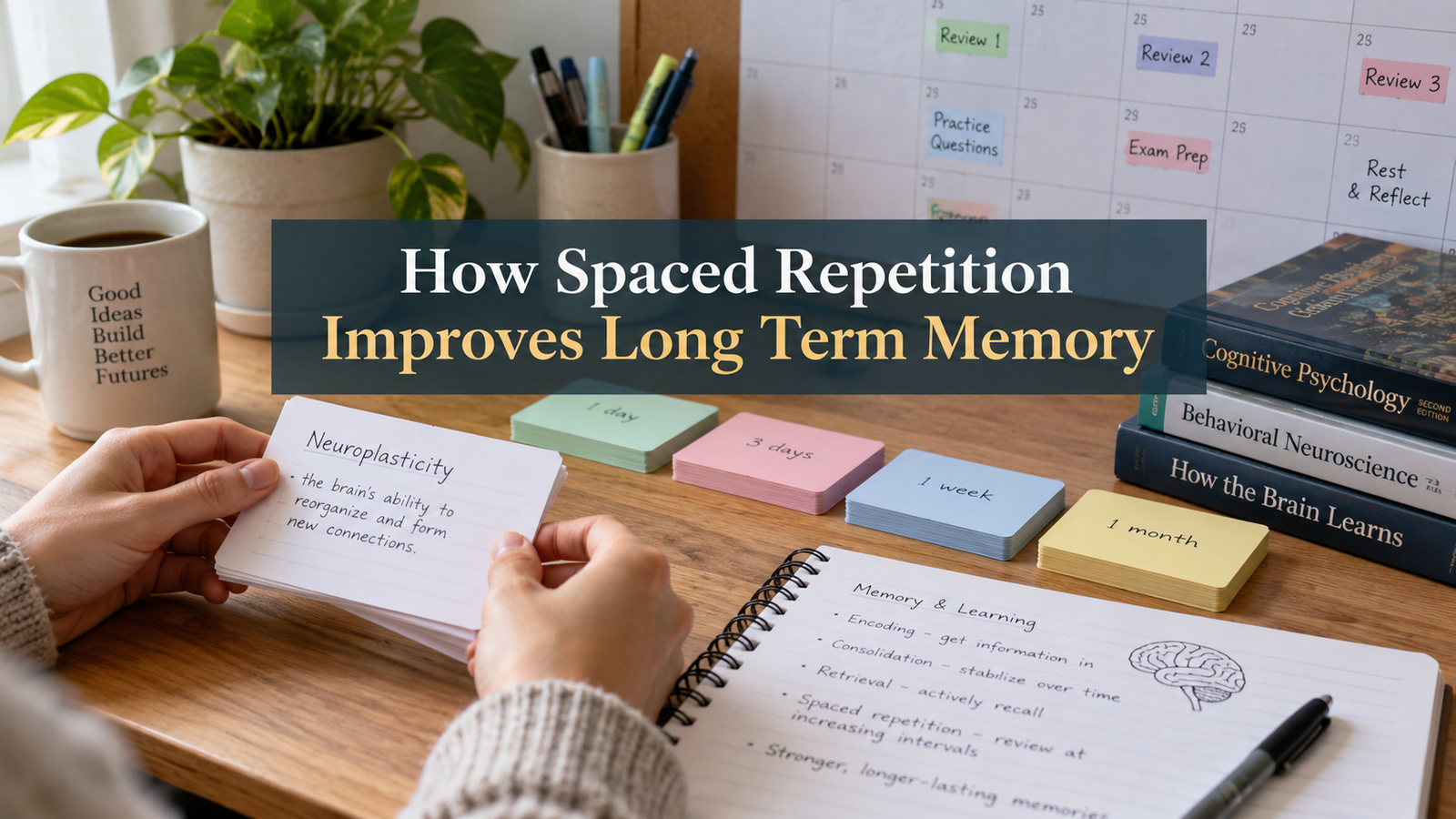
Instead of reading those words twenty times in one sitting, you might review them again tomorrow. Then you may review them after three days, one week, two weeks, and later after one month.
Every time you successfully remember the information, the interval before the next review becomes longer.
The basic idea is simple.
Information that is easy to remember needs less frequent review, while information that is difficult to remember should appear more often.
This approach is very different from cramming.
Cramming involves studying large amounts of information in a short period of time, usually just before an exam.
Spaced repetition spreads learning across days, weeks, or even months.
The purpose is not only to remember information for tomorrow’s test. The goal is to make the knowledge remain available in memory for a much longer period.
Why We Forget Information
To understand why spaced repetition works, it is helpful to understand forgetting.
When we learn something new, the memory may initially feel strong. However, if we do not use or review that information, our ability to recall it often decreases.
This process can happen surprisingly quickly.
We may remember a new fact clearly today but struggle to recall it several days later.
Forgetting is not always a failure of learning. It is a normal part of how memory works.
The brain receives an enormous amount of information every day. It cannot treat every detail as equally important.
Information that is repeatedly recalled or used is more likely to be considered valuable.
Information that is rarely used may gradually become harder to access.
Spaced repetition helps by reminding the brain of important information before it becomes completely forgotten.
Each successful review strengthens the memory and makes future recall easier.
The Forgetting Curve
One important idea connected with spaced repetition is the forgetting curve.
The forgetting curve describes how memory tends to decline when information is not reviewed.
Shortly after learning something, we may remember most of it. As time passes, recall may become weaker.
The decline is often faster in the beginning and slower later.
This means that the first few reviews are especially important.
If a student reviews material shortly after learning it, the information becomes easier to remember.
The next review can then happen after a longer period.
With repeated successful recall, the memory becomes more stable.
This is why spaced repetition usually uses shorter intervals at the beginning and longer intervals later.
How Spaced Repetition Strengthens Long Term Memory
Spaced repetition improves long term memory in several ways.
The first benefit is that it repeatedly activates the same information.
When we try to remember something, the memory becomes active again.
This process can strengthen the connection between the information and our ability to retrieve it later.
A memory that has been successfully recalled many times becomes easier to access.
The second benefit is that spaced repetition introduces useful difficulty.
When a fact is reviewed immediately after learning it, remembering it may be too easy.
Very easy recall does not always create strong learning.
When we wait for some time, remembering becomes slightly harder.
The effort required to retrieve the information can help strengthen the memory.
The review should not be so late that everything has been forgotten, but it should not always be so early that recall requires no effort.
Good spacing creates the right level of difficulty.
Spacing Is Better Than Repeating Everything at Once
Many students believe that repeating something many times in one sitting is the fastest way to learn it.
This can create a feeling of familiarity.
For example, if you read the same definition ten times, the words may begin to look extremely familiar.
You may feel that you know the material very well.
However, familiarity is not the same as long term memory.
A person can recognize something during a study session but still fail to recall it several days later.
Spaced repetition separates study sessions.
This forces the brain to reconstruct the information after some forgetting has already occurred.
That reconstruction process is valuable.
Each time the learner successfully retrieves the information after a delay, the memory becomes more resistant to future forgetting.
The Role of Active Recall
Spaced repetition becomes even more effective when it is combined with active recall.
Active recall means trying to remember information without immediately looking at the answer.
For example, instead of rereading the definition of photosynthesis, a student might ask:
What is photosynthesis?
The student then tries to answer from memory.
Only after attempting the answer should the correct explanation be checked.
This is more demanding than simply reading notes.
That difficulty is useful.
The brain must search for the information and bring it back into awareness.
Spaced repetition determines when you review information.
Active recall determines how you review it.
Together, these two methods can create a powerful learning system.
Why Retrieval Practice Matters
Retrieval practice is the process of deliberately bringing information out of memory.
Every time we retrieve information, we practice accessing it.
This matters because knowing something is not useful if we cannot remember it when needed.
Consider an exam.
Students are not usually asked to recognize the page where they studied an answer. They are expected to recall information and explain it.
The same principle applies outside education.
A doctor may need to remember medical knowledge.
An engineer may need to recall formulas or procedures.
A language learner may need to produce a word during conversation.
Spaced repetition repeatedly creates opportunities for retrieval practice.
Over time, this can make important information easier to access when it is actually needed.
Spaced Repetition and Long Term Learning
Traditional studying often focuses on short term performance.
A student studies intensely before an exam, earns a good score, and then forgets much of the content.
Spaced repetition takes a different approach.
It is designed for retention.
When information is revisited across longer periods, learning becomes more durable.
This is particularly useful for subjects in which knowledge builds gradually.
For example, mathematics depends on previously learned concepts.
Language learning depends on remembering vocabulary and grammar.
Science depends on understanding definitions, processes, and relationships.
If earlier knowledge disappears, learning advanced material becomes more difficult.
Spaced repetition helps maintain the foundation.
How Spaced Repetition Changes Review Timing
A simple spaced repetition schedule might look like this:
Learn the information today.
Review it the next day.
Review it again after three days.
Review it after one week.
Review it after two weeks.
Review it after one month.
This schedule is only an example.
The correct timing depends on the learner, the difficulty of the material, and how long the information needs to be remembered.
If you struggle to remember something, you may need to review it sooner.
If you remember it easily, the next interval can be longer.
The key principle is increasing the gap between successful reviews.
Spaced Repetition for Students
Students can use spaced repetition in almost every academic subject.
In history, it can help with dates, events, names, and important ideas.
In biology, it can help with terminology, functions, processes, and classifications.
In chemistry, it can be used for formulas, symbols, reactions, and concepts.
In mathematics, it can help students remember formulas and problem solving methods.
In language learning, spaced repetition is especially useful for vocabulary.
Students can also use it for definitions, quotations, theories, and key concepts.
The method is flexible because it is not limited to one subject.
Anything that needs to remain in memory can potentially be reviewed using spacing.
Using Flashcards With Spaced Repetition
Flashcards are one of the most common tools used with spaced repetition.
A flashcard usually contains a question or prompt on one side and the answer on the other.
For example:
Front: What is the capital of Japan?
Back: Tokyo.
The learner reads the question and tries to answer before checking the back.
Cards that are difficult can be reviewed more frequently.
Cards that are remembered correctly can be reviewed less often.
Digital flashcard applications can automatically calculate review intervals.
However, physical cards can also work well.
The important part is not the technology.
The important part is the spacing and the effort to recall the answer.
Why Simple Flashcards Work Well
Good flashcards usually focus on one clear idea.
A card containing an entire page of information can become difficult to review.
A short and focused question makes retrieval easier to measure.
For example, instead of writing:
Explain everything about the human heart.
A learner might create separate cards such as:
How many chambers does the human heart have?
What is the function of the left ventricle?
Which blood vessels carry blood away from the heart?
Smaller questions make review faster and more precise.
They also help students identify exactly which information they remember and which information still needs practice.
Spaced Repetition Reduces Unnecessary Study
One of the biggest advantages of spaced repetition is efficiency.
Traditional revision often treats all material equally.
Students may reread an entire chapter even though they already remember most of it.
Spaced repetition focuses attention on information that is close to being forgotten.
Easy information appears less frequently.
Difficult information appears more frequently.
This prevents students from spending too much time repeatedly reviewing things they already know.
Instead, study time is directed toward areas that need the most reinforcement.
Why Cramming Feels Effective
Cramming can sometimes improve short term test performance.
This is why students continue to use it.
When information is repeated many times in a short period, it remains fresh in working memory.
A student may successfully recall the information during an exam held shortly afterward.
The problem appears later.
Because the learning happened during one concentrated period, the memory may not remain strong for long.
Spaced repetition may feel slower at first.
However, it is designed for a different goal.
Cramming focuses on immediate performance.
Spaced repetition focuses on lasting retention.
Spaced Repetition and Language Learning
Language learning is one of the clearest examples of where spaced repetition can help.
A learner may need to remember thousands of words.
Reviewing every word every day would eventually become impossible.
Spaced repetition solves this problem by adjusting review frequency.
New words may appear often.
Words that are remembered consistently appear less frequently.
For example, a new vocabulary word might be reviewed tomorrow.
If remembered correctly, it may appear again after several days.
Later, it may appear after several weeks.
Eventually, a familiar word may require very little deliberate review.
This allows learners to maintain a large vocabulary without reviewing everything constantly.
Spaced Repetition for Conceptual Learning
Spaced repetition is often associated with memorizing facts, but it can also support conceptual learning.
Instead of creating cards that ask only for definitions, students can create questions that require explanation.
For example:
Why does exercise increase heart rate?
How does inflation affect purchasing power?
Why do seasons occur?
What is the difference between mitosis and meiosis?
These questions encourage deeper thinking.
A learner must understand the idea rather than simply recognize a sentence.
Spaced repetition can therefore be used for both factual knowledge and conceptual understanding.
The Importance of Understanding First
Spaced repetition works best when the information has already been understood.
Trying to memorize confusing material without understanding it can make studying unnecessarily difficult.
Before creating review questions, students should first read, listen, discuss, or study the topic carefully.
Once the concept makes sense, spaced repetition can help preserve that understanding.
For example, understanding how blood circulation works should come before memorizing detailed terminology.
Learning becomes easier when new facts fit into a meaningful mental structure.
Common Mistakes When Using Spaced Repetition
One common mistake is creating too many flashcards.
Students sometimes turn every sentence in a textbook into a card.
This can create hundreds or thousands of unnecessary reviews.
It is better to focus on important ideas.
Another mistake is making questions too complicated.
If one card contains five different questions, it becomes difficult to judge whether the answer was correct.
Another problem is reviewing without thinking.
Simply flipping cards quickly can reduce the benefit.
The learner should genuinely attempt to remember the answer.
Finally, students should avoid relying only on flashcards.
Reading, practice problems, writing, discussion, and real application are also important.
Spaced repetition should be part of a wider learning strategy.
How to Start Using Spaced Repetition
Starting does not require complicated software.
Choose one subject.
Identify the most important ideas you need to remember.
Turn those ideas into short questions.
Review them after one day.
Then increase the interval when you answer correctly.
If you forget something, shorten the interval and review it again sooner.
Keep the process simple at the beginning.
A small daily habit is usually easier to maintain than a complicated system.
Even ten or fifteen minutes of spaced review can become useful when practiced consistently.
Consistency Is More Important Than Long Sessions
Spaced repetition works best when it becomes a regular habit.
Studying for two hours once every few weeks is usually less useful than reviewing for a short time on several different days.
Consistency allows the memory to be refreshed at the right time.
The sessions do not need to be very long.
A learner might spend ten minutes reviewing vocabulary in the morning or fifteen minutes reviewing science concepts before starting new lessons.
Small sessions can accumulate into a large amount of learning over time.
The Psychological Benefit of Spaced Learning
Spaced repetition can also reduce some of the pressure associated with studying.
When students know that they will return to the material later, they do not need to master everything permanently in one session.
Learning becomes a gradual process.
This can make difficult subjects feel more manageable.
Instead of trying to memorize one hundred facts immediately, the learner can build memory through repeated exposure.
The process may feel slower, but it is often more sustainable.
Spaced Repetition and Exam Preparation
Spaced repetition is particularly useful when exam preparation begins early.
Suppose an exam is three months away.
Instead of waiting until the final week, a student can begin reviewing key concepts gradually.
By the time the exam approaches, important information may already have been recalled several times.
Final revision then becomes easier.
This can reduce the amount of last minute studying required.
It can also help students enter the exam with knowledge that is more stable and easier to retrieve.
Can Spaced Repetition Replace Other Study Methods?
Spaced repetition is powerful, but it should not replace every other learning method.
Some skills require practice rather than simple recall.
Mathematics requires solving problems.
Writing requires writing.
Programming requires building and debugging.
Speaking a language requires conversation.
Science may require experiments and application.
Spaced repetition can support these skills by keeping important knowledge available in memory.
However, students should also practice using that knowledge in realistic situations.
The strongest learning usually comes from combining several effective methods.
Final Thoughts
Spaced repetition improves long term memory by reviewing information at increasing intervals instead of repeating everything in one session.
It works because some forgetting occurs between study sessions, forcing the brain to retrieve information again.
Every successful retrieval can strengthen the memory and make future recall easier.
The method becomes even more effective when combined with active recall, clear questions, regular practice, and genuine understanding.
For students, spaced repetition offers a practical way to study more efficiently.
Instead of constantly reviewing everything, they can spend more time on information that is becoming difficult to remember.
The most valuable lesson is simple.
Strong memory is not usually created by one very long study session.
It is built through repeated contact with information over time.
When learning is spaced carefully across days, weeks, and months, knowledge has a much better chance of becoming part of long term memory.