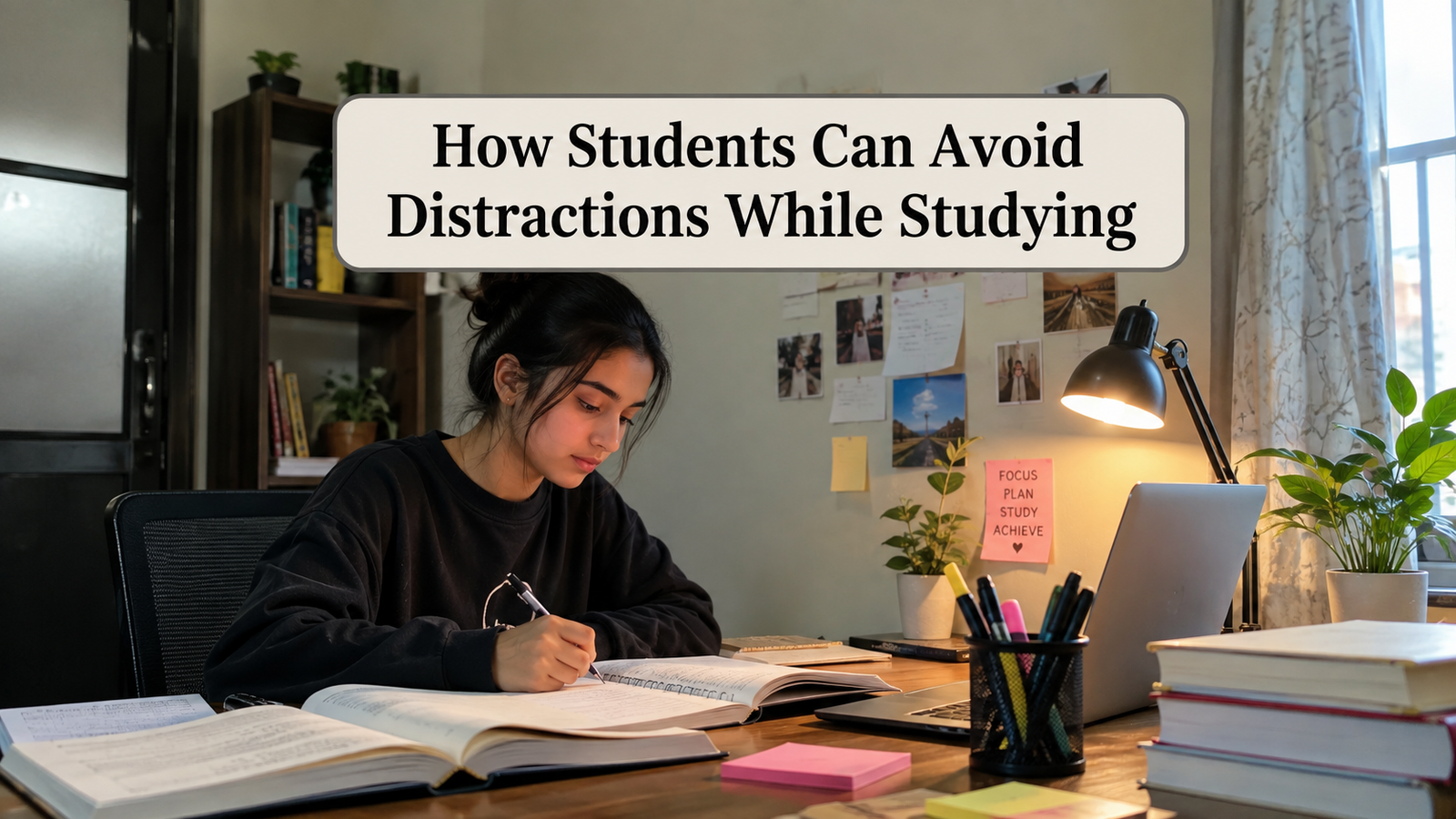
Studying sounds simple when we think about it. We sit down with a book, open our notes, and try to focus. In reality, staying focused can be one of the hardest parts of studying.
A phone notification appears. Someone starts talking nearby. We remember something we wanted to search online. After a few minutes, our attention moves away from the lesson and we realize that very little has actually been learned.
I have noticed through reading about learning habits and observing common study problems that distraction is not always caused by a lack of discipline. Very often, students are simply studying in an environment that makes concentration difficult.
Learning how students can avoid distractions while studying is therefore not about forcing the brain to focus for hours. It is about creating conditions that make focus easier.
When students understand what distracts them, organize their study space, control digital interruptions, and use realistic study sessions, concentration can improve greatly.
Why Students Get Distracted While Studying
Before trying to remove distractions, it is useful to understand where they come from.
Distractions can be external or internal.
External distractions include phones, television, conversations, noise, social media, games, and people moving around.
Internal distractions come from the mind itself. A student may start thinking about food, friends, future plans, school problems, or something that happened earlier in the day.
Sometimes boredom also becomes a distraction. When the study material feels difficult or uninteresting, the brain naturally looks for something easier and more enjoyable.
This is why improving concentration requires more than simply telling yourself to focus.
Students need a study system that reduces opportunities for distraction.
Create a Dedicated Study Space
One of the simplest ways to improve concentration is to have a regular place for studying.
The study area does not need to be large or expensive. A small desk, a quiet corner, or even one side of a room can work well.
The important thing is that the brain begins to associate that location with studying.
When students use the same place regularly, sitting there can become a mental signal that it is time to concentrate.
A good study space should contain only the things needed for the current task.
Books, notebooks, pens, and a computer may be necessary. Other objects that attract attention should be moved away.
A clean environment can make it easier to begin studying because there are fewer visual distractions competing for attention.
Keep the Phone Away
For many students, the smartphone is the biggest source of distraction.
Phones are designed to attract attention. Messages, social media notifications, videos, games, and news can interrupt concentration within seconds.
Even when a phone is silent, simply seeing it on the desk can create the temptation to check it.
A useful strategy is to place the phone somewhere out of reach.
It can be kept in another room, inside a drawer, or several steps away from the study area.
If the phone is needed for educational purposes, notifications should be turned off before the study session begins.
Students can also use focus settings that block unnecessary apps temporarily.
The goal is not to stop using technology completely. The goal is to control when technology receives attention.
Turn Off Unnecessary Notifications
Notifications interrupt concentration because they immediately create curiosity.
A message notification makes us wonder who sent it. A social media alert makes us want to check what happened. Even if we do not open the notification, part of our attention may remain focused on it.
Students should consider disabling unnecessary notifications while studying.
This includes notifications from social media apps, games, shopping apps, news apps, and group chats.
Important calls from family members can usually remain available while less important alerts are temporarily silenced.
When studying becomes free from constant digital interruptions, the brain gets more time to stay focused on one subject.
Set a Clear Study Goal
Studying without a specific goal can easily lead to distraction.
For example, saying “I am going to study science” is too general.
A clearer goal would be:
“Read pages 20 to 30 and write five important points.”
Another goal might be:
“Complete ten mathematics questions.”
Clear goals help students know exactly what they are supposed to accomplish.
They also create a sense of progress.
When there is a clear finish line, it becomes easier to stay focused because the task feels manageable.
Break Large Tasks Into Smaller Parts
Large assignments can feel overwhelming.
A student may look at an entire chapter and immediately feel tired before even starting.
Breaking the task into smaller sections makes it easier to begin.
For example, instead of studying an entire chapter at once, a student might divide it into three sections.
The first session could focus on understanding the main idea.
The second session could focus on important definitions.
The third session could focus on practice questions.
Smaller tasks create regular feelings of achievement, which can help maintain motivation.
Study for Shorter Focused Periods
Long study sessions are not always better.
After studying continuously for a long time, attention often begins to decrease.
Students may continue looking at the page without properly understanding what they are reading.
Shorter focused sessions can sometimes be more effective.
A student might study for around 25 to 45 minutes and then take a short break.
The exact amount of time can vary depending on the subject and the student.
The important thing is to work with full attention during the study period.
A focused 30 minute session can often be more productive than two hours of distracted studying.
Take Purposeful Breaks
Breaks are important, but they should not become another source of distraction.
A short break can help the brain recover.
Students can stand up, stretch, drink water, walk around the room, or look outside.
These activities provide mental rest without pulling the student into something difficult to stop.
Opening social media during a five minute break can easily turn into twenty or thirty minutes.
Because of this, simple physical breaks are often better than digital entertainment.
Make a Study Schedule
A regular study schedule reduces the need to decide when to study every day.
If students always wait until they “feel ready,” studying may be delayed repeatedly.
A schedule creates structure.
For example, a student might decide to study from 6:00 PM to 7:30 PM after returning home and resting.
Once this becomes a habit, the brain begins to expect study time.
A schedule should still be realistic.
Trying to study for several hours every day without enough rest can lead to burnout.
Consistency is usually more useful than extreme study sessions.
Identify Your Most Productive Time
Not every student concentrates best at the same time.
Some students feel mentally fresh early in the morning.
Others focus better in the afternoon or evening.
Students should observe when their concentration is strongest.
Difficult subjects can then be scheduled during these periods.
For example, mathematics or science may require greater concentration than reviewing vocabulary.
Placing demanding work during the most productive time of day can make studying easier.
Avoid Studying When Extremely Tired
Fatigue makes distraction much more likely.
When students are very tired, the brain finds it difficult to maintain attention.
Reading becomes slower and information is harder to remember.
Trying to study late into the night may therefore be less effective than sleeping and continuing the next day.
Good sleep supports memory, attention, and learning.
Students should try to develop a regular sleep routine rather than depending on last minute study sessions.
Keep Water Nearby
Small interruptions can easily break concentration.
If a student repeatedly leaves the study area to get water, snacks, pens, or books, it can become difficult to return to the same level of focus.
Preparing basic items before studying can help.
A bottle of water, necessary books, stationery, and notes can be placed nearby.
This reduces unnecessary movement and allows the study session to continue smoothly.
Reduce Noise
Noise affects students differently.
Some people can study with background sounds while others need silence.
If outside noise is distracting, students can close the door or move to a quieter location.
Libraries are often useful because they provide an environment where studying is expected.
Some students also use simple background sounds without lyrics.
Music with lyrics can sometimes interfere with reading because the brain may try to process both the song and the text at the same time.
Students should experiment and observe what helps them concentrate.
Use One Device or Tab at a Time
When studying online, it is easy to open many browser tabs.
A student may have a lesson open in one tab, social media in another, a video website in another, and several unrelated searches at the same time.
This creates constant opportunities for distraction.
A better approach is to keep only the necessary pages open.
If the lesson requires one website, other unrelated tabs can be closed.
Reducing digital clutter can make online studying feel much more organized.
Write Down Distracting Thoughts
Sometimes distractions come from useful thoughts.
A student may suddenly remember an assignment that needs to be submitted.
Another thought might be about something that needs to be purchased or a message that needs to be sent.
Instead of stopping the study session, students can keep a small piece of paper nearby.
When a thought appears, they can write it down quickly and return to studying.
After the study session, the note can be reviewed.
This prevents the mind from repeatedly reminding the student about the same thing.
Use Active Study Methods
Passive studying can become boring quickly.
Simply reading the same page repeatedly may cause the mind to wander.
Active study methods involve interacting with the material.
Students can ask questions, solve problems, summarize ideas, create flashcards, draw diagrams, or explain a concept in their own words.
These methods require more mental involvement.
When the brain is actively working with information, there is often less room for distraction.
Try Teaching the Topic to Yourself
One useful method is to pretend that you are teaching the topic to someone else.
After reading a section, close the book and explain what you learned using simple words.
If the explanation becomes difficult, open the book and review the missing information.
This method keeps the brain active.
It also shows whether the student truly understands the topic.
Explaining information is usually more engaging than simply reading it again.
Keep Social Media for Later
Social media can create a strong habit of checking for new content.
Students may open an app for a few seconds and suddenly spend much longer scrolling.
One approach is to make social media a reward after completing a study goal.
For example, a student can decide to check messages only after completing two focused study sessions.
This changes social media from an interruption into a controlled activity.
The student decides when to use it instead of responding every time a notification appears.
Tell Family Members You Are Studying
Students who study at home may be interrupted by family members.
A simple solution is communication.
Before studying, tell family members that you need a certain amount of quiet time.
For example, you might say that you are studying for the next 45 minutes and will be available afterward.
This does not remove every interruption, but it can reduce unnecessary ones.
Avoid Multitasking
Multitasking often feels productive, but the brain usually switches attention between tasks rather than focusing on both at the same time.
Watching a video, replying to messages, listening to conversations, and studying together can reduce learning quality.
A better method is to complete one task before moving to another.
When reading, focus on reading.
When solving questions, focus on solving questions.
When taking a break, actually take a break.
Single tasking creates clearer mental boundaries.
Start With Just Five Minutes
Sometimes the biggest distraction is avoiding the study session completely.
Students may keep delaying because the task feels difficult.
A useful trick is to commit to studying for only five minutes.
Open the book, read one paragraph, or solve one question.
Starting reduces the mental resistance connected to the task.
Once students begin, they often continue longer than five minutes.
Beginning is frequently harder than continuing.
Make Studying More Interesting
Not every subject is naturally exciting.
However, students can sometimes make learning more engaging.
They can use diagrams, educational videos, practice quizzes, examples from everyday life, or colorful notes.
The goal is not to turn every lesson into entertainment.
It is simply to make the material easier to interact with.
Interest supports attention.
When students understand why a topic matters, they often find it easier to concentrate.
Use a Simple To Do List
A long list of school responsibilities can make the mind feel crowded.
Writing tasks down can reduce this pressure.
Students can create a short daily list containing only the most important study tasks.
For example:
Read one history chapter.
Complete ten mathematics questions.
Review twenty vocabulary words.
A simple list provides direction and reduces uncertainty about what to do next.
Prepare Before the Study Session
Preparation can prevent many distractions.
Before starting, students should gather everything they are likely to need.
This may include books, notebooks, pens, a calculator, water, and required digital files.
If everything is ready, there is less reason to leave the desk.
Preparation also creates a small routine that signals the beginning of focused work.
Track Your Progress
Students often become more motivated when they can see improvement.
Progress can be tracked using a notebook or calendar.
After completing a study session, students can mark it as finished.
This creates a visual record of consistency.
It can also help students understand how much work they are actually completing.
Seeing progress makes studying feel more rewarding.
Learn From Distraction Instead of Feeling Guilty
Every student becomes distracted sometimes.
The goal is not perfect concentration.
The goal is to notice distraction earlier and return to the task.
If a study session goes badly, students can ask a simple question:
“What distracted me?”
Maybe the phone was too close.
Maybe the room was noisy.
Maybe the study session was too long.
Understanding the cause makes it easier to improve the next session.
Feeling guilty does not improve concentration. Adjusting the study environment does.
Build Better Habits Slowly
Students do not need to change everything at once.
Trying to create a perfect study routine overnight can become stressful.
It is better to improve one habit at a time.
A student might begin by keeping the phone away.
A few days later, they might begin using shorter study sessions.
Then they might create a simple weekly schedule.
Small changes are easier to maintain.
Over time, they can create a study routine that feels natural.
Why Focus Matters More Than Study Time
Many students measure studying by the number of hours spent at a desk.
However, time alone does not show how much learning happened.
Two students may both study for two hours.
One student constantly checks messages and switches between different activities.
The other works in focused sessions with short breaks.
Their results may be very different.
Quality of attention matters greatly.
A shorter session with strong concentration can sometimes produce better learning than a long distracted session.
Final Thoughts
Learning how students can avoid distractions while studying is mainly about creating better conditions for attention.
Students do not need perfect concentration every minute.
They need a study environment that makes distraction less likely and focus easier.
Keeping the phone away, setting clear goals, studying in shorter sessions, reducing notifications, using active learning methods, and taking purposeful breaks can all improve concentration.
Good study habits are usually built gradually.
Once students understand their main distractions, they can begin removing them one by one.
Over time, studying becomes less stressful because the brain learns when it is time to work and when it is time to rest.
The most important lesson is that effective studying does not depend only on spending more hours with books. It depends on using those hours with attention, purpose, and consistency.