Education becomes more meaningful when students can connect what they learn in the classroom with real situations. Reading books, listening to lectures, and memorizing information are important parts of education, but students also need opportunities to use their knowledge. This is where project based learning becomes valuable.
Project based learning is an approach in which students learn by working on meaningful projects. Instead of only studying a topic from a textbook, students investigate a problem, collect information, make decisions, create something, and present their work. During this process, they use many practical skills that are useful in school, university, employment, and daily life.
One of the main reasons project based learning is becoming popular is that it prepares students for situations outside the classroom. Students learn how to communicate, solve problems, manage time, work with others, use technology, and make responsible decisions.
In this article, I will explain how project based learning develops practical skills and why this learning method can be useful for students of different ages.
What Is Project Based Learning?
Project based learning is a teaching method in which students gain knowledge by completing a project related to a real question, challenge, or problem.
For example, instead of only reading about environmental pollution, students may investigate pollution in their local area. They might collect information, talk to community members, study possible solutions, and prepare a report or presentation.
The project becomes the main learning activity.
Students are not simply given information to memorize. They actively search for answers and apply what they have learned.
This approach can be used in many subjects, including science, mathematics, technology, social studies, business, language learning, and art.
A project may take a few days, several weeks, or even longer depending on the subject and learning goals.
Project Based Learning Connects Education With Real Life
One of the strongest benefits of project based learning is its connection with real life.
Students often ask why they need to learn a certain topic. Sometimes they find it difficult to understand how classroom knowledge will be useful in the future.
Projects can answer this question naturally.
For example, mathematics becomes more practical when students use calculations to prepare a budget. Science becomes easier to understand when students conduct experiments. Writing skills become more meaningful when students prepare a report for a real audience.
When students see how knowledge can be used, learning becomes more relevant.
This connection between theory and practice helps students develop skills that they can use outside school.
It Develops Problem Solving Skills
Problem solving is one of the most important practical skills in modern life.
In traditional lessons, students are often given a question that already has a clear answer. In project based learning, the situation can be different.
Students may face problems that require investigation.
Imagine a class is asked to design a small school garden. Students may need to decide where the garden should be located, what plants should be selected, how much water will be needed, and how much the project will cost.
There is no single answer.
Students must consider different possibilities and choose the most suitable solution.
During this process, they learn how to identify problems, understand causes, compare options, and make decisions.
These problem solving habits can be useful in almost every profession.
It Improves Communication Skills
Good communication is another important practical skill developed through project based learning.
Many projects require students to explain ideas, ask questions, discuss plans, and present results.
Students may communicate with classmates, teachers, parents, local experts, or community members.
They learn that communication is not only about speaking. It also includes listening carefully and understanding the ideas of others.
For example, during a group project, one student may have a good idea but may need to explain it clearly so that other group members can understand it.
Another student may need to ask questions to clarify information.
Students may also prepare written reports, posters, presentations, or digital content.
These activities improve both written and verbal communication skills.
Students Learn Teamwork
Most workplaces require people to work with others.
Project based learning gives students early experience of teamwork.
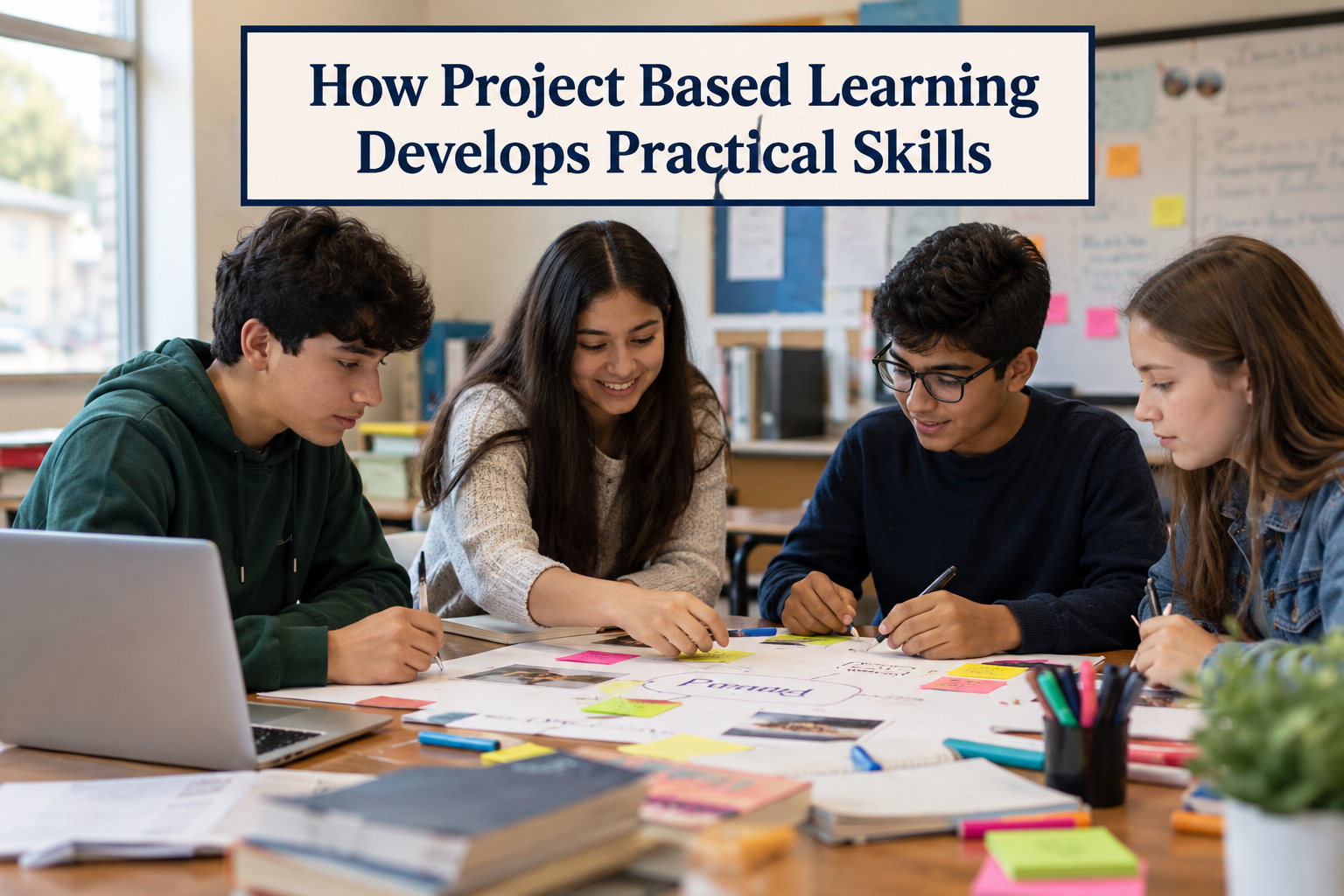
In group projects, students may divide responsibilities according to their abilities. One student may research information, another may manage data, another may create visuals, and another may prepare the presentation.
However, working in a group is not always easy.
Students may disagree about ideas. Some students may work faster than others. Sometimes responsibilities may not be shared equally.
These challenges are part of the learning process.
Students gradually learn how to cooperate, respect different opinions, solve disagreements, and support other team members.
These teamwork skills are useful in both personal and professional life.
It Builds Time Management Skills
Many students struggle with time management because they are used to completing small tasks with short deadlines.
A project usually requires more planning.
Students may need to divide a large task into smaller activities.
For example, they might need to complete research during the first week, organize information during the second week, create the final product during the third week, and prepare the presentation before the deadline.
This teaches students how to plan ahead.
They also learn that delaying every task until the final day can create unnecessary pressure.
Over time, students become better at setting priorities and managing their schedules.
Time management is a practical skill that becomes even more important during university and employment.
Project Based Learning Encourages Independent Learning
One important difference between project based learning and traditional instruction is the role of the student.
In many traditional lessons, the teacher provides most of the information.
During a project, students often need to find information themselves.
They may use books, educational websites, interviews, surveys, observations, or experiments.
This develops independent learning.
Students begin to understand how to search for information instead of waiting for someone to provide every answer.
The teacher still provides guidance, but students take greater responsibility for their learning.
This independence can make students more confident when they face unfamiliar topics in the future.
It Develops Research Skills
Research is an important part of many projects.
Students learn that useful information can come from different sources.
They may begin by searching online, but they also learn the importance of checking books, articles, reports, and reliable educational resources.
Students gradually understand that not every source contains accurate information.
They need to compare sources and decide which information is trustworthy.
They may also learn how to take notes, summarize information, organize references, and avoid copying material without understanding it.
These research skills are valuable for higher education and professional work.
Students Learn How to Make Decisions
Projects often require students to make choices.
They may need to select a topic, choose materials, decide between different designs, or select the best solution to a problem.
Decision making is a practical skill that improves through experience.
Students learn that every decision can have advantages and disadvantages.
For example, if students are designing a model house, they may need to choose materials based on cost, strength, appearance, and availability.
They cannot simply choose the most attractive option.
They need to think about different factors.
This process teaches students to make more thoughtful decisions.
It Encourages Creativity
Project based learning can provide more space for creativity than many traditional classroom activities.
Students are often allowed to decide how they want to present their ideas.
They may create models, videos, posters, presentations, websites, experiments, or demonstrations.
This gives students an opportunity to use their imagination.
Creativity is not limited to art.
A student can be creative while solving a science problem, designing a business idea, planning a community activity, or explaining a difficult concept.
When students realize that there may be several possible ways to solve a problem, they become more willing to explore new ideas.
It Develops Digital Skills
Technology has become an important part of education and employment.
Many project based learning activities involve digital tools.
Students may search for information online, create presentations, prepare spreadsheets, edit videos, design posters, or communicate with team members using digital platforms.
As students complete these activities, they gain practical experience with technology.
They also learn that technology should be used for more than entertainment.
It can help with research, planning, communication, creativity, and problem solving.
These digital skills are becoming increasingly valuable in modern careers.
Students Learn From Mistakes
In traditional education, mistakes are sometimes seen only as incorrect answers.
In project based learning, mistakes can become part of the learning process.
A design may fail.
An experiment may not produce the expected result.
A plan may take longer than expected.
Instead of ending the learning process, these situations encourage students to ask what went wrong.
Students may need to change their approach and try again.
This teaches persistence.
It also helps students understand that real problems are not always solved successfully on the first attempt.
Learning how to respond to failure is an important practical life skill.
It Builds Confidence
Confidence often develops when students successfully complete meaningful work.
A student may begin a project without knowing exactly how to complete it.
During the project, the student learns new information, solves problems, and creates a final result.
When the student presents that work to others, there can be a strong sense of achievement.
Students begin to realize that they are capable of learning difficult things.
This confidence may encourage them to participate more actively in future lessons.
It can also help students become more comfortable speaking in front of others.
Project Based Learning Improves Leadership Skills
Group projects can create natural opportunities for leadership.
Students may need to organize a team, assign responsibilities, manage deadlines, or help other members complete their tasks.
Leadership does not always mean controlling the group.
Good leadership often involves listening, encouraging others, solving conflicts, and keeping the team focused.
Students can learn these skills through experience.
Some students who are quiet during ordinary lessons may discover that they are good organizers or problem solvers when they participate in a project.
It Develops Financial Awareness
Some projects involve money, budgeting, or resource management.
For example, students may be asked to design a small business idea.
They may need to estimate costs, calculate prices, compare options, and understand profit.
Even simple school projects can teach students that resources are limited.
Students might have to complete a project using a fixed amount of money.
They learn how to plan spending carefully instead of using resources without thinking.
These experiences can improve basic financial awareness.
Students Learn Responsibility
Project based learning can also teach students responsibility.
When students are given a task within a group, other members depend on them.
If one student fails to complete their work, the entire project may be affected.
Students begin to understand the importance of keeping promises and meeting deadlines.
They may also become responsible for equipment, materials, information, or project records.
This sense of responsibility can help students become more dependable.
It Encourages Critical Thinking
Critical thinking involves analyzing information instead of accepting everything immediately.
Projects usually require students to ask questions.
Is this information accurate?
What evidence supports this idea?
Are there other explanations?
Which solution is more practical?
These questions encourage deeper thinking.
For example, if students are researching renewable energy, they may discover that every energy source has both benefits and limitations.
Instead of simply saying that one option is good and another is bad, they can compare cost, environmental effects, availability, and efficiency.
This type of analysis strengthens critical thinking.
Students Understand How Different Subjects Connect
Real life problems rarely belong to only one subject.
A single project may involve mathematics, science, communication, technology, and creativity.
For example, designing a small bridge model may require knowledge of mathematics for measurements, science for understanding forces, technology for design, and language skills for presenting the final explanation.
Students begin to understand that school subjects are connected.
This can make learning more meaningful.
Instead of viewing each subject as a separate collection of information, students see how knowledge can work together.
It Helps Students Prepare for Future Careers
Project based learning can give students a small experience of how professional work is completed.
Many careers involve projects.
Engineers work on design projects.
Architects develop building projects.
Business professionals create marketing and financial plans.
Researchers investigate questions.
Software developers create digital products.
Teachers design learning activities.
Health professionals work together to solve patient care problems.
Students who regularly complete projects become familiar with planning, research, teamwork, communication, deadlines, and presentation.
These skills can support them in many different careers.
The Role of the Teacher in Project Based Learning
Project based learning does not mean that students work without guidance.
Teachers still play an important role.
However, their role may change.
Instead of providing every answer, teachers may guide students by asking useful questions.
They can help students choose suitable sources, organize their plans, solve problems, and reflect on their progress.
Teachers can also monitor group participation to make sure every student has a meaningful role.
Good guidance is important because students may feel confused if a project is too open or poorly structured.
The most effective projects usually provide enough freedom for creativity while still giving students clear learning goals.
Simple Examples of Project Based Learning
Project based learning does not always require expensive equipment.
A project can be simple.
Students could design a healthy weekly meal plan and calculate the estimated cost.
They could study water use at home and suggest ways to reduce waste.
They could create a small business plan for a local product.
They could interview older family members about changes in education.
They could design a model of an energy efficient house.
They could investigate traffic problems near their school.
They could create an awareness campaign about recycling.
Each of these projects allows students to use classroom knowledge while developing practical skills.
Why Reflection Is Important After a Project
Completing the final product is not the only important part of project based learning.
Students should also think about what they learned.
Reflection can include simple questions.
What worked well?
What problems did we face?
What would we change next time?
What new skills did we learn?
Which part was most difficult?
Reflection helps students recognize their own progress.
It also helps them understand that practical skills improve over time.
A student may not become an excellent communicator after one presentation, but several projects can gradually build confidence and ability.
Final Thoughts
Project based learning develops practical skills by allowing students to actively use knowledge instead of only memorizing it. Through meaningful projects, students learn how to solve problems, communicate ideas, manage time, work in teams, conduct research, use technology, make decisions, and take responsibility.
It also helps students develop creativity, confidence, leadership, critical thinking, and independent learning habits.
These abilities are valuable because education is not only about passing examinations. Students also need to know how to use what they learn.
Project based learning creates a bridge between classroom knowledge and real life experience.
When students research problems, test ideas, work with others, and create useful outcomes, learning becomes more practical and memorable.
For this reason, project based learning can play an important role in preparing students for higher education, future careers, and everyday challenges.
The main strength of this approach is simple. Students do not only learn about something. They learn how to do something with what they know.