
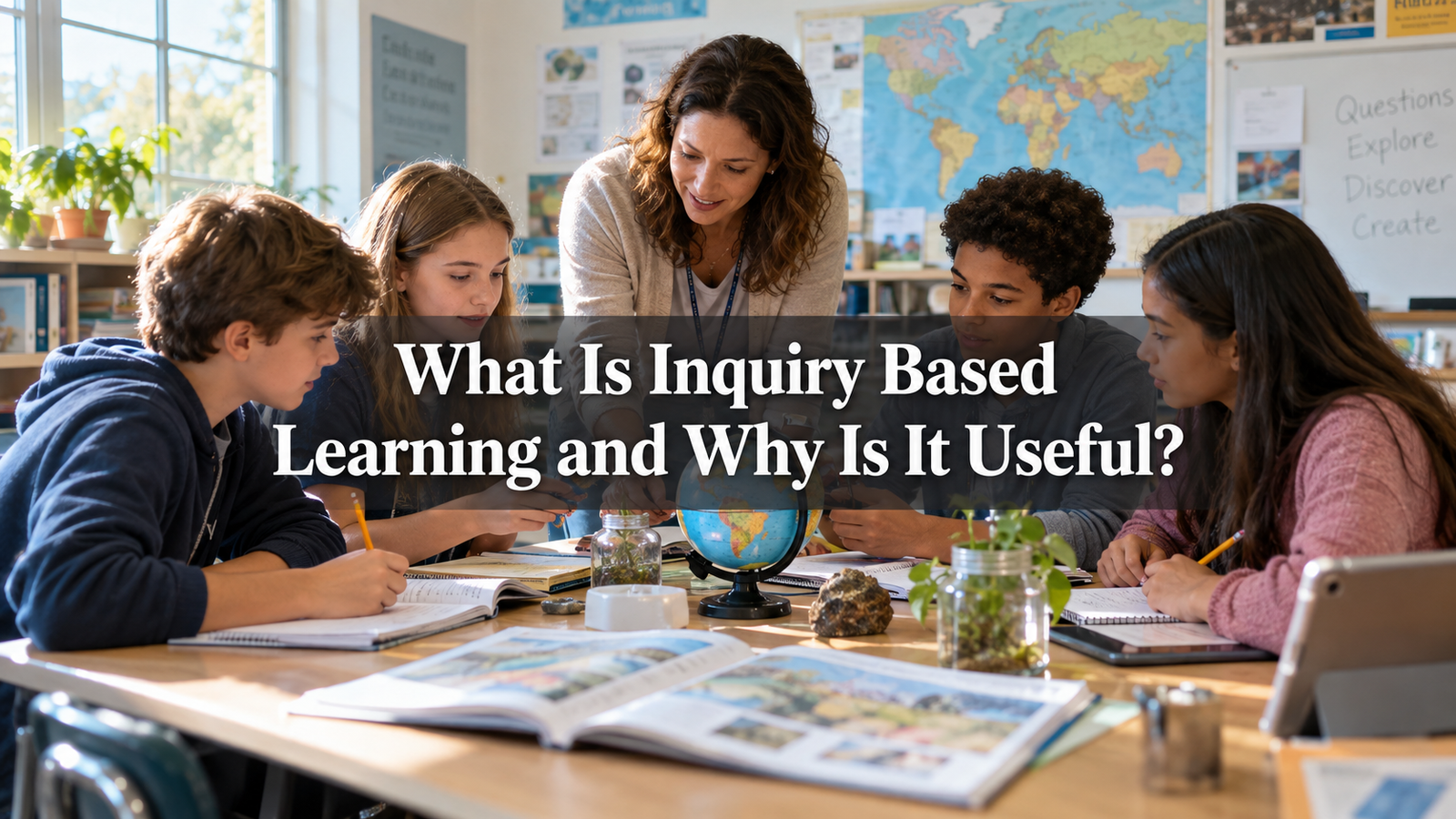
Education becomes more meaningful when students are encouraged to think, ask questions, explore ideas, and discover answers instead of simply memorizing information. One teaching approach that supports this idea is inquiry based learning.
Inquiry based learning gives students an active role in the learning process. Instead of receiving every answer directly from the teacher, students are encouraged to investigate questions, examine information, discuss possibilities, and develop their own understanding.
While reading about different teaching methods, I noticed that inquiry based learning appears frequently in discussions about modern education. The reason is simple. It helps students develop curiosity, critical thinking, problem solving skills, communication skills, and independent learning habits.
This method does not mean that teachers stop teaching. Instead, the teacher becomes a guide who helps students move through the learning process.
In this article, I will explain what inquiry based learning is, how it works, its main types, its benefits, examples from classrooms, and why it can be useful for students.
What Is Inquiry Based Learning?
Inquiry based learning is a teaching method in which students learn by asking questions and investigating possible answers.
The learning process often begins with a problem, question, situation, experiment, observation, or topic that encourages curiosity.
Students may then collect information, read books, observe examples, conduct experiments, discuss ideas, compare evidence, and form conclusions.
For example, instead of telling students exactly why some objects float and others sink, a teacher may provide several objects and ask students to predict what will happen when those objects are placed in water.
Students can test their predictions, observe the results, and discuss why certain objects behave differently.
Through this process, students are not simply memorizing a fact. They are building understanding through investigation.
This is the main idea behind inquiry based learning.
How Inquiry Based Learning Is Different From Traditional Learning
In a traditional classroom, the teacher often explains a topic first. Students listen, take notes, read textbooks, and later answer questions about the information they have learned.
This approach can be effective for teaching important facts and introducing new concepts.
Inquiry based learning uses a different starting point.
Instead of beginning with an explanation, learning may begin with a question.
Students are encouraged to think about what they already know and what they still need to discover.
For example, a science teacher could simply explain how plants respond to sunlight.
With inquiry based learning, the teacher might ask students:
Why do some plants grow toward a window?
Students can then observe plants, research how they grow, compare different conditions, and develop an explanation.
The final knowledge may be similar, but the path toward that knowledge is different.
Students participate more actively in discovering the answer.
The Main Idea Behind Inquiry Based Learning
The central idea of inquiry based learning is curiosity.
People naturally learn by asking questions.
Children often ask questions such as:
Why is the sky blue?
Why does rain fall?
Why do leaves change color?
Why does ice melt?
Why do shadows move?
These questions show a natural desire to understand the world.
Inquiry based learning uses this curiosity as part of education.
Teachers create opportunities where students can ask meaningful questions and explore possible answers.
Instead of treating questions as interruptions, questions become an important part of the lesson.
How Does Inquiry Based Learning Work?
Inquiry based learning usually follows a series of stages.
The exact process can change depending on the subject, age of the students, and learning goals.
However, several common stages are often included.
Asking a Question
The learning process often begins with a question.
The question should be interesting enough to make students think.
For example:
Why do some materials conduct electricity while others do not?
How does pollution affect local water?
Why do people remember some information better than other information?
A strong question creates curiosity and gives students a reason to investigate.
Investigating the Question
Students then begin collecting information.
They may read textbooks, use educational websites, conduct experiments, interview people, observe events, or examine data.
The purpose is to gather information that can help answer the question.
Analyzing Information
Students must then think carefully about the information they have collected.
They may compare different sources, identify patterns, evaluate evidence, and discuss possible explanations.
This stage develops critical thinking because students must decide which information is useful and reliable.
Developing an Explanation
After studying the evidence, students develop an explanation or conclusion.
Their answer should be based on the information they have discovered.
Students may also realize that their original ideas were incomplete or incorrect.
Changing an opinion after seeing better evidence is an important part of learning.
Sharing the Results
Students may present their conclusions to the class, write a report, create a presentation, prepare a poster, or participate in a discussion.
Explaining their ideas helps students organize their thinking and improve communication skills.
Reflecting on the Learning Process
Students can also think about what they learned and how they discovered it.
They may ask themselves:
What did I understand?
What surprised me?
What evidence changed my opinion?
What questions do I still have?
Reflection helps students become more aware of their own learning.
Types of Inquiry Based Learning
Inquiry based learning can be used at different levels.
The teacher may provide significant guidance or allow students to work more independently.
Confirmation Inquiry
In confirmation inquiry, students usually know the expected result.
The teacher provides the question and method.
Students conduct an activity to confirm a concept they have already learned.
For example, students may conduct an experiment showing that plants need light for healthy growth.
This type of inquiry is useful for beginners because students learn how investigation works while still receiving clear guidance.
Structured Inquiry
In structured inquiry, the teacher provides the question and general procedure, but students must study the results and develop their own conclusions.
This gives students slightly more responsibility.
They must think about the evidence instead of simply following instructions.
Guided Inquiry
Guided inquiry gives students more freedom.
The teacher may provide the main question, but students decide how they will investigate it.
They may select sources, plan experiments, divide responsibilities, and decide how to present their findings.
The teacher provides support when necessary.
Open Inquiry
Open inquiry gives students the greatest level of independence.
Students may create their own questions, design their investigation, collect evidence, analyze information, and present conclusions.
This approach can work well with older students who already have experience with research and independent learning.
Why Is Inquiry Based Learning Useful?
Inquiry based learning can offer many educational benefits.
It encourages students to participate actively rather than remaining passive listeners.
It also develops skills that can be useful inside and outside the classroom.
It Encourages Curiosity
One of the biggest advantages of inquiry based learning is that it encourages curiosity.
Students are more likely to become interested in a topic when they are trying to answer a question.
Curiosity creates motivation.
When students genuinely want to know something, learning may feel less like a requirement and more like a discovery.
This can make lessons more engaging.
It Develops Critical Thinking
Inquiry based learning requires students to think carefully about information.
Students must examine evidence, compare ideas, identify patterns, and decide whether their conclusions make sense.
They cannot rely only on memorization.
For example, if students are researching the environmental effects of plastic waste, they may find information from several sources.
They must decide which sources are trustworthy and how the evidence supports different claims.
This type of thinking helps develop important academic skills.
It Improves Problem Solving Skills
Many inquiry based activities begin with a problem.
Students must decide what information they need and how they can find it.
They may try one method, discover that it does not work, and then try another approach.
This process develops problem solving skills.
Students learn that difficult questions do not always have immediate answers.
Sometimes finding a good solution requires patience, experimentation, and careful thinking.
It Makes Learning More Active
Students learn in different ways.
Some students understand ideas better when they participate directly in the learning process.
Inquiry based learning may include experiments, discussions, observations, research, projects, and presentations.
These activities create opportunities for students to interact with the subject.
Instead of only reading about a concept, students may experience how the concept works.
This can make learning more meaningful.
It Can Improve Understanding
Memorizing information does not always mean understanding it.
A student may remember a definition for an exam but forget it shortly afterward.
Inquiry based learning encourages students to understand why something happens.
When students investigate an idea, they often connect new information with existing knowledge.
These connections can help students develop deeper understanding.
It Encourages Independent Learning
Students cannot always depend on teachers for every answer.
As they grow older, they need to become more responsible for their own learning.
Inquiry based learning helps develop this independence.
Students learn how to ask useful questions, search for information, evaluate evidence, and reach conclusions.
These skills can be valuable in higher education and professional life.
It Supports Communication Skills
Inquiry based learning often involves communication.
Students may work in groups, discuss ideas, explain evidence, ask questions, and present conclusions.
These activities help students practice expressing their thoughts clearly.
They also learn how to listen to other opinions.
A student may discover that another classmate has interpreted the same information differently.
Discussing these differences can improve understanding.
It Encourages Collaboration
Many inquiry based activities involve teamwork.
Students may divide research tasks, conduct experiments together, share observations, and prepare presentations.
Working with others teaches students how to cooperate and manage responsibilities.
Collaboration can also expose students to different ways of thinking.
One student may notice something that another student missed.
Together, they may develop a better answer.
It Connects Learning With Real Life
Inquiry based learning can connect classroom topics with real problems.
For example, students studying environmental science may investigate water use in their school.
Students studying mathematics may analyze the cost of organizing an event.
Students studying social studies may research changes in their local community.
These activities help students understand how academic knowledge can be applied in real situations.
Examples of Inquiry Based Learning
Inquiry based learning can be used in almost every school subject.
Science Example
A teacher asks:
Which conditions help seeds grow fastest?
Students may place seeds in different environments.
Some receive more water, some receive less water, and some receive different amounts of light.
Students record the results and compare growth.
Through this activity, they learn about plant growth while also practicing observation and data collection.
Mathematics Example
A teacher asks students to plan a small school event using a limited budget.
Students must calculate costs, compare prices, estimate quantities, and decide how money should be spent.
They use mathematics to solve a realistic problem.
History Example
Instead of simply reading a chapter about an important historical event, students may examine letters, photographs, newspaper reports, maps, and other sources.
They can compare the information and discuss how different people experienced the same event.
This helps students understand that history can involve interpretation as well as facts.
Geography Example
Students may investigate why certain cities develop near rivers.
They can study maps, transportation routes, agriculture, water access, and population growth.
Students then use the evidence to explain patterns they observe.
Language Learning Example
Students learning a language may investigate how different forms of communication are used in everyday situations.
They might examine advertisements, conversations, news reports, and stories.
They can identify vocabulary, sentence patterns, and communication styles.
The Role of the Teacher
Inquiry based learning does not reduce the importance of teachers.
In many ways, the teacher becomes even more important because students need thoughtful guidance.
The teacher may help students develop useful questions, select reliable information, plan investigations, understand difficult concepts, and reflect on their learning.
Teachers must also decide how much freedom students are ready to handle.
Younger students may need more structured inquiry.
Older or more experienced students may be able to conduct independent investigations.
A successful inquiry based classroom creates a balance between student independence and teacher support.
The Role of Students
Students also have greater responsibility in inquiry based learning.
They are expected to participate actively.
Students may need to ask questions, search for information, record observations, evaluate evidence, communicate with classmates, and explain conclusions.
This responsibility can initially feel challenging.
Some students are accustomed to receiving direct instructions.
However, with practice, they can become more confident in managing their learning.
Challenges of Inquiry Based Learning
Although inquiry based learning has many benefits, it also has challenges.
Teachers need to plan carefully.
Some investigations may require extra classroom time.
Students may also reach incorrect conclusions if they misunderstand evidence.
For this reason, teacher guidance is important.
Access to books, technology, laboratory equipment, or research materials may also affect the activities that teachers can organize.
Another challenge is classroom management.
When students work in groups or move between different activities, teachers need clear rules and expectations.
Inquiry based learning works best when activities have a clear purpose.
How Teachers Can Use Inquiry Based Learning Effectively
Teachers do not need to change every lesson into a large research project.
Inquiry can begin with simple questions.
A teacher might show students an unusual photograph and ask what they notice.
A science teacher might demonstrate a surprising experiment and ask students to explain what happened.
A literature teacher might ask why a character made a particular decision.
A mathematics teacher might present two different solutions and ask students which method is more efficient.
These small questions can encourage students to think more deeply.
Teachers can gradually introduce more complex inquiry activities as students develop confidence.
Inquiry Based Learning and Technology
Technology can support inquiry based learning in many ways.
Students can use digital libraries, educational databases, videos, simulations, interactive maps, and online research tools.
For example, students studying weather can examine real weather data.
Students studying geography can explore digital maps.
Students studying science can use simulations to investigate concepts that may be difficult to recreate in the classroom.
However, students also need to learn how to evaluate online information.
Not every website provides accurate or reliable information.
Teaching students how to compare sources is an important part of modern inquiry based learning.
Does Inquiry Based Learning Work for Every Student?
Students have different learning needs.
Some students enjoy independent investigation immediately.
Others prefer more structure and guidance.
This is why inquiry based learning should not mean removing all direct teaching.
Teachers can combine explanation, reading, practice, discussion, and inquiry.
Students may first learn basic information from the teacher and then use inquiry activities to explore the topic more deeply.
A balanced approach can help students develop knowledge while also practicing independent thinking.
Inquiry Based Learning in Modern Education
Modern education increasingly focuses on skills as well as knowledge.
Students still need facts and academic knowledge, but they also need to know how to use information.
They need to ask good questions, analyze evidence, solve problems, communicate ideas, and continue learning throughout life.
Inquiry based learning supports many of these goals.
It prepares students to face situations where the answer may not already be available in a textbook.
In real life, people often need to investigate problems, compare information, and make decisions based on evidence.
Inquiry based learning gives students opportunities to practice these abilities while they are still in school.
Final Thoughts
Inquiry based learning is an educational approach that encourages students to learn through questions, investigation, evidence, discussion, and reflection.
Instead of simply receiving information, students participate in discovering and understanding it.
This method can encourage curiosity, improve critical thinking, develop problem solving skills, strengthen communication, and help students become more independent learners.
Inquiry based learning does not replace teachers or traditional teaching methods. Instead, it offers another useful way to help students understand subjects more deeply.
From what I have learned while reading about different educational approaches, one of the strongest ideas behind inquiry based learning is that good education should not only teach students what to know. It should also teach them how to think, how to ask questions, and how to search for reliable answers.
When students become comfortable asking meaningful questions, education becomes more than preparation for exams. It becomes preparation for lifelong learning.