Technology has become an important part of modern education. Classrooms today look very different from the classrooms many people remember from the past. Traditional blackboards, printed worksheets, and heavy textbooks are still used in many schools, but they are now often supported by digital tools, online learning platforms, interactive screens, educational applications, and internet based resources.
The purpose of classroom technology is not simply to replace books or teachers. Its real value comes from helping students understand lessons more clearly, giving teachers better ways to explain difficult ideas, and creating more opportunities for students to participate in learning.
While reading about modern education and classroom practices, I have noticed that technology is changing not only what students learn but also how they learn. Students can now watch demonstrations, participate in virtual activities, communicate with classmates, complete digital assignments, and receive feedback much faster than before.
This article explains how technology is changing the modern classroom, the benefits it offers, the challenges schools may face, and what the future of technology in education may look like.
Technology Has Changed the Role of the Classroom
In the past, the classroom was often the main place where students could access educational information. Teachers explained lessons, students took notes, and textbooks provided most of the learning material.
Today, information is available almost everywhere.
Students can access educational websites, digital libraries, recorded lectures, online courses, and learning applications through computers, tablets, and smartphones. This means the classroom is no longer only a place where information is delivered.
It is becoming a place where students discuss ideas, solve problems, practice skills, and work together.
Teachers can introduce a topic and then allow students to explore it using digital resources. Students may watch a science experiment, explore an interactive map, study a historical document online, or use educational software to practice mathematics.
As a result, classroom learning can become more active and flexible.
Interactive Learning Makes Lessons More Engaging
One of the biggest changes brought by technology is the growth of interactive learning.
Instead of only listening to a lecture, students can participate in digital quizzes, simulations, educational games, and classroom activities.
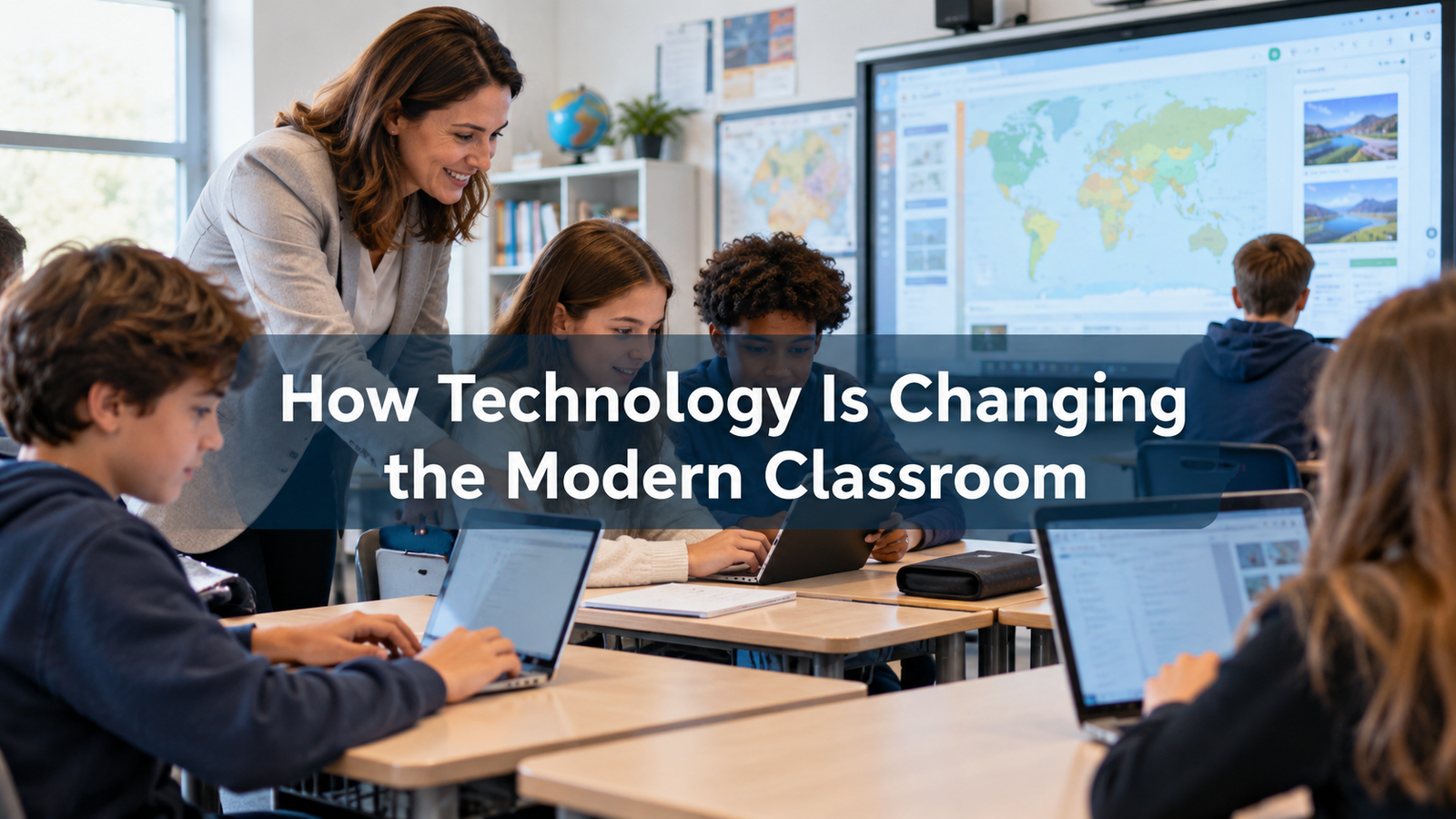
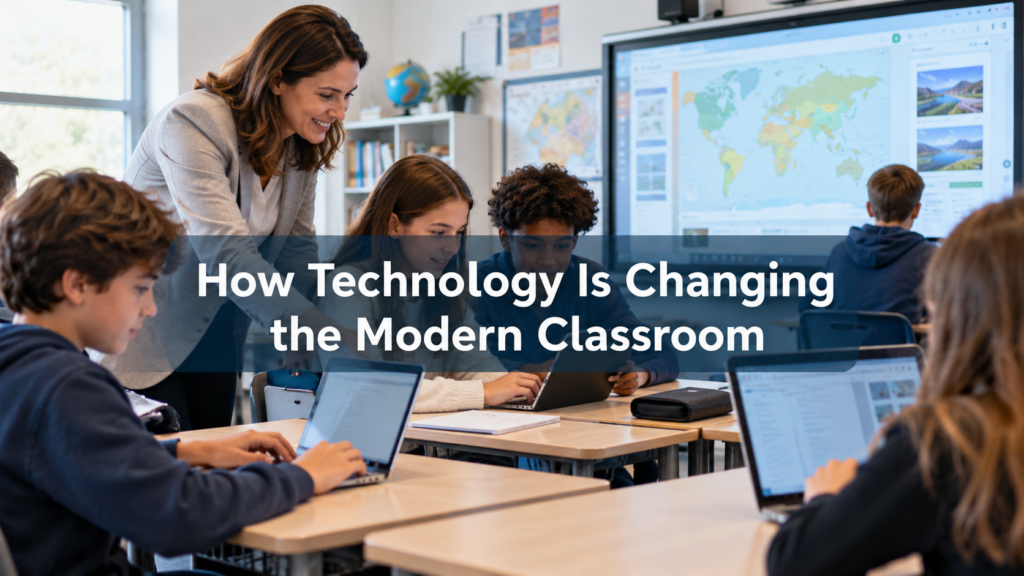
Interactive screens can allow teachers to display diagrams, videos, presentations, and exercises in front of the class. Students can answer questions, move objects on the screen, or take part in group activities.
For example, during a geography lesson, students may explore a digital map instead of only looking at a printed picture. During a biology lesson, they may view a three dimensional model of the human body. During mathematics lessons, teachers can demonstrate how graphs change when different values are entered.
These experiences can make abstract ideas easier to understand.
Students often learn better when they can see, hear, discuss, and interact with information rather than simply reading it.
Digital Resources Provide More Learning Opportunities
Modern classroom technology gives students access to a much wider range of learning resources.
A single textbook may contain useful information, but digital resources can provide videos, animations, research articles, photographs, diagrams, practice exercises, and additional explanations.
This variety can be helpful because students do not all learn in exactly the same way.
Some students understand a concept after reading about it. Others understand better after watching a demonstration or listening to an explanation.
Technology allows teachers to provide several types of learning materials for the same topic.
For example, a teacher explaining the solar system may use a textbook chapter, an animation showing the movement of planets, photographs taken by space missions, and an interactive activity where students explore the size and position of different planets.
The subject becomes much more interesting when students can experience it in different ways.
Technology Supports Personalized Learning
One of the most important developments in modern education is personalized learning.
In a traditional classroom, every student may receive the same lesson, complete the same exercise, and move through the subject at the same speed.
However, students have different abilities, interests, and learning needs.
Digital learning systems can help teachers provide more suitable learning experiences.
Some educational platforms can adjust the difficulty of questions based on how well a student is performing. If a student struggles with a topic, the platform may provide additional practice or simpler explanations.
If another student understands the topic quickly, the system may provide more challenging activities.
This does not mean that technology replaces teachers.
Teachers still make important decisions about instruction. Technology simply gives them additional tools to support different learners.
Personalized learning can help students practice at a comfortable pace while teachers spend more time helping those who need individual attention.
Teachers Can Present Difficult Ideas More Clearly
Some subjects are difficult to explain using words alone.
Technology can help teachers turn complex ideas into visual experiences.
Animations can demonstrate how blood moves through the heart. Virtual models can show the structure of an atom. Videos can demonstrate chemical reactions. Interactive timelines can help students understand historical events.
Visualization is especially useful when students are learning about something they cannot easily observe in real life.
For example, students cannot travel inside a volcano during a lesson, but a digital simulation can show how pressure builds beneath the surface.
Students cannot watch hundreds of years of environmental change during one class, but digital models can demonstrate how landscapes may change over time.
These resources can make difficult concepts easier to imagine and remember.
Online Collaboration Is Becoming Common
Technology has also changed the way students work together.
Group projects once required students to sit around the same table and work on one piece of paper.
Today, students can collaborate using shared documents, digital presentation tools, classroom platforms, and online discussion spaces.
Several students can work on the same project while contributing different ideas. One student may write the introduction, another may collect information, and another may prepare images or charts.
Teachers can also review the work while it is being completed.
This type of collaboration can teach students important skills such as communication, organization, problem solving, and teamwork.
These skills are useful not only in education but also in many modern workplaces.
Digital Classrooms Offer More Flexible Learning
Technology has made education more flexible.
Students do not always have to complete every learning activity during classroom hours.
Teachers can upload lesson materials, homework instructions, recorded explanations, and additional resources to online classroom systems.
Students can review these materials later if they need more time.
This can be especially helpful when a student misses a lesson or wants to revise before an examination.
Recorded lessons can also allow students to pause an explanation, replay difficult sections, and take notes at their own pace.
This flexibility gives students more control over their learning.
However, it also requires responsibility. Students need to learn how to manage their time and complete digital tasks without constant supervision.
Technology Can Improve Student Feedback
Feedback plays an important role in learning.
Students need to understand what they are doing correctly and where they need improvement.
Traditional assignments may take several days for teachers to check, especially when classes are large.
Digital assessment tools can sometimes provide faster feedback.
For example, an online quiz can immediately show students which answers are correct. Some learning platforms can also provide explanations after each question.
Teachers can use the results to identify common mistakes across the class.
If many students answer the same question incorrectly, the teacher knows that the topic may need to be explained again.
Technology therefore gives teachers useful information about student progress.
It can also help students identify areas they should practice.
Classroom Technology Helps Develop Digital Skills
Students are growing up in a world where technology is used in almost every profession.
Learning how to use digital tools responsibly is becoming an important part of education.
Students may need to learn how to search for reliable information, create digital presentations, organize files, communicate online, protect personal information, and use productivity software.
These are practical skills that can support students later in university and employment.
However, simply giving students devices is not enough.
Schools also need to teach digital literacy.
Students should understand that not everything they read online is accurate. They should learn how to compare sources, recognize unreliable information, and use online material responsibly.
Technology education should therefore include both technical skills and critical thinking.
Artificial Intelligence Is Entering Education
Artificial intelligence is becoming another important classroom technology.
AI tools can help explain concepts, generate practice questions, provide writing support, translate information, and organize learning materials.
Teachers may also use artificial intelligence to prepare lesson ideas, create examples, or identify patterns in student performance.
Students can use AI based systems for additional explanations when studying difficult topics.
However, schools also need clear rules about responsible use.
Students should not depend on artificial intelligence to complete every assignment for them. Learning still requires thinking, practice, questioning, and personal effort.
Teachers may need to design assignments that encourage students to explain their reasoning rather than simply provide a final answer.
Artificial intelligence can be a useful educational tool when it supports learning instead of replacing it.
Virtual Reality Can Create New Learning Experiences
Virtual reality is another technology that may become more common in classrooms.
With virtual reality, students can experience digital environments that feel more realistic than traditional images or videos.
A history class might explore a reconstruction of an ancient city.
A science class might travel through the human bloodstream.
Geography students could explore mountains, forests, oceans, or distant regions without leaving the classroom.
These experiences can make learning memorable.
Virtual reality is still more expensive and less common than computers or tablets, but its educational possibilities are interesting.
As equipment becomes easier to access, more schools may experiment with immersive learning.
Teachers Remain Essential in Technology Rich Classrooms
When people discuss educational technology, there is sometimes a concern that technology may eventually replace teachers.
In reality, effective education still depends heavily on good teaching.
Technology can provide information, demonstrations, exercises, and feedback. But teachers understand their students in ways that software cannot always do.
Teachers notice when students are confused, discouraged, distracted, or ready for a greater challenge.
They also encourage discussion, creativity, cooperation, and curiosity.
A computer can provide information about a historical event, but a skilled teacher can ask questions that help students think deeply about why the event happened and what can be learned from it.
The best modern classrooms therefore combine technology with strong teaching rather than treating technology as a replacement for teachers.
Technology Can Support Students With Different Needs
Educational technology can also improve accessibility.
Students with different learning needs may benefit from tools such as text enlargement, speech recognition, audio books, captions, screen readers, and digital note taking.
A student who has difficulty reading small printed text may use a larger digital display.
A student who learns better through listening may use audio materials.
Students learning a new language may use translation tools or pronunciation support.
These technologies can help more students participate in classroom activities.
Inclusive technology gives teachers additional ways to make lessons accessible to a wider group of learners.
Challenges of Technology in the Modern Classroom
Although technology offers many benefits, it also creates challenges.
One major issue is access.
Not every school can afford modern computers, high speed internet, interactive screens, or tablets.
Even when devices are available at school, some students may not have reliable internet access at home.
This difference can create a digital gap between students.
Another challenge is distraction.
A computer or tablet can be used for learning, but it can also provide access to games, entertainment, and social media.
Teachers need classroom rules and good lesson planning to keep students focused.
Technical problems can also interrupt learning.
Internet connections may fail, software may stop working, and devices sometimes require maintenance.
Teachers therefore need backup plans when technology is unavailable.
Screen Time Needs to Be Balanced
Technology should not be used simply because it is available.
Students already spend a significant amount of time using digital devices outside school.
For this reason, classroom technology should have a clear educational purpose.
Some lessons may be better with a computer, while others may be better with books, classroom discussions, experiments, physical activities, or handwritten work.
Young students especially need opportunities for movement, conversation, creativity, and direct interaction with teachers and classmates.
The goal should not be to create a classroom where students look at screens all day.
The goal should be to use technology when it improves the learning experience.
Balance is important.
Cybersecurity and Online Safety Matter
As classrooms become more connected, schools must also pay attention to online safety.
Students and teachers may store assignments, educational records, passwords, and personal information on digital systems.
Schools need appropriate security measures to protect this information.
Students should also learn basic online safety practices.
They need to understand why strong passwords matter, why personal information should not be shared carelessly, and how to behave responsibly when communicating online.
Cybersecurity is becoming an important part of digital education.
Safe technology use should be taught just like responsible behavior in a physical classroom.
Technology Is Changing Homework and Assessment
Homework is also becoming more digital.
Teachers can assign online exercises, research tasks, digital presentations, videos, and collaborative projects.
Students may submit their work electronically instead of handing in printed pages.
Assessment methods are also changing.
Instead of relying only on traditional written examinations, teachers can use digital quizzes, projects, presentations, portfolios, and interactive activities.
This can provide a broader picture of what students understand.
However, traditional assessment still has an important role.
Digital assessment should be used carefully so that technology measures learning rather than simply testing how comfortable a student is with a device.
Parents Can Become More Connected With Learning
Classroom technology can also improve communication between schools and families.
Many schools use online systems where parents can view attendance, assignments, schedules, school announcements, and academic progress.
Teachers may also communicate with families through digital platforms.
This can help parents understand what their children are learning and identify problems earlier.
However, schools should avoid overwhelming parents with constant notifications.
Digital communication is most useful when it is clear, organized, and focused on meaningful information.
The Future of Technology in Education
The modern classroom will probably continue to change as new technologies develop.
Artificial intelligence, virtual reality, adaptive learning systems, digital textbooks, and interactive platforms are likely to become more advanced.
Future classrooms may provide highly personalized learning experiences while allowing teachers to monitor progress more effectively.
Students may have greater access to experts, digital libraries, international classrooms, and educational experiences from around the world.
However, the basic purpose of education will remain the same.
Students still need to learn how to think, communicate, solve problems, understand other people, and apply knowledge in real situations.
Technology should support these goals.
It should not become the goal itself.
Conclusion
Technology is changing the modern classroom in many important ways. It is making lessons more interactive, improving access to educational resources, supporting personalized learning, encouraging collaboration, and giving teachers new ways to explain difficult concepts.
Digital tools can also provide faster feedback, improve accessibility, develop useful digital skills, and make learning more flexible.
At the same time, technology brings challenges related to cost, distraction, screen time, internet access, privacy, and online safety.
For this reason, successful technology use requires thoughtful planning.
The most effective classroom is not necessarily the classroom with the most devices. It is the classroom where teachers choose the right tools for the right learning purpose.
Technology works best when it supports good teaching, encourages student curiosity, and makes important ideas easier to understand.
As education continues to develop, technology will remain an important part of the classroom. The challenge for schools and teachers will be to use it wisely while keeping students, learning, and human interaction at the center of education.