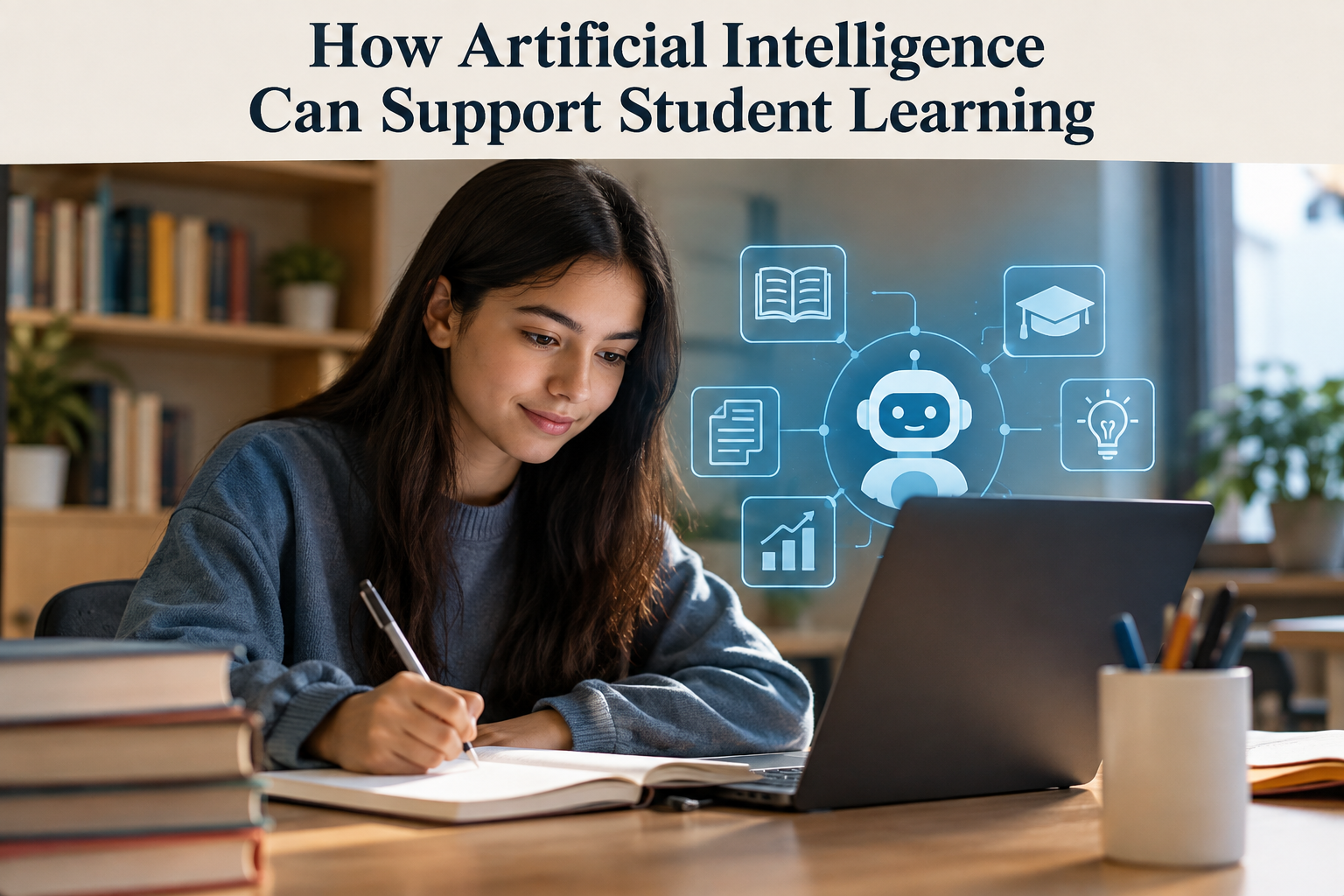
Artificial intelligence is becoming an important part of modern education. It is changing the way students study, practice, ask questions, and understand difficult subjects. In the past, students mainly depended on textbooks, teachers, libraries, and classroom notes. These sources are still essential, but artificial intelligence is adding new ways for students to learn more independently and receive support when they need it.
When I read about artificial intelligence in education, one idea appears again and again. AI should not replace teachers. Instead, it can support teachers and students by making learning more flexible, personalized, and accessible. A teacher brings human understanding, experience, encouragement, judgment, and classroom management. Artificial intelligence can provide additional practice, explanations, feedback, and learning resources.
This makes AI a useful educational tool when students use it carefully and responsibly.
What Is Artificial Intelligence in Education?
Artificial intelligence refers to computer systems that can perform tasks that normally require some level of human intelligence. These tasks may include understanding questions, recognizing patterns, analyzing information, generating explanations, and suggesting possible solutions.
In education, artificial intelligence can be used in learning platforms, tutoring systems, language applications, writing tools, educational software, and digital study assistants.
For example, a student may use an AI powered learning platform to practice mathematics. The system can examine the student’s answers and identify the topics where the student is struggling. It can then provide more practice questions related to those areas.
Another student may use artificial intelligence to understand a difficult science concept. Instead of reading the same paragraph repeatedly, the student can ask for a simpler explanation or request an example.
This ability to adjust information according to the learner’s needs is one of the main reasons artificial intelligence can support student learning.
Artificial Intelligence Can Provide Personalized Learning
Every student learns differently. Some students understand new ideas quickly, while others need additional examples and practice. Some students prefer visual explanations, while others learn better through reading or problem solving.
Traditional classrooms often have many students, which can make it difficult for teachers to provide completely personalized instruction to everyone.
Artificial intelligence can help by adjusting learning activities according to individual performance.
For example, an educational platform may track how well a student performs on quizzes. If the student consistently answers certain questions incorrectly, the system may provide easier explanations or additional exercises.
If another student performs well, the system may introduce more challenging questions.
This creates a learning experience that is closer to the student’s current ability.
Personalized learning can also help students become more aware of their strengths and weaknesses. Instead of simply receiving a final score, they may be able to see which topics need more attention.
AI Can Help Students Understand Difficult Concepts
One of the biggest challenges students face is understanding complicated topics.
A textbook may explain a concept clearly for one learner but seem confusing to another. Sometimes students hesitate to ask the same question several times in class because they are worried about appearing slow.
Artificial intelligence can provide another source of explanation.
A student studying physics might ask for a simple explanation of gravity. If the first explanation is still difficult, the student can ask for an everyday example.
Similarly, a student studying economics could ask for inflation to be explained using a household shopping example.
The ability to request different explanations can make learning more flexible.
However, students should still compare important information with textbooks, teachers, and reliable educational sources because AI generated responses can sometimes contain mistakes.
Artificial Intelligence Can Support Independent Learning
Independent learning is an important skill because students cannot always depend on someone else to guide every study session.
Artificial intelligence can support students who want to study on their own.
A student can use AI to create practice questions, review important concepts, summarize notes, or organize a study plan.
For example, after reading a chapter about the human digestive system, a student might ask an AI tool to create ten practice questions based on the topic.
The student can then answer the questions without looking at the textbook.
This turns reading into active learning.
Independent learning also encourages students to take responsibility for their progress. Instead of waiting for a teacher to identify every weakness, students can review their own understanding.
AI Can Give Students Immediate Feedback
Feedback is an important part of learning.
Students improve when they understand what they did correctly and what needs improvement.
In a traditional classroom, teachers may need time to check assignments because they are responsible for many students.
Artificial intelligence can sometimes provide faster feedback.
For example, a language learning program may immediately tell a student whether a grammar answer is correct.
A mathematics platform may show where a calculation went wrong.
Immediate feedback is useful because students can correct mistakes while the topic is still fresh in their minds.
This does not mean automated feedback is always better than teacher feedback. Teachers can understand context, creativity, effort, and individual circumstances in ways that software may not.
The strongest approach may involve combining technology based feedback with teacher guidance.
AI Can Support Writing Skills
Writing is another area where artificial intelligence can support student learning.
Students can use AI tools to identify grammar problems, improve sentence structure, organize ideas, and understand why certain sentences are unclear.
For example, a student writing an essay may have difficulty creating a clear introduction. Instead of asking the AI to write the entire essay, the student can ask for guidance about how a strong introduction is structured.
The student can then write the paragraph independently.
This approach is more educational because the student remains responsible for the final work.
AI can also help students compare different writing styles.
A learner could ask how formal academic writing differs from conversational writing. This can help students understand tone, vocabulary, and sentence structure.
The key is to use AI as a learning assistant rather than a shortcut.
Artificial Intelligence Can Improve Language Learning
Language learning requires frequent practice.
Students need opportunities to read, write, listen, and speak.
Artificial intelligence can provide useful support in this area.
A student learning English may use an AI tool to practice conversations. The student can ask questions, write answers, and receive corrections.
AI systems may also help students understand vocabulary in context.
Instead of simply learning the meaning of a word, students can ask for several example sentences.
For example, a student learning the word “analyze” could request examples related to science, business, and daily life.
This helps the student understand how the same word can be used in different situations.
Some language applications also use speech recognition technology to help learners practice pronunciation.
Regular practice can increase confidence and make language learning more interactive.
AI Can Help Students Prepare for Exams
Exam preparation often requires students to review large amounts of information.
Artificial intelligence can help organize this process.
Students can use AI tools to create revision schedules, practice quizzes, flashcards, and sample questions.
For example, a student preparing for a history exam could list several topics and ask for a seven day revision plan.
The student could then study one topic at a time instead of trying to review everything on the final day.
AI can also generate questions based on different difficulty levels.
Students may begin with simple questions and gradually move toward more challenging ones.
This type of structured practice can make exam preparation more manageable.
However, students should always check that practice materials match their actual curriculum and examination requirements.
Artificial Intelligence Can Support Students With Different Learning Needs
Students have different learning needs.
Some students require more repetition. Others need information presented in simpler language.
Artificial intelligence can help make educational material more flexible.
For example, a difficult paragraph can be rewritten in simpler words.
A long explanation can be converted into a shorter summary.
A topic can also be explained step by step.
These features may help students who find traditional learning materials difficult to follow.
AI supported accessibility tools can also assist with tasks such as speech recognition, text reading, captioning, and language translation.
These technologies can make digital educational resources easier to access.
Teachers still play an important role in deciding which tools are suitable for individual learners.
AI Can Help Students Organize Their Studies
Many students struggle because they do not organize their study time properly.
They may spend too much time on easy subjects and avoid difficult ones until exams are close.
Artificial intelligence can help students create realistic study plans.
A student might provide information about subjects, available study hours, and upcoming tests.
An AI system can then suggest how the student could divide the available time.
Students can also use AI to break large assignments into smaller tasks.
For example, instead of writing “complete research project” on a study schedule, the project can be divided into smaller steps such as selecting a topic, finding sources, creating an outline, writing the first draft, and editing.
Breaking large tasks into smaller parts can reduce stress and make progress easier to measure.
AI Can Encourage Active Learning
Learning is usually more effective when students actively work with information.
Simply reading a textbook repeatedly may not be enough.
Students need to recall information, solve problems, explain ideas, and apply knowledge.
Artificial intelligence can support these activities.
After studying a lesson, students can ask AI to test them with questions.
They can also ask for short scenarios that require them to apply what they have learned.
For example, a business student studying marketing could ask for a simple case study about a small company launching a new product.
The student could then suggest a marketing strategy.
This type of learning requires thinking rather than memorization.
Artificial Intelligence Can Support Research Skills
Students often use the internet for research, but finding reliable information can be challenging.
Artificial intelligence can help students begin exploring a topic by suggesting keywords, questions, and possible areas of research.
Suppose a student is writing about renewable energy.
The student could use AI to identify related topics such as solar energy, wind power, battery storage, environmental impact, and electricity costs.
These ideas can guide further research.
However, students should not treat AI generated information as a final source.
Original sources such as textbooks, academic journals, official reports, government websites, and respected educational organizations should be checked whenever accuracy is important.
Learning how to verify information is becoming an essential academic skill.
AI Can Help Teachers Support Students
Although artificial intelligence is often discussed from the student’s point of view, it can also help teachers.
Teachers spend a large amount of time preparing lessons, creating practice activities, checking assignments, and organizing learning materials.
AI tools can help with some of these tasks.
For example, a teacher might use AI to generate ideas for classroom activities or create different versions of practice questions.
This may give teachers more time to focus on students who need direct support.
AI based systems can also help identify patterns in student performance.
If several students are struggling with the same concept, the teacher may decide to explain that topic again.
Technology can therefore support decision making, but the teacher should remain responsible for educational judgments.
Students Must Learn to Use AI Responsibly
Artificial intelligence provides many opportunities, but responsible use is extremely important.
Students should understand the difference between receiving support and allowing technology to do all the work.
If a student asks AI to complete every homework assignment, the student may receive good looking answers but learn very little.
This can create serious problems later when the student has to complete an exam or solve a problem without assistance.
Responsible use means using AI to understand, practice, review, and improve.
Students should still think independently.
They should ask questions such as:
Does this answer make sense?
Can I explain this idea in my own words?
Can I verify this information?
What source supports this claim?
These habits help students develop critical thinking skills.
AI Information Should Always Be Checked
Artificial intelligence can produce useful explanations, but it is not always correct.
Sometimes an AI system may misunderstand a question, provide outdated information, or generate incorrect details.
This is why students should verify important information.
If a student is studying a scientific fact, historical date, legal rule, or academic theory, the information should be compared with trusted sources.
Students should also be careful with references generated by AI because some systems may produce inaccurate or nonexistent citations.
Verification teaches students an important lesson about digital information.
Technology can help find information, but human judgment is still necessary.
Privacy Is Also Important
Students should be careful about the information they enter into artificial intelligence systems.
Personal information such as passwords, identification numbers, private school records, financial details, or confidential documents should not be shared unnecessarily.
Schools and universities may also have their own policies regarding the use of AI tools.
Students should understand these rules before using artificial intelligence for academic work.
Responsible digital behavior is becoming as important as traditional study skills.
AI Should Support Thinking, Not Replace It
One of the greatest concerns about artificial intelligence in education is that students may become too dependent on it.
Education is not only about finding the correct answer.
It is also about learning how to think.
Students need to practice reasoning, problem solving, creativity, communication, and decision making.
If artificial intelligence always provides the answer immediately, students may lose opportunities to develop these skills.
A better approach is to use AI after making an initial effort.
For example, a student solving a mathematics problem could first attempt the question independently.
If the answer is incorrect, the student could ask for a hint rather than the complete solution.
This keeps the student actively involved in the learning process.
Teachers Will Remain Important
Artificial intelligence is becoming more advanced, but teachers remain central to education.
A teacher does much more than explain information.
Teachers motivate students, manage classrooms, understand emotions, encourage teamwork, observe behavior, and help learners develop confidence.
They also understand the cultural and social context of their students.
Artificial intelligence can provide information, but human relationships remain an important part of education.
The most effective future classrooms may therefore combine skilled teachers with useful technology.
Teachers can decide when artificial intelligence adds value and when traditional learning methods are more appropriate.
The Future of AI in Student Learning
Artificial intelligence will probably become more common in education over the coming years.
Learning platforms may become better at identifying student needs.
Digital tutors may provide more personalized explanations.
Language learning tools may improve speaking practice.
Educational software may also become more interactive.
However, the future of AI in education should not only focus on technology.
It should also focus on how students actually learn.
Schools and families need to ask whether a tool improves understanding, encourages independent thinking, and supports meaningful learning.
Technology should have a clear educational purpose.
Using artificial intelligence simply because it is new does not automatically improve education.
Final Thoughts
Artificial intelligence can support student learning in many practical ways. It can provide personalized practice, explain difficult concepts, support independent study, improve writing and language skills, provide immediate feedback, and help students organize their learning.
At the same time, artificial intelligence should be used carefully.
Students still need teachers, textbooks, reliable sources, discussion, practice, and independent thinking. They should verify important information and avoid using AI as a replacement for genuine learning.
The real value of artificial intelligence in education comes from how it is used.
When students use AI to ask better questions, practice difficult skills, explore new ideas, and understand their mistakes, it can become a powerful learning assistant.
The goal should not be to make students dependent on technology. The goal should be to use technology in a way that helps students become more capable, curious, independent, and confident learners.
Frequently Asked Questions
How can artificial intelligence help students learn?
Artificial intelligence can help students by providing explanations, practice questions, personalized activities, study planning, language practice, writing feedback, and revision support.
Can AI replace teachers?
Artificial intelligence can support teaching, but it cannot replace the complete role of a teacher. Teachers provide human guidance, motivation, judgment, classroom management, and personal understanding.
Is AI useful for exam preparation?
Yes. Students can use AI to create practice questions, revision plans, summaries, flashcards, and topic based quizzes. Students should make sure the material matches their actual syllabus.
Can students use AI for homework?
AI can be useful for understanding homework questions, receiving hints, reviewing concepts, and checking work. Students should avoid using it to complete assignments without understanding the subject.
Is information from AI always correct?
No. Artificial intelligence can make mistakes. Important information should be checked using textbooks, teachers, academic sources, and reliable websites.
How can students use AI responsibly?
Students should use AI to support learning rather than replace thinking. They should protect personal information, follow school rules, verify important facts, and complete their own academic work.