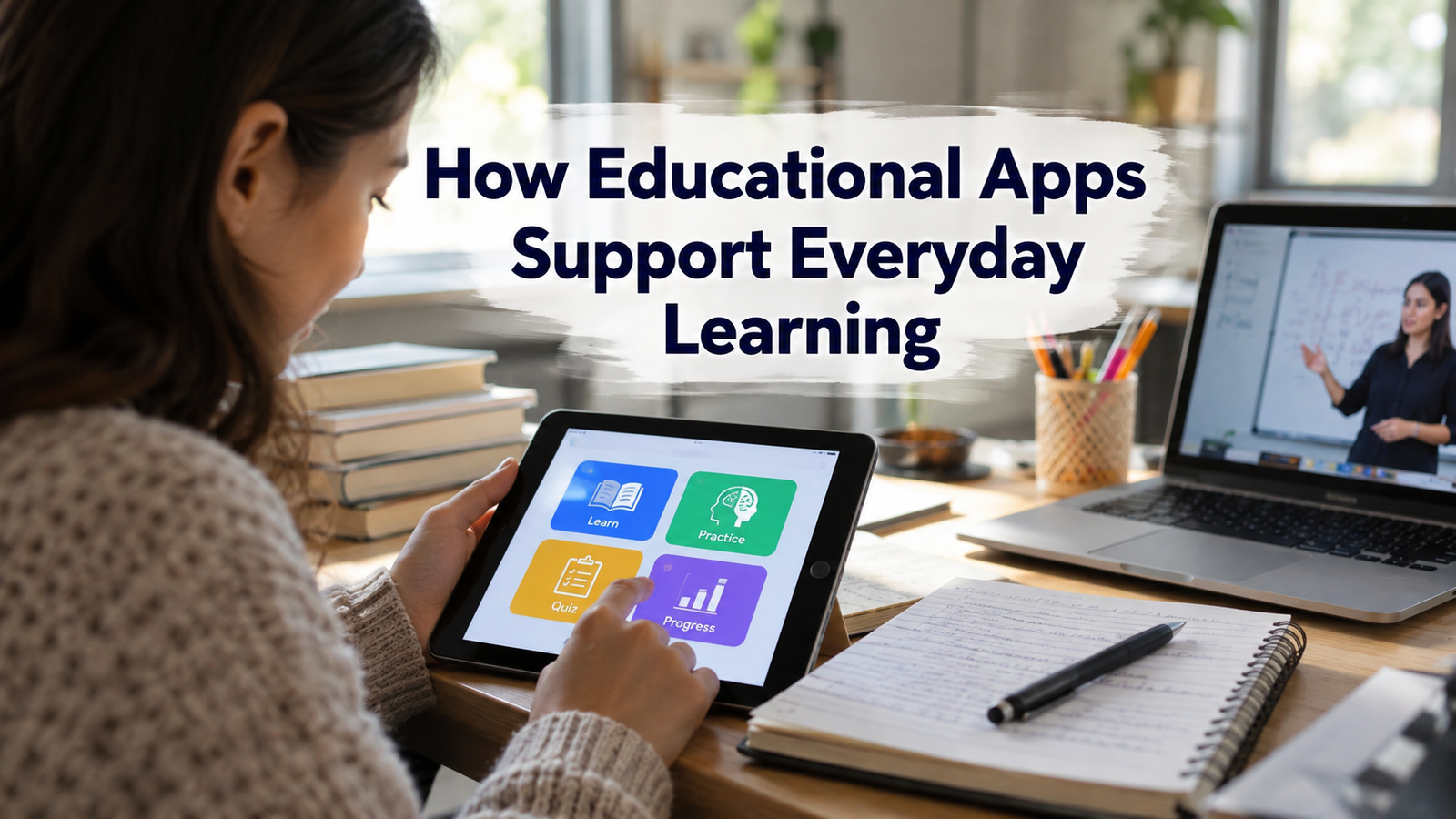
Learning is no longer limited to classrooms, textbooks, or fixed study hours. Today, students can learn almost anywhere by using a smartphone, tablet, or computer. Educational apps have become an important part of this change because they make useful learning material available throughout the day.
I have noticed that one of the strongest benefits of educational apps is their flexibility. A student does not always need to sit at a desk for several hours. Even a short period of free time can be used to review vocabulary, solve a mathematics problem, watch an educational lesson, or practice a new skill.
This ability to learn in small moments makes educational apps especially useful for everyday learning.
Educational apps do not completely replace teachers, schools, or books. Instead, they work best as additional learning tools. They can help students practice what they have already learned, explore new topics, improve weak areas, and develop independent learning habits.
In this article, I will explain how educational apps support everyday learning, why they are becoming popular, and how students can use them effectively.
What Are Educational Apps?
Educational apps are digital applications designed to help people learn knowledge or skills.
Some apps focus on school subjects such as mathematics, science, history, and languages. Others help users improve reading, writing, memory, communication, coding, creativity, or professional skills.
Educational apps may include lessons, quizzes, videos, flashcards, puzzles, simulations, practice exercises, and progress tracking tools.
The main purpose is usually simple. They give learners an easier way to access educational content and practice regularly.
Some educational apps are designed for children, while others are made for university students, teachers, professionals, or adults who simply want to continue learning.
This wide variety means people can often find an app that matches their interests and learning goals.
Educational Apps Make Learning More Accessible
One major advantage of educational apps is accessibility.
Traditional learning often depends on a particular location. Students may need to go to school, visit a library, attend a tutoring center, or sit in front of a computer.
Educational apps make learning more portable.
A student can review a lesson while traveling, waiting for an appointment, sitting at home, or taking a short break.
This does not mean every moment should become study time. Rest is also important. However, easy access gives students more control over when and where they learn.
For students who live far from educational institutions or have limited access to learning materials, digital resources can also provide additional opportunities.
Learning Can Become Part of Daily Life
One reason educational apps are useful is that they can turn learning into a regular habit.
When I think about effective learning, consistency seems more important than studying for many hours only before an examination.
A student who studies for fifteen or twenty minutes every day may remember information more effectively than someone who studies the same topic only once.
Educational apps can support this type of regular practice.
For example, a language learner might practice ten new words each morning. A mathematics student might solve five problems after school. A science student might review flashcards before going to bed.
These small learning sessions can gradually build knowledge.
When learning becomes part of everyday life, it may feel less stressful and more natural.
Educational Apps Support Short Learning Sessions
Many students believe they need a large amount of free time before they can study properly.
That is not always true.
Short study sessions can also be productive when they are focused.
Educational apps are particularly suitable for short sessions because lessons are often divided into smaller sections.
A learner may complete one quiz, read one explanation, or practice one skill in a few minutes.
This approach is sometimes connected with microlearning, where information is presented in smaller and more manageable units.
Smaller lessons can make difficult topics feel less overwhelming.
Instead of thinking about an entire chapter, students can focus on one idea at a time.
Immediate Feedback Helps Students Learn
Feedback is an important part of learning.
If students complete an exercise but do not know whether their answer is correct, they may continue making the same mistake.
Many educational apps provide immediate feedback.
For example, after answering a question, the learner may instantly see whether the answer was correct. Some apps also explain why a particular answer is correct.
This can help students identify mistakes quickly.
Immediate feedback is especially useful in subjects where regular practice is important, such as mathematics, language learning, grammar, spelling, and science.
Students can correct misunderstandings before they become stronger habits.
Educational Apps Can Make Practice More Interesting
Repeating the same type of exercise can sometimes become boring.
Educational apps often use interactive activities to make practice more engaging.
These may include quizzes, challenges, progress levels, puzzles, points, badges, and visual activities.
When these features are used properly, they can encourage students to continue practicing.
The purpose should still be learning rather than simply collecting points.
A good educational app keeps the learner interested while making sure the activity has real educational value.
For younger students especially, colorful visuals and interactive exercises can sometimes make difficult subjects feel more approachable.
Personalized Learning Is Easier With Apps
Students do not all learn at the same speed.
One student may understand mathematics quickly but struggle with reading. Another student may be strong in science but need extra help with grammar.
Traditional classrooms have to serve many students at the same time, so teachers cannot always provide completely different lessons for every learner.
Educational apps can sometimes offer more personalized practice.
Some apps adjust difficulty according to the learner’s performance.
If a student answers several questions correctly, the app may introduce harder activities. If the student struggles, it may provide easier questions or additional explanations.
This allows students to spend more time on areas where they need practice.
Personalized learning can make study sessions more efficient because learners are not always forced to follow exactly the same path.
Students Can Learn at Their Own Pace
Another useful feature of educational apps is self paced learning.
In a classroom, the teacher usually has a limited amount of time to complete a lesson.
Students who understand quickly may want to move forward, while others may need more time.
With educational apps, learners can often repeat lessons as many times as necessary.
They can pause a video, review an explanation, attempt a quiz again, or return to an earlier topic.
There is usually less pressure to keep up with other students.
This can make learning more comfortable, especially for students who need additional practice.
Apps Can Support Language Learning
Language learning is one area where educational apps are widely used.
Learning a language requires frequent exposure and practice.
Students need to develop vocabulary, grammar, listening, reading, writing, and speaking skills.
Educational apps can provide short daily activities for many of these areas.
For example, learners can practice vocabulary through flashcards, listen to pronunciation examples, complete grammar exercises, or answer listening questions.
Some apps also use speech recognition to help students practice pronunciation.
Regular language practice is important because skills can weaken when they are not used.
Using an app for a few minutes each day can help learners maintain contact with the language.
Mathematics Practice Becomes More Convenient
Mathematics is another subject that benefits from regular practice.
Reading a formula is usually not enough. Students need to solve problems repeatedly to understand how the method works.
Educational mathematics apps can provide practice questions at different levels.
Some also show step by step explanations.
This can help students understand where they made a mistake instead of simply seeing the final answer.
However, students should avoid becoming completely dependent on automatic solutions.
It is better to attempt the problem independently before checking the explanation.
Educational apps should support thinking rather than replace it.
Science Can Become More Visual
Some scientific ideas are difficult to understand through text alone.
Subjects such as astronomy, biology, chemistry, and physics often involve processes that are easier to understand visually.
Educational apps can use animations, diagrams, videos, and interactive models to explain these concepts.
For example, students may be able to explore the solar system, examine parts of a human cell, observe a chemical process, or experiment with a digital physics simulation.
Visual explanations can help learners connect abstract concepts with something they can actually see.
This can make complex subjects easier to remember.
Educational Apps Encourage Independent Learning
One of the most valuable skills a student can develop is the ability to learn independently.
School education is important, but people continue learning throughout life.
Educational apps give students opportunities to take responsibility for their own learning.
They can choose what to study, decide when to practice, monitor their progress, and search for explanations when they do not understand something.
Over time, this may help students become more confident learners.
Independent learning does not mean students should never ask teachers for help.
It means they become more active participants in their own education.
Progress Tracking Can Improve Motivation
It can be difficult to notice improvement when learning happens gradually.
Many educational apps include progress tracking tools.
These tools may show completed lessons, quiz scores, study time, learning streaks, or skills that need more practice.
Seeing progress can motivate students.
For example, a learner who has practiced a language for thirty consecutive days may feel encouraged to continue.
Progress tracking can also help students identify weaknesses.
If quiz scores remain low in one topic, the student knows that area may require additional study.
Educational Apps Can Support Classroom Learning
Educational apps are not only useful outside school.
Teachers can also use digital learning tools to support classroom activities.
For example, a teacher might use an app for quizzes, revision activities, interactive exercises, or homework practice.
Students can review classroom lessons later using the same digital resources.
This combination of classroom teaching and digital learning can provide more opportunities for practice.
The teacher still plays an important role by explaining concepts, answering questions, guiding discussions, and helping students understand difficult ideas.
Technology works best when it supports good teaching rather than trying to replace it.
Learning Through Games Can Increase Engagement
Some educational apps use game based learning.
Instead of presenting only traditional questions, they turn learning activities into challenges or games.
Students may earn points, complete levels, solve puzzles, or compete against their previous scores.
This can make learning more enjoyable.
However, game features should have a clear educational purpose.
If students focus only on winning points and stop thinking about the subject, the activity loses much of its value.
The strongest educational games combine enjoyment with meaningful practice.
Apps Can Help Students Review Before Exams
Revision is an important part of exam preparation.
Educational apps can make revision more organized.
Students can use flashcards to review definitions, complete practice questions, take mock quizzes, and identify topics they have forgotten.
Regular revision through an app may also reduce the need for last minute study.
Instead of reviewing everything one day before an examination, students can revise small amounts regularly over several weeks.
This approach can make exam preparation feel more manageable.
Educational Apps Support Lifelong Learning
Educational apps are not only for school students.
Adults can also use them to continue learning.
People may study a new language, learn computer skills, improve financial knowledge, explore history, practice writing, or study a professional subject.
This reflects the idea of lifelong learning.
Education does not have to end when someone leaves school or university.
Technology has made it easier for people to continue developing knowledge throughout their lives.
Even learning something for personal interest can be valuable.
Choosing the Right Educational App
Not every educational app is equally useful.
Students should choose apps carefully.
A good educational app should have clear lessons, accurate information, simple navigation, and activities that support real learning.
Students should also consider whether the app matches their age, subject, and learning level.
Reviews can sometimes help, but popularity alone does not prove educational quality.
It is useful to compare the content with reliable books, school materials, or guidance from teachers.
Students should also check privacy settings and avoid sharing unnecessary personal information.
Avoiding Too Much Screen Time
Although educational apps can be helpful, balance is important.
Learning through technology should not replace every other type of activity.
Students still need physical exercise, sleep, social interaction, outdoor activities, handwriting practice, books, and face to face communication.
Long periods of screen use can also reduce concentration.
For this reason, educational apps are often most useful when they are used for focused study sessions.
Students can complete an activity, take a break, and then continue with another form of learning.
Apps Should Support Thinking, Not Replace It
A major concern with technology is that students may become too dependent on digital assistance.
If an app provides every answer immediately, students may stop trying to solve problems themselves.
The goal of education is not simply to reach the correct answer.
Students also need to understand how and why the answer is correct.
When using educational apps, learners should attempt questions independently, think carefully, and use explanations only when needed.
The best learning tools encourage curiosity and reasoning.
Parents Can Support Younger Learners
Parents can play an important role when younger children use educational apps.
They can help children choose suitable apps and create reasonable study routines.
Parents can also ask children what they learned.
For example, after a science activity, a parent might ask the child to explain the concept in their own words.
This simple conversation can reveal whether the child truly understood the lesson.
Parents should also monitor screen time and make sure digital activities do not replace sleep, exercise, play, or family interaction.
Teachers Remain Essential
Technology has changed education, but teachers remain extremely important.
An app can provide exercises and information, but it cannot fully replace the understanding, encouragement, judgment, and personal guidance of a good teacher.
Teachers understand classroom situations and individual student needs in ways that technology may not always recognize.
Educational apps are therefore most effective when they are considered learning tools rather than complete replacements for traditional education.
A balanced approach can combine teachers, books, discussions, practical activities, and digital resources.
Building a Healthy Everyday Learning Routine
Students do not need dozens of educational apps.
Using a small number of useful tools consistently is usually more effective.
A simple learning routine might include fifteen minutes of language practice in the morning, a short mathematics quiz after school, and ten minutes of reading before bed.
The exact routine depends on the learner.
The important point is consistency.
Learning becomes more effective when students know what they want to achieve and use technology for a specific purpose.
Opening an educational app without a goal can easily turn into distraction.
A clear study objective helps keep attention focused.
Final Thoughts
Educational apps have changed the way people access and practice knowledge. They allow students to learn in short sessions, review difficult subjects, receive quick feedback, track progress, and explore topics beyond the classroom.
Their greatest value may be convenience.
A student no longer has to wait for a formal lesson every time they want to learn something. Useful educational material can be available throughout the day.
However, educational apps should be used thoughtfully.
They work best when they support teachers, books, classroom activities, discussions, and independent thinking rather than replacing them.
Students should choose reliable apps, create realistic study routines, take regular breaks, and focus on understanding rather than simply completing activities.
When used in this balanced way, educational apps can turn everyday moments into useful learning opportunities. A few minutes of focused practice each day may seem small, but over time those small sessions can build stronger knowledge, better study habits, and greater confidence in learning.
For modern students, this is one of the most practical benefits of educational technology. Learning can continue beyond the classroom and become a natural part of everyday life.