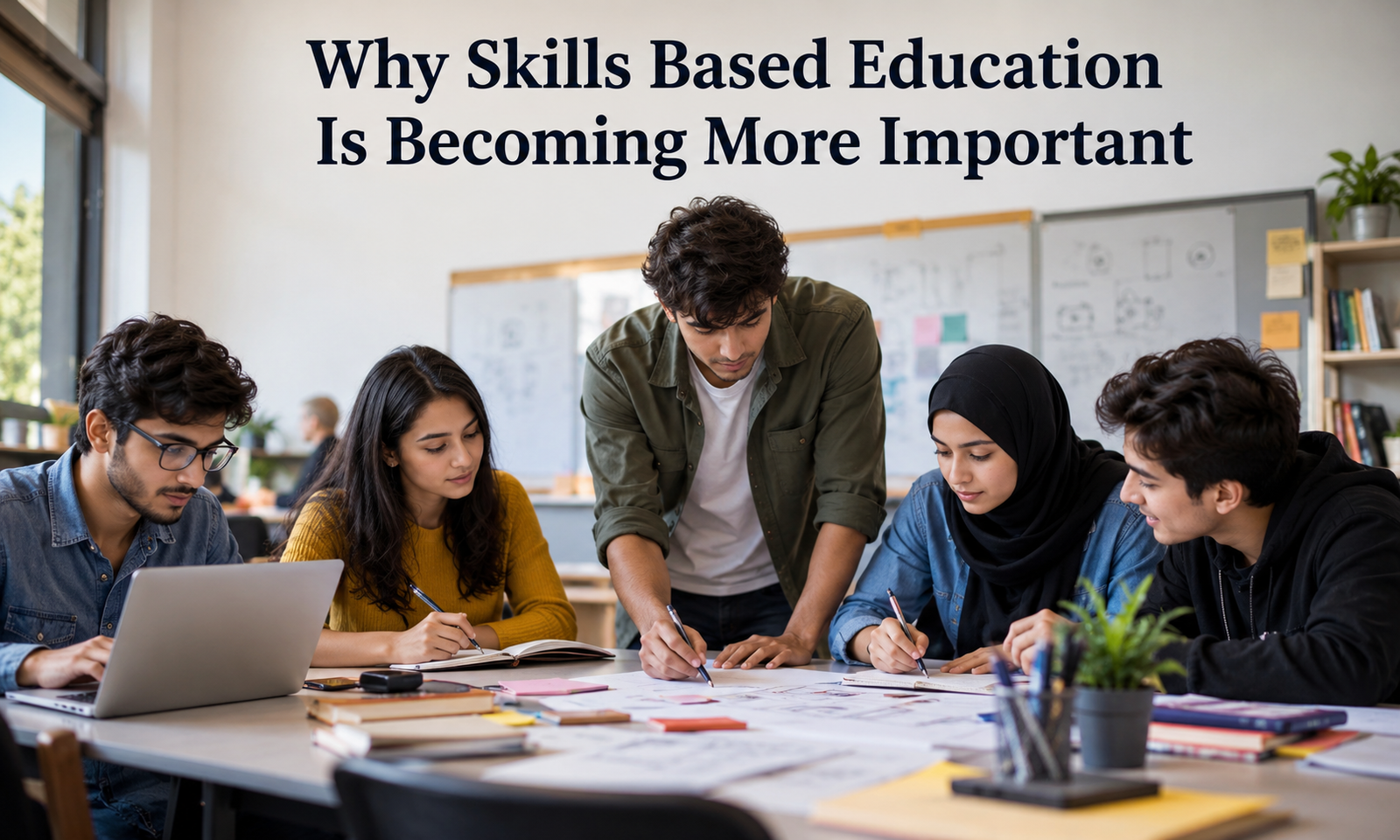
Education has always played an important role in preparing people for the future. For many years, schools and colleges mainly focused on textbooks, examinations, grades, and academic qualifications. These things are still important, but the world of work is changing quickly. Employers now want people who can not only explain what they know but also show what they can actually do.
This change is one of the main reasons why skills based education is becoming more important.
Skills based education focuses on practical abilities, problem solving, communication, creativity, teamwork, digital knowledge, and other useful competencies. Instead of measuring students only through written exams, it also looks at how well they can apply their knowledge in real situations.
As technology changes industries and new types of jobs appear, students need more than theoretical knowledge. They need skills that help them adapt, learn, communicate, solve problems, and perform tasks confidently.
In this article, I will explain why skills based education is becoming more important, how it works, what benefits it offers, and why it may become a major part of the future of education.
What Is Skills Based Education?
Skills based education is an approach to learning that focuses on developing specific abilities that students can use in education, work, and daily life.
Traditional education often asks questions such as:
What facts does the student remember?
What score did the student receive?
Did the student pass the exam?
Skills based education asks different questions.
Can the student solve a real problem?
Can the student communicate an idea clearly?
Can the student use digital tools?
Can the student work successfully with others?
Can the student apply knowledge in a practical situation?
This does not mean that academic knowledge becomes unimportant. Knowledge remains the foundation of learning. The main difference is that students are also encouraged to use that knowledge.
For example, a student may learn mathematical formulas in class. In a skills based environment, the student may also use those formulas to create a budget, calculate costs, interpret data, or solve a practical problem.
The goal is to connect learning with useful ability.
Why Skills Based Education Is Growing
There are several reasons why schools, universities, employers, and governments are paying more attention to skills.
One major reason is the rapid change in the workplace.
Many jobs that existed twenty years ago have changed because of technology. Some tasks have become automated, while completely new professions have appeared.
Employers therefore need workers who can learn new systems and adapt to changing situations.
A qualification may show that a person completed a course, but employers also want evidence that the person can perform the required tasks.
This has increased interest in practical learning, professional training, short courses, certifications, internships, projects, and other forms of skills development.
The Job Market Is Changing
The modern job market is very different from the job market of previous generations.
In the past, a person could learn one profession and continue using almost the same knowledge for many years.
Today, industries change much faster.
Software is updated regularly. New digital tools appear. Artificial intelligence is changing business processes. Online communication has become common. Companies are using more data to make decisions.
Because of these changes, workers need to continue learning throughout their careers.
Skills based education prepares students for this reality by teaching them how to develop useful abilities rather than depending only on memorized information.
The ability to learn may become just as important as the information already learned.
Employers Are Looking for Practical Skills
Employers often receive many applications from people with similar academic qualifications.
In such situations, practical skills can make an important difference.
A degree may show that someone has studied a subject, but an employer may still want to know whether the applicant can communicate, organize work, solve problems, use technology, or complete a task successfully.
For example, a company hiring a marketing employee may look for abilities such as:
Content writing
Data analysis
Communication
Social media management
Presentation skills
Basic design knowledge
Planning
Research
These abilities may be more directly connected to the job than a person’s exam scores.
Skills based education tries to reduce the gap between classroom learning and workplace expectations.
Students Need to Know How to Apply Knowledge
Memorizing information can help students pass exams, but it does not always prove that they understand how to use that information.
Practical learning creates a stronger connection between knowledge and action.
Imagine two students studying environmental science.
One student memorizes definitions about pollution.
The second student learns the same definitions but also studies pollution in a local area, collects information, analyzes causes, and suggests possible solutions.
The second approach allows the student to practice research, observation, communication, analysis, and problem solving.
This is the basic idea behind skills based learning.
Students should not only know the answer. They should understand how to use what they know.
Technology Has Increased the Need for New Skills
Technology is changing almost every part of life.
Students today are growing up in a world of smartphones, cloud platforms, digital classrooms, online collaboration, artificial intelligence, and automated systems.
Because of this, digital literacy has become an important part of education.
Students may need to learn how to:
Search for reliable information
Use productivity software
Analyze digital information
Create presentations
Work through online platforms
Communicate professionally online
Protect personal information
Understand basic cybersecurity
Use artificial intelligence responsibly
These are practical skills that can support both education and employment.
Technology also changes quickly, so students must learn how to adapt when new tools appear.
Artificial Intelligence Is Changing Work
Artificial intelligence is one of the strongest reasons why skills based education is receiving more attention.
AI tools can now help with writing, data analysis, customer service, design, coding, research, translation, and many other tasks.
This does not mean that human skills are becoming unnecessary.
In many cases, the opposite may happen.
As technology handles more routine tasks, people may need stronger abilities in areas such as judgment, creativity, communication, leadership, problem solving, and decision making.
Students may also need to understand how to use AI tools effectively without depending on them completely.
Skills based education can help students learn how to combine human abilities with technology.
Problem Solving Is Becoming More Valuable
Real life problems rarely look like textbook questions.
They are often unclear and may have several possible solutions.
This is why problem solving is one of the most useful skills students can develop.
Skills based learning often includes activities where students must identify a problem, gather information, compare options, test ideas, and explain their final decision.
These activities help students become more independent thinkers.
Problem solving is useful in almost every profession, from engineering and healthcare to business, education, construction, technology, and public services.
It is also useful in daily life.
Communication Skills Matter in Every Career
A person can have strong technical knowledge but still struggle professionally if they cannot communicate clearly.
Good communication includes speaking, writing, listening, presenting ideas, asking questions, and explaining information to different audiences.
Skills based education gives students more opportunities to practice these abilities.
Students may participate in presentations, discussions, group activities, interviews, reports, and collaborative projects.
These activities can help them become more confident and professional communicators.
Communication skills are especially important because modern workplaces often include people from different departments, cultures, and professional backgrounds.
Teamwork Is an Important Workplace Skill
Many school activities are completed individually, but most workplaces depend heavily on teamwork.
Employees often need to share responsibilities, discuss ideas, solve disagreements, support colleagues, and work toward common goals.
Students can learn these skills through group projects and collaborative activities.
Good teamwork is not simply about putting several students in the same group.
Students need to learn how to divide tasks, manage time, communicate clearly, and take responsibility for their contribution.
These experiences can prepare them for real workplace situations.
Skills Based Education Supports Active Learning
Traditional classrooms can sometimes become passive.
Students listen to the teacher, take notes, read textbooks, and prepare for examinations.
Skills based education often encourages more active learning.
Students may complete experiments, build models, solve case studies, create presentations, conduct research, participate in simulations, or work on practical projects.
Active learning can make lessons more meaningful because students are directly involved in the learning process.
Instead of receiving information only, they use it.
This can also improve understanding because students see how ideas work in practice.
It Can Increase Student Motivation
Students often ask an important question.
Why am I learning this?
If they cannot see the connection between a subject and real life, they may lose interest.
Skills based education can make the purpose of learning clearer.
A student learning mathematics may understand how it is used in budgeting, engineering, construction, business, or data analysis.
A student learning language skills may understand how writing and communication can help in professional life.
A student learning science may see how scientific thinking is used to understand health, technology, agriculture, and the environment.
When students understand why something matters, they may become more motivated to learn it.
It Encourages Creativity
Skills based education often gives students more freedom to explore different solutions.
Instead of searching for only one correct answer, students may be asked to design something, create a project, develop an idea, or propose a solution.
This encourages creativity.
Creativity is becoming increasingly valuable because organizations often need new ideas to improve products, services, systems, and customer experiences.
Students can develop creativity by practicing it regularly.
Activities such as design projects, writing, experiments, presentations, and problem solving can all encourage creative thinking.
Skills Based Education Can Build Confidence
Students sometimes perform well in written exams but feel nervous when asked to complete a practical task.
The opposite can also happen.
Some students may not achieve the highest exam grades, but they may be excellent at practical work.
Skills based education gives students more ways to demonstrate their abilities.
When students successfully complete projects, solve problems, present ideas, or create something useful, they can develop greater confidence.
This confidence may help them in future interviews, university work, professional training, and employment.
Learning Becomes More Relevant to Real Life
One of the strongest advantages of skills based education is relevance.
Students can connect classroom lessons with situations they may actually experience.
For example, financial education can include creating a personal budget.
Business education can include developing a simple business plan.
Computer education can include building a website or analyzing data.
Language education can include writing professional emails.
Science education can include conducting experiments and interpreting results.
These activities help students understand that education is not separate from real life.
Education can become a tool for solving real problems.
Skills Based Education Supports Career Readiness
Career readiness means preparing students for the expectations of the workplace.
Academic knowledge is one part of this preparation, but students also need professional skills.
These may include:
Time management
Communication
Teamwork
Leadership
Problem solving
Digital literacy
Critical thinking
Planning
Adaptability
Professional behavior
Skills based education can introduce these abilities before students enter the workforce.
This can make the transition from education to employment easier.
Critical Thinking Is Becoming More Important
Students have access to enormous amounts of information through the internet.
The challenge is no longer simply finding information.
The challenge is deciding whether that information is accurate, useful, biased, outdated, or misleading.
Critical thinking helps students evaluate information carefully.
They learn to ask questions such as:
Where did this information come from?
Is the source reliable?
What evidence supports the claim?
Are there other explanations?
Is important information missing?
These questions are useful in education, work, and daily decision making.
Skills based education often encourages this kind of thinking.
Learning Can Become More Personalized
Not every student learns in exactly the same way or at exactly the same speed.
Skills based learning can support more personalized education because students may progress according to their ability to demonstrate a particular skill.
A student who already understands a concept may move forward more quickly.
Another student may receive additional practice.
This approach can make learning more flexible.
It also helps teachers identify specific strengths and weaknesses instead of relying only on a total exam score.
Skills Can Be Measured in Different Ways
Traditional education often relies heavily on written examinations.
Skills based education can use several forms of assessment.
These may include:
Projects
Presentations
Portfolios
Practical demonstrations
Case studies
Assignments
Simulations
Group activities
Performance tasks
These methods allow teachers to see how students apply knowledge.
For example, a written test may measure whether a student understands the theory of public speaking.
A presentation can show whether the student can actually speak clearly in front of an audience.
Both forms of assessment can be useful, but they measure different things.
The Importance of Technical Skills
Technical skills are abilities related to a particular profession or task.
Examples include coding, graphic design, accounting, machine operation, laboratory testing, data analysis, electrical work, or digital marketing.
These skills are important because they allow people to perform specific types of work.
Skills based education can help students begin developing technical abilities earlier.
Vocational institutions have used this approach for many years, but universities and schools are also beginning to include more practical learning.
Technical education can be especially valuable when it is combined with strong general knowledge.
The Importance of Soft Skills
Soft skills are personal and interpersonal abilities that help people work effectively.
Examples include communication, adaptability, teamwork, leadership, emotional awareness, organization, and time management.
These skills are useful across many different careers.
Someone may change industries several times during their working life, but communication and problem solving will continue to be useful.
This is one reason soft skills are receiving increasing attention in education.
Lifelong Learning Is Becoming Necessary
Education is no longer something that ends when a person leaves school or university.
Modern workers may need to learn new tools, technologies, and methods throughout their careers.
This idea is often called lifelong learning.
Skills based education supports lifelong learning because it teaches people how to develop abilities continuously.
Workers can take short courses, earn professional certificates, complete online programs, attend workshops, or learn independently.
Continuous learning can help people remain useful and adaptable as industries change.
Skills Based Education Does Not Mean Ignoring Academic Knowledge
There is sometimes a misunderstanding that skills based education means replacing traditional subjects completely.
That is not the goal.
Students still need knowledge.
A doctor needs medical knowledge.
An engineer needs mathematics and science.
A teacher needs knowledge of education and the subject being taught.
A financial professional needs knowledge of economics and accounting.
Skills become useful when they are built on strong knowledge.
The most effective education system may therefore combine academic understanding with practical application.
Students need to know and do.
Challenges of Skills Based Education
Although skills based education offers many benefits, it also has challenges.
Teachers need proper training to design practical learning activities.
Schools may need equipment, technology, laboratories, or suitable learning spaces.
Assessing practical skills can also be more difficult than marking a written test.
Different teachers may judge performance differently, so clear assessment standards are important.
Large class sizes can create another challenge because teachers may have limited time to observe every student.
Schools therefore need careful planning when introducing skills based learning.
The Role of Teachers Is Changing
In skills based education, the teacher is still very important.
However, the teacher may play a slightly different role.
Instead of only delivering information, teachers may also guide projects, support discussions, provide feedback, and help students solve problems.
The teacher becomes a facilitator of learning as well as a source of knowledge.
This does not reduce the teacher’s importance.
In many ways, it can make the role more demanding because teachers must understand both the subject and how students can apply it.
The Future of Skills Based Education
Skills based education is likely to become more visible as technology and employment continue to change.
Schools may include more project based learning.
Universities may offer more industry connected programs.
Employers may place greater value on portfolios, certifications, and demonstrated abilities.
Students may combine traditional degrees with shorter professional courses.
Online learning platforms may also make skills training more accessible.
Education may gradually become more flexible, allowing people to learn different skills at different stages of life.
The future may not belong to academic education alone or skills training alone.
The strongest model may combine both.
How Students Can Develop Useful Skills
Students do not have to wait for their school or university to completely change its education system.
They can begin developing useful skills independently.
A student can practice writing, communication, research, coding, design, data analysis, public speaking, or another useful ability.
Online courses, books, projects, volunteering, internships, and personal practice can all help.
The important thing is to move from only reading about a skill to actually practicing it.
For example, someone learning graphic design should create designs.
Someone learning coding should build small programs.
Someone learning writing should write regularly.
Someone learning public speaking should practice speaking.
Skill develops through practice.
Why Skills Based Education Matters for the Future
The world students are entering is becoming more dynamic.
Jobs are changing.
Technology is advancing.
Information is easier to access.
Employers are expecting more practical abilities.
People may change careers several times during their lives.
In this environment, education must prepare students not only for an exam but also for change.
Skills based education helps students become more flexible, confident, practical, and independent learners.
It teaches them how to use knowledge rather than simply store it.
Final Thoughts
Skills based education is becoming more important because the modern world demands more than academic qualifications.
Students still need strong subject knowledge, but they also need communication, problem solving, digital literacy, teamwork, creativity, critical thinking, and practical experience.
These abilities can help students move more successfully from the classroom into higher education and the workplace.
The most useful education systems will probably not choose between knowledge and skills. They will connect the two.
Students should understand ideas, but they should also know how to apply them.
As technology continues to change the way people live and work, the ability to learn new skills may become one of the most valuable abilities of all.
Skills based education prepares students for that future by turning learning into something practical, flexible, and connected to real life.
Frequently Asked Questions
What is skills based education?
Skills based education is a learning approach that focuses on practical abilities as well as academic knowledge. Students learn how to apply what they know in real situations.
Why is skills based education important?
It helps students develop practical abilities such as communication, problem solving, teamwork, digital literacy, creativity, and critical thinking.
Is skills based education replacing traditional education?
Not necessarily. It can work alongside traditional education by adding practical application to academic knowledge.
What skills are most important for students?
Important skills include communication, critical thinking, teamwork, digital literacy, problem solving, creativity, adaptability, and time management.
How does skills based learning prepare students for jobs?
It gives students opportunities to practice abilities that employers often expect, including collaboration, communication, technology use, planning, and practical problem solving.
Can skills based education improve student motivation?
Yes. Students may become more interested in learning when they understand how a subject connects to real life and future careers.
What is the difference between knowledge and skills?
Knowledge is what a person understands or remembers. A skill is the ability to use that knowledge to complete a task or solve a problem.
Will skills become more important in the future?
Skills are likely to remain increasingly important because technology, workplaces, and industries continue to change. People may need to learn and update their abilities throughout their careers.