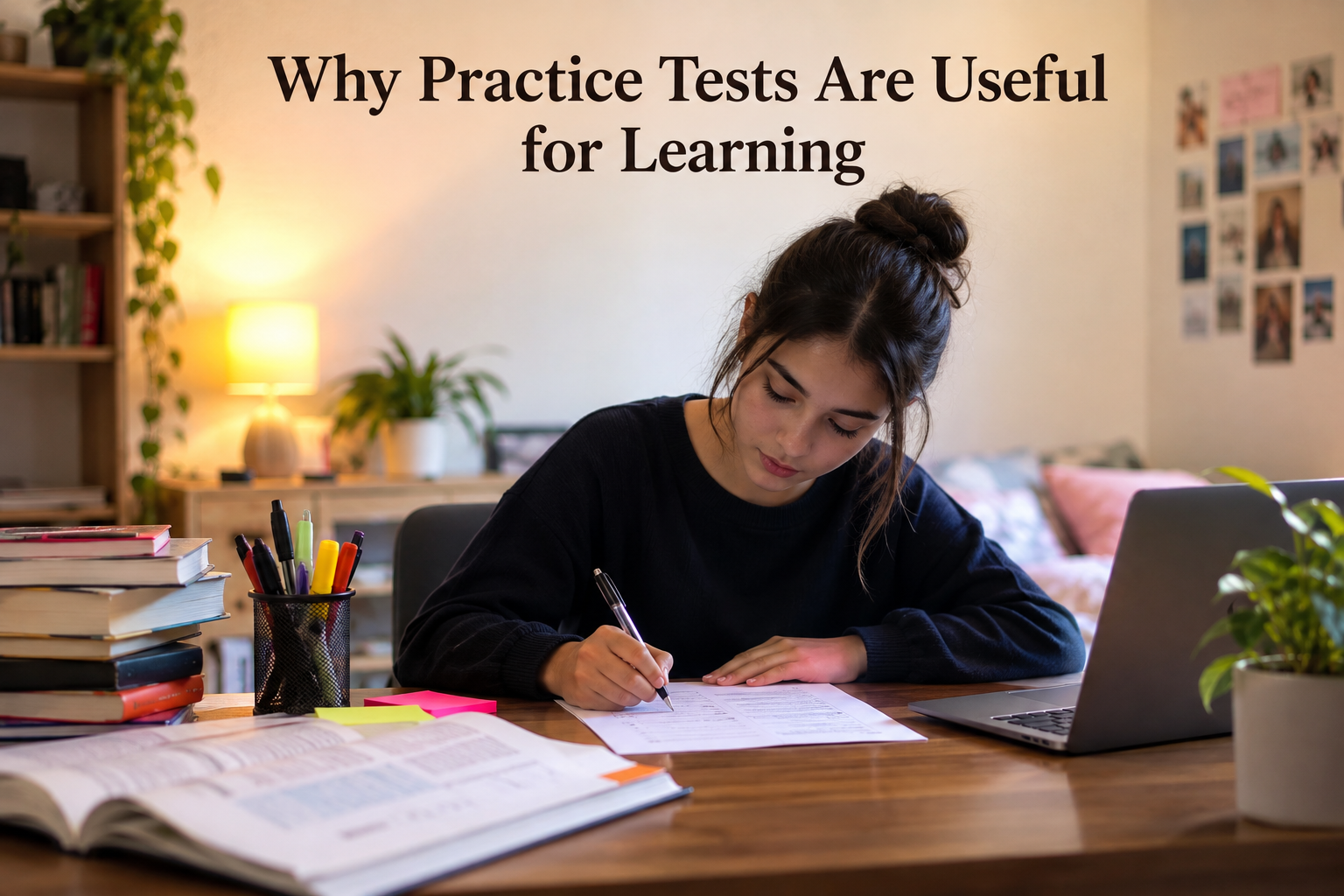
Learning is not only about reading books, listening to lectures, or writing notes. Real learning happens when we are able to remember information and use it when needed. This is one reason why practice tests are so useful for students.
A practice test is a simple way of checking what you know before the real exam. It can include multiple choice questions, short answers, written questions, calculations, or any other format related to a subject. Students often think that practice tests are only useful for exam preparation. In reality, they can improve the learning process itself.
When students try to answer questions without looking at their notes, the brain has to search for the information. This active effort strengthens memory and shows which topics are clear and which topics need more attention.
In this article, I will explain why practice tests are useful for learning, how they improve memory, how they reduce exam stress, and how students can use them effectively.
What Is a Practice Test?
A practice test is a set of questions designed to help students review what they have learned. It usually follows the same type of content that students may see in a classroom test, quiz, or final examination.
Practice tests can be created by teachers, found in textbooks, downloaded from educational websites, or prepared by students themselves.
For example, after studying a chapter about the human digestive system, a student can close the book and answer questions such as:
What is the function of the stomach?
Where does most nutrient absorption take place?
What role does the liver play in digestion?
These questions force the student to recall information instead of simply looking at it.
This difference is very important because remembering information is a skill. Like any other skill, it becomes stronger with practice.
Practice Tests Encourage Active Learning
One of the biggest benefits of practice tests is that they make students actively participate in learning.
Reading is often a passive activity. A student may read the same page several times and feel familiar with the information. However, familiarity does not always mean understanding.
When students take a practice test, they must produce an answer from memory.
For example, reading the definition of photosynthesis may feel easy because the words are already visible on the page. But when the book is closed and the student is asked to explain photosynthesis, the task becomes more challenging.
That challenge is useful.
It shows whether the student truly understands the topic.
Active learning also keeps the brain more involved. Instead of simply receiving information, the student has to think, remember, compare, organize, and explain.
This deeper level of thinking can make learning more effective.
Practice Tests Strengthen Memory
Practice tests are especially useful because they encourage memory retrieval.
Memory retrieval means bringing information out of memory without looking at the original source.
Suppose a student has learned that water boils at 100 degrees Celsius under normal atmospheric pressure.
Reading this fact ten times may make it look familiar.
However, if the student closes the book and answers the question, “At what temperature does water boil?” the brain has to retrieve the answer.
Every successful retrieval can strengthen the memory connection.
This is why practice questions can sometimes be more useful than repeatedly reading the same material.
The purpose is not simply to discover whether the answer is correct. The process of trying to remember is itself part of learning.
Practice Tests Show What You Really Know
Students sometimes believe they understand a topic because they have spent a long time reading it.
This can create false confidence.
A chapter may look familiar because the student has seen the words several times. But during an exam, the student cannot see the textbook.
A practice test creates a more realistic situation.
It asks the student to produce an answer independently.
This helps students separate three different levels of knowledge.
The first level is information they know well.
The second level is information they partly remember.
The third level is information they do not understand or remember.
Once students can identify these levels, they can study more intelligently.
Instead of spending equal time on every topic, they can focus more attention on areas where their knowledge is weak.
Practice Tests Help Identify Learning Gaps
Every student has learning gaps.
A learning gap is an area where knowledge is incomplete or incorrect.
Sometimes students do not notice these gaps while reading.
For example, a student may understand the basic idea of fractions but become confused when asked to add fractions with different denominators.
A practice question reveals this weakness immediately.
After identifying the problem, the student can return to the lesson and review that specific concept.
This creates a useful cycle:
Study the topic.
Take a practice test.
Check the answers.
Identify mistakes.
Review weak areas.
Test yourself again.
This process is far more focused than simply studying everything again from the beginning.
Practice Tests Improve Long Term Learning
Students often study for the short term. They memorize information before an exam and forget much of it later.
Practice testing can help students remember information for longer periods because it repeatedly activates the knowledge stored in memory.
If a student learns something once and never uses it again, the memory may gradually weaken.
However, when the information is recalled after a few days and then recalled again later, it becomes easier to access.
This is especially useful for subjects where new knowledge depends on older knowledge.
Mathematics is a good example.
A student learning algebra still needs basic arithmetic skills.
A biology student learning genetics may need to remember ideas about cells, DNA, and reproduction.
Practice tests can keep important knowledge active.
Practice Tests Make Revision More Efficient
Many students spend hours revising without knowing whether their study method is working.
They read chapters, highlight sentences, copy notes, and sometimes rewrite entire lessons.
These activities can be useful, but they can also consume a lot of time.
Practice tests provide faster feedback.
If a student answers twenty questions and gets seventeen correct, there is no need to study every part of the topic equally.
The student can concentrate on the three questions that caused difficulty.
This makes revision more targeted.
Instead of asking, “What should I study today?” the student can ask, “Which questions did I get wrong, and why?”
That small change can make study sessions much more productive.
Practice Tests Help Students Understand Question Styles
Knowing a subject is important, but understanding how questions are asked is also useful.
Different exams use different question styles.
Some exams focus on multiple choice questions.
Others require short explanations.
Some may include essays, calculations, diagrams, or case studies.
Practice tests help students become familiar with these formats.
A student may know the information but still struggle to present it properly.
For example, a short answer question may require a direct response, while an essay question may require explanation, evidence, examples, and a conclusion.
By practicing different formats, students learn how to organize their knowledge according to the question.
Practice Tests Can Improve Time Management
Time management is a common problem during exams.
Some students know the answers but spend too much time on the first few questions.
Others rush because they do not know how long each section should take.
Timed practice tests can help.
Students can set a realistic time limit and complete questions without using notes.
After finishing, they can check how long different sections required.
This helps them develop a better sense of timing.
For example, if a student has sixty minutes to answer thirty questions, practicing under similar conditions can teach the student how quickly decisions need to be made.
With experience, students can learn when to move on from a difficult question and return to it later.
Practice Tests Can Reduce Exam Stress
Exams can feel stressful when students do not know what to expect.
Practice tests make the experience more familiar.
Students become used to reading instructions, answering questions, managing time, and working without notes.
This familiarity can increase confidence.
The real exam may still feel important, but the process is no longer completely new.
A student who has completed several realistic practice tests may enter the exam room with a clearer idea of what to do.
Practice does not remove all nervousness, but preparation often makes anxiety easier to manage.
Mistakes Become Useful Information
Students sometimes see mistakes as something negative.
However, mistakes can be very useful during learning.
A wrong answer shows exactly where more work is needed.
If a student discovers a mistake during a practice test, there is still time to correct it before the real exam.
This makes practice tests a safe place to make errors.
The important step is to review each mistake carefully.
Students should not simply look at the correct answer and move to the next question.
They should ask:
Why did I choose the wrong answer?
Did I misunderstand the concept?
Did I forget a fact?
Did I misread the question?
Did I make a calculation error?
Did I confuse two similar ideas?
Understanding the reason behind a mistake can prevent the same problem from happening again.
Practice Tests Encourage Better Study Planning
Practice tests can also help students create better study schedules.
Suppose a student is preparing for a science exam that includes biology, chemistry, and physics.
After taking a practice test, the student may discover that biology is strong, chemistry is average, and physics needs more attention.
The study schedule can then be adjusted.
More time can be given to physics.
Some time can be used to strengthen chemistry.
Biology can receive shorter review sessions.
Without testing, the student might spend equal time on all three subjects even though the needs are different.
Practice test results provide useful information for planning.
Practice Tests Can Improve Confidence
Confidence usually improves when students can see evidence of progress.
Imagine a student takes a practice test and scores 55 percent.
After reviewing mistakes and studying again, the student takes another test and scores 70 percent.
Later, the score improves to 82 percent.
This progress shows that the study process is working.
It can motivate students to continue.
Confidence based on preparation is more useful than confidence based only on hope.
Students know they have practiced the material and improved their performance.
Practice Tests Work Well With Spaced Learning
Practice testing becomes even more powerful when combined with spaced learning.
Spaced learning means reviewing information over several days or weeks instead of trying to learn everything at once.
For example, a student can study a chapter on Monday.
On Tuesday, the student can answer ten practice questions.
On Friday, another short test can be completed.
The following week, the student can answer a few more questions from the same topic.
This repeated recall helps keep the information active.
Short practice tests spread across time are often easier to manage than one very long revision session before an exam.
Students Can Create Their Own Practice Questions
Practice tests do not always have to come from teachers.
Students can create their own questions.
While reading a chapter, they can turn headings into questions.
For example, a heading such as “Causes of Climate Change” can become:
What are the main causes of climate change?
A section called “Functions of the Heart” can become:
What are the major functions of the heart?
Creating questions encourages students to think about the most important ideas in a lesson.
These questions can later be used for self testing.
Students can also exchange questions with classmates.
This can introduce different ways of thinking about the same subject.
Practice Tests Are Useful for Many Subjects
Practice testing can be used in almost every area of education.
In mathematics, students can solve problems without checking examples.
In science, they can explain processes and answer concept questions.
In history, they can recall dates, causes, events, and consequences.
In language learning, they can test vocabulary, grammar, reading, and sentence construction.
In geography, they can identify locations, explain physical processes, and interpret maps.
Even subjects that involve creativity or practical skills can use practice questions to strengthen basic knowledge.
The exact format may change, but the main principle remains the same.
Students should try to recall and use what they have learned.
How to Use Practice Tests Effectively
Practice tests are most useful when they are used properly.
Students should first study enough material to understand the basic topic. They should then attempt questions without constantly checking notes.
After completing the questions, they should compare their answers with reliable information.
Incorrect answers should be reviewed carefully.
It is also useful to keep a simple record of mistakes.
For example, a student can create a notebook page called “Topics I Need to Review.”
Whenever a difficult question appears, the topic can be added to the list.
Over time, the list becomes a personalized revision guide.
Students should also return to old practice questions after several days.
A question that feels easy immediately after studying may feel harder one week later.
Testing again shows whether the information has truly stayed in memory.
Common Mistakes When Using Practice Tests
Practice tests are helpful, but students can use them incorrectly.
One common mistake is checking the answer too quickly.
If students look at the answer after only a few seconds, the brain does not get enough time to search for the information.
Another mistake is memorizing the answer to a specific question instead of understanding the concept.
For example, a student may remember that the answer to question five is option B. This does not necessarily mean the student understands the topic.
Students should sometimes change the wording of questions or use different examples.
Another mistake is taking many tests without reviewing errors.
The number of tests completed is less important than what students learn from them.
Practice Tests Should Be Part of a Balanced Study Method
Practice tests are valuable, but they should not be the only study method.
Students still need to read explanations, listen to teachers, take notes, solve examples, discuss ideas, and ask questions.
Practice testing works best as part of a wider learning strategy.
A good study session may begin with reading a topic.
Next, the student may write a short summary.
Then the book can be closed and several practice questions attempted.
Finally, mistakes can be reviewed.
This creates a complete learning cycle.
Students first understand the information, then organize it, then retrieve it, and finally correct weaknesses.
Final Thoughts
Practice tests are useful for learning because they turn studying into an active process.
They help students retrieve information from memory, identify weak areas, improve long term learning, manage exam time, understand question formats, and build confidence.
Perhaps the most valuable benefit is that practice tests provide clear feedback.
Instead of guessing whether a topic has been learned, students can test themselves and see the result.
A wrong answer is not simply a failure. It is information about what should be studied next.
For students who want to study more effectively, practice tests can become a regular part of the learning routine.
Even a short quiz with five or ten questions can be valuable.
The goal is not to test yourself only when an exam is near. The goal is to use testing as a method of learning.
When students regularly practice recalling information, checking their understanding, and correcting mistakes, studying becomes more focused and meaningful.
Over time, this approach can help students become more independent learners and feel better prepared when real exams arrive.