Education has always changed with the development of new ideas and technology. From printed books to computers and online learning, every major innovation has given students new ways to understand the world. One of the most interesting technologies now entering education is virtual reality.
Virtual reality can create a digital environment that feels realistic and interactive. Instead of only reading about a place, process, or event, students can explore it visually. They may walk through a historical location, examine the human body, visit another planet, or practice a technical skill in a simulated environment.
The use of virtual reality in education is still developing, but its potential is already clear. It can make lessons more engaging, practical, and memorable when it is used with a clear learning purpose. Virtual reality does not replace teachers, textbooks, or traditional classroom activities. Instead, it can become another useful learning tool.
Understanding how virtual reality can be used in education helps teachers, students, and parents see where this technology may fit into modern learning.
What Is Virtual Reality in Education?
Virtual reality is a technology that creates a computer generated environment that users can explore and interact with.
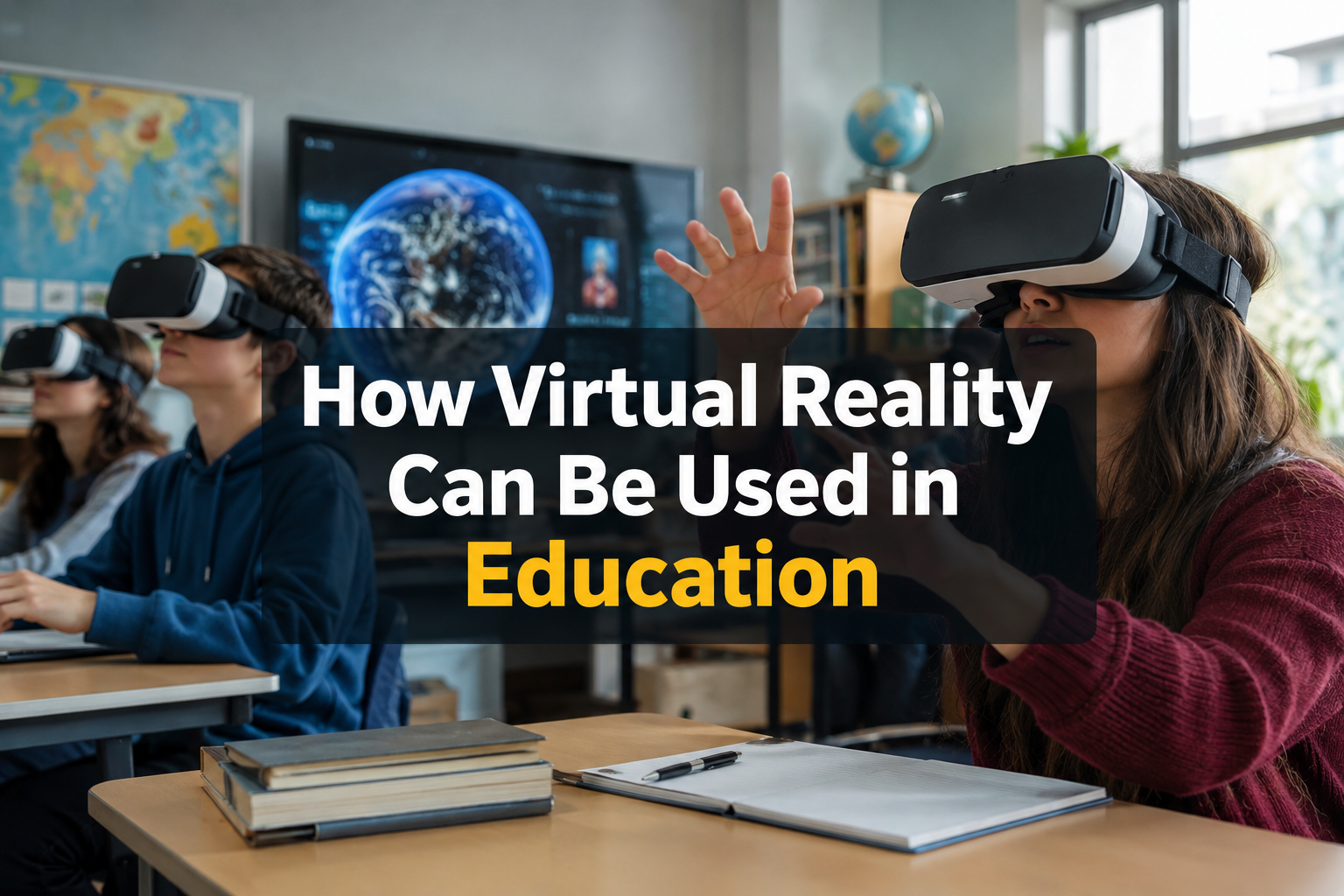
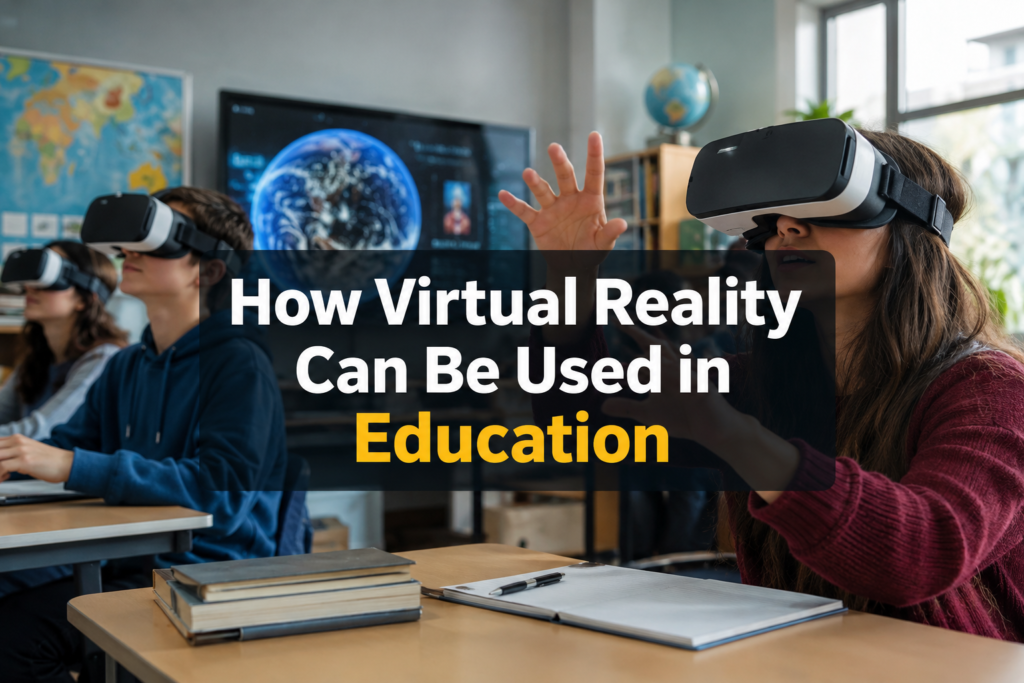
A student usually experiences virtual reality through a headset. The headset displays a digital scene around the user. Some systems also use hand controllers or motion sensors so that students can interact with objects inside the virtual environment.
In education, virtual reality is used to create learning experiences that may be difficult to provide inside a normal classroom.
For example, a geography teacher may use virtual reality to let students explore mountains, deserts, forests, or oceans. A science teacher may allow students to enter a digital laboratory where they can perform experiments. Medical students may use virtual simulations to study the structure of the human body.
The main idea is simple. Virtual reality allows students to experience a subject instead of only reading or hearing about it.
Why Virtual Reality Is Becoming Important in Education
Students learn in different ways. Some understand concepts easily through reading, while others learn better through images, demonstrations, and practical experiences.
Virtual reality supports visual and experiential learning.
A difficult concept can sometimes become easier when students can see it in three dimensions. For example, understanding the movement of planets from a textbook diagram may be difficult for some learners. A virtual simulation can allow students to observe the solar system from different angles.
This type of experience can make abstract ideas feel more concrete.
Virtual reality is also becoming more relevant because digital technology is now part of everyday life. Students already use smartphones, computers, educational apps, videos, and online learning platforms. Virtual reality is another stage in the development of digital education.
However, its real value depends on how carefully it is connected with educational goals.
Virtual Reality Can Make Learning More Engaging
One of the strongest benefits of virtual reality in education is student engagement.
Traditional lessons sometimes require students to sit quietly while listening to explanations. This approach is useful in many situations, but long periods of passive learning can reduce attention.
Virtual reality introduces a more active experience.
Imagine a student learning about ancient civilizations. Instead of only reading about ancient buildings, the student may enter a virtual recreation of an ancient city. The learner can look around, observe architecture, and explore different areas.
This experience can create curiosity.
When students become curious, they are often more willing to ask questions and explore a topic further.
Engagement does not mean that learning should only be entertaining. The purpose of virtual reality should always remain educational. A well designed virtual lesson should support the subject being taught.
Learning History Through Virtual Experiences
History is one subject where virtual reality can be especially useful.
Historical events happened in places and environments that students may find difficult to imagine. Books provide important information, but virtual environments can help students visualize the setting.
For example, students may virtually visit an ancient city, historical monument, museum, or archaeological site.
A virtual tour can show the size of buildings, the arrangement of streets, and the relationship between different locations.
This can give students a stronger understanding of historical context.
Teachers can then use the virtual experience as a starting point for deeper discussion.
Students might be asked to describe what they observed, compare the virtual reconstruction with historical sources, or explain how people may have lived during that period.
In this way, virtual reality becomes part of a wider learning activity rather than a separate form of entertainment.
Using Virtual Reality in Science Education
Science education often involves processes that are difficult to observe directly.
Some processes happen inside the human body. Others occur at microscopic or extremely large scales.
Virtual reality can make these processes easier to explore.
Students studying biology may enter a virtual model of the human body. They can observe organs, bones, muscles, and body systems in three dimensions.
In chemistry, students may explore molecular structures or perform simulated experiments.
Physics students can observe forces, motion, electricity, or energy through interactive simulations.
Astronomy is another area where virtual reality can be useful. Students can explore planets, stars, and galaxies without leaving the classroom.
These experiences can help learners connect scientific theory with visual understanding.
Virtual Laboratories for Students
Laboratory learning is an important part of science education, but physical laboratories can have limitations.
Equipment may be expensive. Certain experiments may require special safety conditions. Some materials may not be available in every school.
Virtual laboratories can provide an additional option.
Inside a virtual lab, students may practice procedures, use simulated equipment, and observe the results of experiments.
They can also repeat an experiment several times without wasting physical materials.
Virtual laboratories should not completely replace real practical work because students still need experience with actual equipment. However, they can be useful for preparation.
A student may practice the steps of an experiment virtually before performing it in a real laboratory.
This can improve confidence and understanding.
Virtual Reality in Medical Education
Medical education requires students to understand complex structures and procedures.
Traditionally, medical students learn through textbooks, diagrams, models, lectures, and supervised practice.
Virtual reality can add another layer to this learning process.
Students can explore three dimensional models of the human body and examine organs from different angles.
They may also practice certain procedures inside realistic simulations.
The advantage of simulation is that students can make mistakes in a controlled environment.
A mistake inside a simulation does not place a real patient at risk.
Students can repeat the activity until they understand the correct process.
This makes virtual reality useful for practice and preparation before working in real clinical situations.
Virtual Reality in Engineering and Technical Education
Engineering and technical subjects often require students to understand machines, structures, systems, and physical processes.
Virtual reality can help students examine these systems in a visual environment.
For example, an engineering student may explore the internal parts of a machine without physically opening it.
Students can also study construction systems, industrial equipment, electrical systems, or mechanical processes.
Technical training can sometimes involve dangerous environments.
A virtual simulation can allow students to practice safety procedures before entering a real workplace.
This is particularly useful in industries where mistakes can be expensive or dangerous.
Virtual learning cannot replace real workplace experience, but it can prepare students for that experience.
Virtual Field Trips
Field trips can make education more memorable because students learn outside the normal classroom.
However, real field trips are not always possible.
Travel costs, distance, safety concerns, time limits, and accessibility can prevent schools from visiting certain places.
Virtual reality can provide an alternative through virtual field trips.
Students may visit museums, natural environments, historical locations, or scientific facilities digitally.
A classroom in one country may explore a museum located on another continent.
Students may also explore places that would normally be impossible to visit, such as the surface of Mars or the bottom of the ocean.
Virtual field trips do not fully replace physical travel, but they can increase access to learning experiences.
Supporting Geography Education
Geography is closely connected with locations, landscapes, environments, and human settlements.
Virtual reality can help students explore these topics more clearly.
Instead of only looking at a photograph of a mountain range, students may experience a three dimensional virtual environment.
They can observe valleys, rivers, deserts, forests, and coastlines.
Urban geography can also be explored through virtual models of cities.
Students can compare different environments and study how people interact with geographical conditions.
A teacher may ask students to observe the landscape and then identify important geographical features.
This makes the learning process more active.
Language Learning Through Virtual Environments
Learning a language requires more than memorizing vocabulary.
Students need opportunities to understand how language is used in real situations.
Virtual reality can create simulated environments where learners practice conversations.
For example, students learning English may enter a virtual shop, restaurant, airport, classroom, or hotel.
They can practice words and phrases connected with the situation.
This gives vocabulary a practical context.
Speaking in a simulated environment may also feel less stressful for some students compared with speaking in front of an entire classroom.
The technology can therefore support language practice when combined with teacher guidance and real conversation.
Improving Student Memory
Students often remember information better when it is connected with a meaningful experience.
Reading information is important, but an interactive experience may create additional visual and spatial memories.
For example, a student who explores a virtual model of the heart may remember its structure more clearly than a student who only looks at a flat diagram.
The experience gives the learner more ways to connect with the information.
However, virtual reality alone does not guarantee good memory.
Students still need to review information, answer questions, take notes, practice recall, and connect new knowledge with existing knowledge.
Virtual reality works best when it becomes part of a complete learning process.
Supporting Different Learning Styles
Every classroom includes students with different strengths.
Some students enjoy reading and writing. Others respond strongly to visual information or practical activities.
Virtual reality provides another way to present information.
Students who find a difficult idea confusing in a textbook may understand it more clearly through an interactive model.
For example, a student learning about the structure of a building may find a two dimensional drawing difficult to understand. A virtual three dimensional model can make the relationship between spaces easier to see.
Teachers can therefore use virtual reality as one of several teaching methods.
Giving students multiple ways to explore a topic can make learning more inclusive.
Building Practical Skills
Some skills require repeated practice.
Virtual reality can create environments where learners practice without the same level of risk or expense as real training.
For example, students may practice operating equipment, following safety instructions, completing technical procedures, or responding to emergencies.
The simulation can be repeated many times.
Students may receive feedback after each attempt.
This allows them to identify mistakes and improve their performance.
The goal is not simply to experience the virtual environment. The goal is to develop knowledge and skills that can later be applied in real situations.
Virtual Reality for Special Education
Virtual reality may also provide useful learning opportunities for some students with additional educational needs.
A carefully designed virtual environment can reduce distractions and present information in a clear way.
Students may practice social situations, daily routines, or specific skills inside a controlled setting.
Teachers can adjust the experience according to the needs of the learner.
However, virtual reality should always be introduced carefully.
Not every student will feel comfortable wearing a headset. Some learners may experience sensory discomfort or difficulty using the technology.
Teachers should therefore consider individual needs before using virtual reality in special education.
Encouraging Active Learning
Active learning means students participate in the learning process instead of only receiving information.
Virtual reality naturally supports many forms of active learning.
Students can explore, observe, make decisions, solve problems, and interact with digital objects.
For example, students learning environmental science may enter a virtual ecosystem and observe how different changes affect plants and animals.
They may be asked to solve a problem related to pollution or resource management.
This changes the student from a passive observer into an active participant.
Active participation can help students think more deeply about the subject.
Developing Problem Solving Skills
Virtual reality simulations can present students with realistic challenges.
Students may need to examine a situation, collect information, make decisions, and observe the results.
This can support problem solving skills.
For example, engineering students may be asked to identify a technical problem inside a virtual machine.
Medical students may need to respond to a simulated patient situation.
Business students may practice making decisions inside a simulated workplace.
These activities can help students understand that real problems often require more than memorized facts.
They require reasoning, observation, communication, and decision making.
Increasing Access to Difficult Experiences
Some educational experiences are too expensive, dangerous, distant, or rare to provide regularly.
Virtual reality can make some of these experiences more accessible.
A school may not be able to send students to another country, but it may be able to provide a virtual tour.
A science class may not have access to advanced laboratory equipment, but students may practice certain procedures through simulation.
A student may not be able to visit a famous historical site, but a virtual recreation can provide a useful visual experience.
This does not make the virtual experience identical to the real world.
However, it can give students access to learning opportunities that would otherwise be difficult to provide.
Teachers Still Have an Important Role
Technology cannot automatically create good learning.
A virtual reality lesson needs clear educational planning.
Teachers must decide why the technology is being used.
They also need to connect the experience with learning objectives.
Before a virtual activity, the teacher may explain what students should observe.
During the activity, students may complete questions or tasks.
Afterward, the teacher can lead a discussion, review key ideas, or assign a written reflection.
This structure helps turn an interesting experience into meaningful learning.
The teacher remains responsible for guiding students, correcting misunderstandings, and connecting the virtual experience with the curriculum.
Challenges of Using Virtual Reality in Education
Virtual reality offers many possibilities, but schools also need to consider its limitations.
One challenge is cost.
High quality headsets, computers, software, and technical support can require investment.
Another challenge is classroom management.
Teachers need enough space, equipment, and time to organize virtual activities.
Technical problems can also interrupt lessons.
Health and comfort are important as well.
Some users may experience dizziness, eye strain, or discomfort after using virtual reality for long periods.
Because of this, virtual sessions should usually be limited and carefully supervised.
Schools must also consider privacy and data protection when using digital platforms.
These challenges do not mean virtual reality should be avoided. They simply show why thoughtful planning is necessary.
The Importance of High Quality Educational Content
Virtual reality is only useful if the educational content is accurate and well designed.
An impressive virtual environment may attract attention, but visual quality alone does not create learning.
Educational content should be connected with the curriculum.
Instructions should be clear.
Information should be accurate.
Activities should encourage students to think rather than simply look around.
Teachers should also review virtual content before using it in class.
A good virtual reality lesson should answer an important question.
What will students understand or be able to do after completing this activity?
If that question has a clear answer, the technology is more likely to support meaningful learning.
Virtual Reality and Collaborative Learning
Virtual reality does not always have to be an individual experience.
Some platforms allow several students to enter the same virtual environment.
Students may work together to solve problems, complete projects, or explore digital spaces.
This can support communication and teamwork.
For example, a group of students may enter a virtual building and discuss its design.
Another group may work together inside a simulated scientific environment.
Collaborative virtual learning can be especially useful when students are studying from different locations.
However, teachers should make sure that every student has a meaningful role in the activity.
Virtual Reality and Online Education
Online education has become an important part of modern learning.
Most online courses use videos, reading material, quizzes, discussion boards, and live classes.
Virtual reality may add a more immersive element to online learning.
Students studying remotely may participate in virtual classrooms, laboratories, or training environments.
They may interact with digital objects or explore simulations from home.
This could make some online courses more practical.
However, access remains an important issue.
Not every learner owns a virtual reality headset or a computer powerful enough to run advanced software.
Educational institutions need to consider these differences when designing virtual learning programs.
How Schools Can Introduce Virtual Reality
Schools do not need to transform every classroom immediately.
A gradual approach may be more practical.
Teachers can begin with a small number of carefully selected virtual activities.
For example, a school might first use virtual reality for one science lesson or one history project.
Teachers can then observe how students respond.
They can evaluate whether the activity improved understanding.
Feedback from students can also help schools decide how to improve future lessons.
The focus should remain on educational value rather than simply using technology because it is new.
The Future of Virtual Reality in Education
Virtual reality technology is likely to become more advanced over time.
Headsets may become lighter, more comfortable, and more affordable.
Educational software may also become easier for teachers to use.
In the future, students may regularly explore virtual laboratories, historical environments, scientific simulations, and training spaces.
Artificial intelligence may also become connected with virtual reality.
Students could interact with intelligent virtual tutors or receive personalized guidance during simulations.
Schools may create virtual classrooms where students from different countries can learn together.
Even with these developments, traditional education will remain important.
Students still need teachers, books, writing, discussion, real experiments, and human interaction.
The strongest educational system is likely to combine traditional methods with useful digital tools.
Conclusion
Virtual reality can be used in education to make learning more visual, interactive, and practical. It can support subjects such as history, science, geography, medicine, engineering, languages, and technical education.
Students can explore virtual environments, visit distant places, study three dimensional models, practice skills, and participate in realistic simulations.
These experiences may improve engagement and help students understand difficult concepts.
However, virtual reality should not be treated as a replacement for teachers or traditional learning methods.
Its value depends on how it is used.
Teachers need to connect virtual activities with clear learning goals, guide students through the experience, and provide opportunities for reflection and discussion.
Cost, accessibility, health, privacy, and content quality must also be considered.
When virtual reality is used thoughtfully, it can become a powerful addition to modern education. It allows students to move beyond simply reading about the world and gives them new ways to explore, observe, practice, and understand it.