
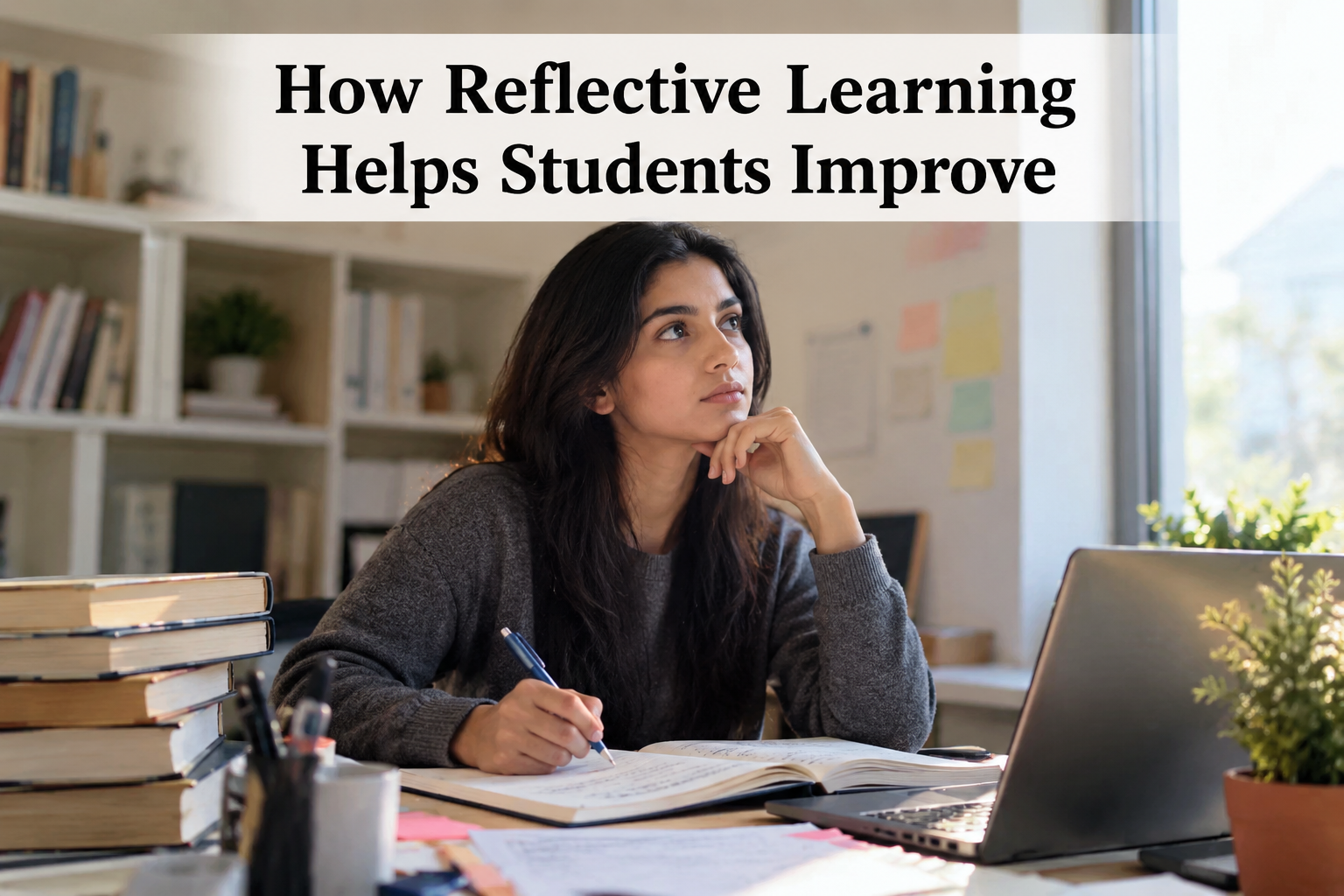
Students often spend a lot of time studying, attending classes, completing assignments, and preparing for exams. However, simply spending more time on learning does not always guarantee better results. Sometimes students need to stop for a moment and think about what they have learned, what they understood well, where they struggled, and what they should do differently next time.
This process is known as reflective learning.
Reflective learning is a simple but powerful learning method that encourages students to think about their own learning experiences. Instead of moving quickly from one lesson to another, students review their progress and try to understand how they are learning.
In my view, reflective learning is useful because it turns ordinary study experiences into lessons for future improvement. A student may make a mistake in an exam, struggle with a difficult chapter, or perform well in a presentation. Reflection helps the student understand why that result happened.
When students regularly reflect on their learning, they can become more independent, organized, confident, and aware of their strengths and weaknesses.
What Is Reflective Learning?
Reflective learning means thinking carefully about a learning experience and using that experience to improve future performance.
It is not simply remembering what happened.
A student using reflective learning usually asks questions such as:
What did I learn?
What was easy for me?
What was difficult?
Why did I make certain mistakes?
Which study method worked well?
What could I improve next time?
These questions help students look beyond grades and focus on the actual learning process.
For example, imagine a student receives a low score on a mathematics test. Without reflection, the student may simply feel disappointed and move on.
With reflective learning, the student may review the test and notice that most mistakes happened in word problems. The student may then realize that formulas were understood, but applying them to real situations was difficult.
This reflection gives the student a clear direction for future practice.
Why Reflective Learning Is Important
Students often repeat the same study habits because those habits feel familiar. Unfortunately, familiar habits are not always effective habits.
Some students read their notes again and again without checking whether they can actually remember the information. Others spend hours studying but become distracted frequently. Some focus heavily on topics they already understand while avoiding difficult areas.
Reflective learning helps students notice these patterns.
Once students understand how they are studying, they can make better decisions about how to use their time and effort.
Reflection also encourages active participation in learning. Instead of depending completely on teachers, students begin to take responsibility for their own progress.
This can make learning more meaningful.
Reflective Learning Helps Students Understand Their Strengths
Every student has areas where learning feels easier.
One student may understand visual information quickly. Another may remember information better after explaining it aloud. Some students are strong in writing, while others perform better in practical activities.
Reflection helps students recognize these strengths.
For example, a student may notice that diagrams make science topics easier to remember. After recognizing this pattern, the student can include more diagrams and mind maps in future study sessions.
Understanding strengths can also increase confidence.
Students often focus too much on their weaknesses. Reflective learning reminds them that they also have successful strategies and abilities that can be used more effectively.
It Helps Students Identify Weaknesses
Improvement becomes difficult when students do not understand where the real problem exists.
A student may believe that a subject is simply difficult. However, after reflection, the student may discover that the main problem is actually poor note taking, weak time management, missing basic concepts, or insufficient practice.
This difference is important.
A general problem such as “I am bad at chemistry” is difficult to solve.
A specific problem such as “I do not understand how chemical equations are balanced” is much easier to address.
Reflective learning helps students turn unclear problems into specific learning needs.
Once a weakness becomes clear, students can work on it directly.
Reflective Learning Can Improve Study Habits
One of the biggest benefits of reflective learning is that it helps students evaluate their study methods.
Students can ask themselves whether their current study habits are actually producing results.
For example, a student may spend three hours reading a textbook before an exam. After the exam, the student may realize that very little information could be recalled.
Reflection may show that passive reading was not enough.
The student may decide to use practice questions, flashcards, retrieval practice, or self testing during the next study session.
Over time, this process helps students build better study habits.
The goal is not to study longer.
The goal is to study more effectively.
Reflection Encourages Independent Learning
Independent learning is an important skill for students at every level of education.
Teachers can explain ideas, provide resources, and give feedback, but students still have to take responsibility for their own learning.
Reflective learning supports this responsibility.
Students begin to ask themselves what they need rather than waiting for someone else to tell them.
For example, a student preparing for an exam may reflect on previous test results and decide to spend extra time on weak topics.
Another student may notice that studying late at night reduces concentration and choose an earlier study time.
These decisions show growing independence.
Students who understand their own learning process are often better prepared to manage new academic challenges.
It Helps Students Learn From Mistakes
Mistakes are a normal part of learning.
The problem is not making a mistake.
The problem is making the same mistake repeatedly without understanding why it happens.
Reflective learning helps students treat mistakes as useful information.
Suppose a student writes an essay and receives feedback that the main argument is unclear.
Instead of focusing only on the grade, the student can review the essay and think about how the argument was presented.
The student may realize that the introduction did not clearly explain the main idea.
During the next assignment, the student can focus more carefully on developing a strong introduction and clear thesis.
In this way, a mistake becomes a learning opportunity.
Reflective Learning Improves Decision Making
Students make many learning decisions every day.
They decide what to study first, how long to study, which resources to use, when to ask for help, and how to prepare for assessments.
Reflection can improve these decisions.
Past experiences provide useful information.
If a student knows that studying one night before an exam caused stress and poor performance, reflection may encourage earlier preparation next time.
If group study helped with a difficult topic, the student may choose that method again when facing similar material.
Reflection allows students to use previous experiences to make better future choices.
It Can Improve Time Management
Poor time management is one of the most common challenges students face.
Students may underestimate how long assignments will take or spend too much time on low priority tasks.
Reflective learning can help students understand how they are using their time.
At the end of a study session, a student can ask:
Did I finish what I planned?
Which task took longer than expected?
Was I distracted?
Did I spend too much time on one topic?
Was my study schedule realistic?
These simple questions can reveal useful patterns.
A student may discover that checking a phone regularly reduces productivity. Another may realize that difficult subjects require more time than originally planned.
These observations help students create better schedules.
Reflection Can Increase Motivation
Motivation is not always easy to maintain.
Long courses, difficult subjects, and disappointing grades can make students feel that they are not making progress.
Reflection helps students see improvement that may otherwise go unnoticed.
For example, a student may still find public speaking difficult but realize that speaking in front of the class now feels easier than it did several months earlier.
Another student may notice that reading speed has improved or that fewer mistakes are being made in mathematics.
Recognizing progress can increase motivation.
Students are more likely to continue working when they can see evidence that their effort is producing improvement.
Reflective Learning Builds Self Awareness
Self awareness means understanding your own thoughts, habits, strengths, weaknesses, and reactions.
In education, this can be extremely useful.
A student who understands personal learning habits can make better choices.
For example, one student may recognize that concentration is strongest in the morning. Another may notice that anxiety increases when preparation begins too late.
A student may also discover that understanding improves when information is explained to another person.
These observations help students create learning routines that suit their individual needs.
There is no single study method that works perfectly for everyone.
Reflective learning helps students discover what works best for them.
Reflection Helps Students Use Feedback Better
Teachers often provide feedback on assignments, tests, projects, and presentations.
However, feedback is only useful when students actually think about it and apply it.
Some students look only at their grade.
Reflective learners look more closely.
They read comments, compare them with their work, and think about what should change next time.
For example, if a teacher says that an essay needs stronger evidence, the student can reflect on how sources were used.
The student may decide to spend more time researching evidence before writing the next assignment.
This makes teacher feedback more useful because it becomes part of the learning process.
How Students Can Practice Reflective Learning
Reflective learning does not require complicated tools.
Students can begin with a few simple habits.
After a study session, spend a few minutes thinking about what was learned.
Ask what worked well and what felt difficult.
After receiving a test result, review mistakes instead of looking only at the final score.
After completing an assignment, think about which part took the most time.
After a presentation, consider what went well and what could be improved.
These small reflections can create valuable learning information.
Keep a Learning Journal
A learning journal is one of the easiest ways to practice reflective learning.
Students can write short notes about their study experiences.
The journal does not need to be long.
A simple entry may include:
Today I studied photosynthesis.
I understood the basic process well.
I struggled to remember the role of chlorophyll.
Drawing the process helped me understand it.
Tomorrow I will review the diagram and test myself without looking at the textbook.
This short reflection gives the student a clear plan.
Over several weeks, a journal can also reveal patterns in learning behavior.
Students may notice which study techniques work best or which problems appear repeatedly.
Ask Reflective Questions
Good questions make reflection more useful.
Students can ask themselves questions before, during, and after learning.
Before studying:
What do I already know about this topic?
What do I want to understand?
Which part may be difficult?
During studying:
Do I understand what I am reading?
Can I explain this idea in my own words?
Should I change my study method?
After studying:
What did I learn?
What can I remember without looking at my notes?
What confused me?
What should I review later?
These questions encourage deeper thinking.
Use Exam Results as Learning Information
Students often see exams only as judgments of success or failure.
A reflective approach looks at exams differently.
Exam results can provide useful information about learning.
Students can review which topics were answered correctly, which questions caused difficulty, and what kind of mistakes were made.
Were the mistakes caused by lack of knowledge?
Did the student misunderstand the question?
Was there not enough time?
Was the information forgotten?
Did careless errors occur?
Different problems require different solutions.
Understanding the reason behind an incorrect answer can help prevent similar mistakes in the future.
Reflect After Group Work
Reflective learning is also useful during group projects.
After completing a group task, students can think about their contribution.
Did they communicate clearly?
Did they complete tasks on time?
Did they listen to other group members?
Was responsibility shared fairly?
What could make the next project better?
These reflections help students develop teamwork skills in addition to academic skills.
Reflection Can Support Long Term Learning
Education is not only about passing the next exam.
Students also need skills that continue to help them later in life.
Reflective learning supports long term development because it teaches students how to learn from experience.
This skill can be useful in university, professional training, careers, and personal development.
A person who regularly reflects can identify mistakes, adapt to new situations, and improve continuously.
Learning therefore becomes an ongoing process rather than something limited to the classroom.
Avoid Overthinking During Reflection
Reflection is useful, but it should remain practical.
Students do not need to analyze every small detail of every study session.
Too much reflection can become overthinking.
The purpose is to identify useful lessons.
A few focused questions are often enough.
What worked?
What did not work?
Why?
What will I do differently next time?
These questions keep reflection simple and productive.
Combine Reflection With Action
Reflection becomes valuable when it leads to change.
A student may realize that studying with a phone nearby causes distraction. That understanding is useful, but improvement happens only when the student changes the study environment.
A student may notice weakness in a particular topic. Progress happens when additional practice is completed.
This means reflection and action should work together.
Think about the experience.
Identify a lesson.
Make a change.
Observe the result.
Reflect again.
This cycle can gradually improve learning performance.
How Teachers Can Encourage Reflective Learning
Teachers can also help students develop reflective habits.
They can ask students to write short reflections after assignments or tests.
They can encourage students to explain which learning strategies they used.
Teachers may also ask questions such as:
What part of this task was most challenging?
What strategy helped you solve the problem?
What would you do differently next time?
These questions shift attention from grades toward the learning process.
Students begin to understand that improvement is not only about getting the correct answer. It is also about understanding how they reached that answer.
Common Challenges With Reflective Learning
Some students find reflection difficult at first.
They may not know what questions to ask.
Others may give very general answers such as “I need to study harder.”
This type of reflection is not very useful because it does not explain what needs to change.
Specific reflection is better.
Instead of saying:
I need to improve mathematics.
A student could say:
I understand formulas, but I struggle to choose the correct formula in word problems. I will practice five word problems after each lesson.
The second reflection gives a clear action.
Another challenge is consistency.
Reflection works best when it becomes a regular habit.
Even five minutes after an important study session can be enough.
Reflective Learning and Academic Improvement
Reflective learning does not guarantee perfect grades, but it can help students improve the way they approach learning.
Academic performance depends on many factors, including previous knowledge, teaching quality, practice, motivation, health, available resources, and study habits.
Reflection helps students understand some of these factors and make better choices where possible.
A student who regularly evaluates learning methods is more likely to notice ineffective habits.
This awareness can lead to better preparation, stronger understanding, and more efficient studying.
Final Thoughts
Reflective learning helps students improve because it teaches them to learn from their own experiences.
Instead of studying automatically, students begin to think about what they understand, where they struggle, which methods work, and what should change.
This process can improve study habits, time management, self awareness, motivation, problem solving, and independent learning.
One of the best things about reflective learning is its simplicity.
Students do not need special equipment or complicated techniques.
They only need to pause, think carefully, ask useful questions, and turn their observations into action.
A short reflection after a lesson, assignment, test, or study session can provide valuable information for future learning.
Over time, these small improvements can become significant.
The purpose of reflection is not to criticize every mistake. It is to understand the learning process more clearly.
When students know how they learn, they are in a better position to improve.
That is why reflective learning can be a valuable habit for students who want to become more effective, confident, and independent learners.
