
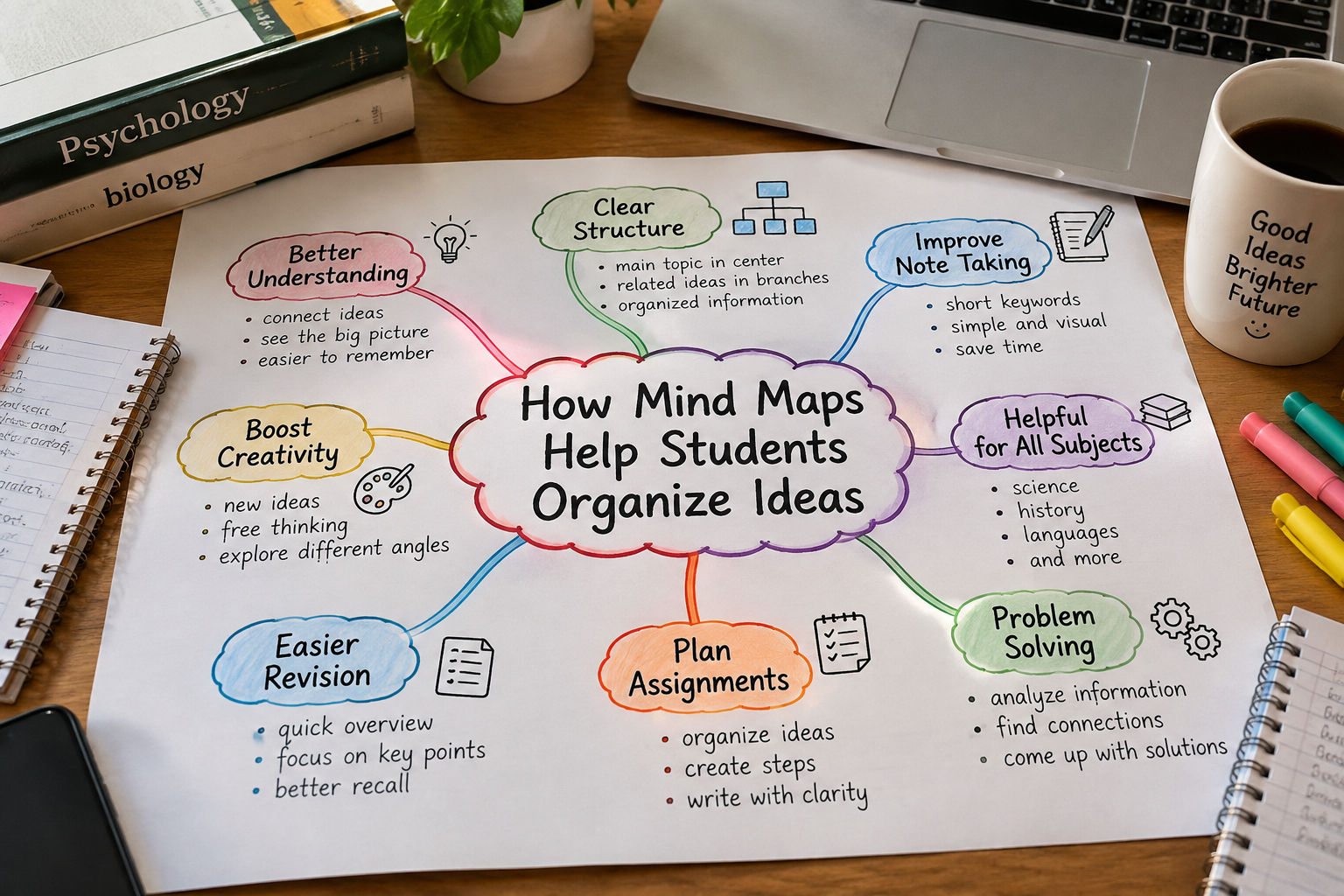
Students often have many ideas in their minds at the same time. During a lesson, while reading a book, or when preparing for an exam, information can quickly become difficult to manage. Some ideas are connected, some are more important than others, and some need further explanation.
This is where mind maps can become useful.
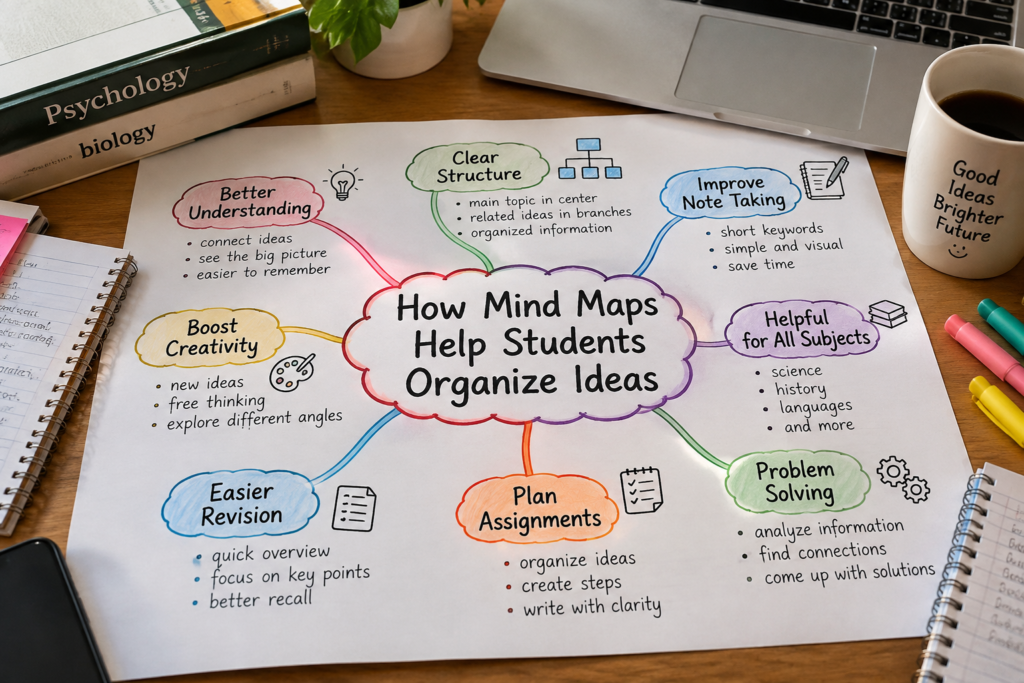
A mind map is a visual way of organizing information around one main topic. Instead of writing everything in long paragraphs, students place the main idea in the center and connect related ideas around it. These connections make information easier to understand, review, and remember.
I have found that mind maps are especially helpful when a topic feels too large or confusing. When information is placed on a page in a clear visual structure, it becomes easier to see how different ideas are related.
Mind maps are not only useful for studying. Students can also use them for planning assignments, preparing presentations, solving problems, revising lessons, and organizing ideas before writing.
In this article, I will explain how mind maps help students organize ideas and why this simple study method can make learning more manageable.
What Is a Mind Map?
A mind map is a visual diagram that begins with one central topic.
The main subject is placed in the middle of the page. From this central topic, several branches extend outward. Each branch represents an important idea related to the main subject.
Smaller branches can then be added to explain details, examples, facts, questions, or supporting information.
For example, imagine a student is studying the topic of plants.
The word “Plants” could be written in the center of the page.
From this central topic, the student might create branches for:
Photosynthesis
Plant structure
Reproduction
Water and nutrients
Types of plants
Each of these branches could then contain more detailed information.
Under “Plant structure,” for example, the student could add roots, stems, leaves, and flowers.
In this way, a large topic becomes divided into smaller and more understandable sections.
Why Students Sometimes Struggle to Organize Ideas
Learning is not only about collecting information. Students also need to understand how information fits together.
This can be difficult when notes are written as long blocks of text.
A student may read several pages of information and understand each sentence, but still struggle to see the overall structure of the topic.
This often happens because traditional notes usually move from one point to another in a straight line.
Mind maps work differently.
They show the relationship between ideas on one page.
This visual structure can help students identify the main topic, important categories, supporting ideas, and smaller details.
Instead of seeing information as a long list, students can see it as a connected system.
Mind Maps Make Large Topics Easier to Understand
One of the biggest advantages of mind maps is that they can simplify large subjects.
When students first begin studying a difficult topic, the amount of information can feel overwhelming.
For example, a history chapter may include people, dates, causes, events, and consequences.
Writing all of this information in paragraphs may make the chapter feel even more complicated.
A mind map allows the student to divide the chapter into clear categories.
A history mind map could include branches such as:
Background
Important people
Major events
Causes
Results
Long term effects
Once information is divided into sections, the topic becomes easier to manage.
Students can focus on one branch at a time instead of trying to remember everything at once.
Mind Maps Show Connections Between Ideas
Learning becomes stronger when students understand relationships between ideas.
Many subjects are built around connections.
In science, one process may cause another.
In history, one event may lead to several consequences.
In literature, a character’s actions may influence the direction of a story.
In geography, climate may affect agriculture, population, and settlement.
Mind maps make these relationships easier to see.
When related ideas are connected with branches, students can understand how one piece of information connects to another.
This is important because meaningful learning usually happens when new information is connected to existing knowledge.
A student who understands these relationships may find it easier to explain a topic in their own words.
Mind Maps Help Students Identify Main Ideas
Students sometimes spend too much time focusing on small details.
This can make studying inefficient.
Mind mapping encourages students to first identify the most important ideas.
Before creating branches, the student has to decide what the main topic is.
Then the student needs to choose the major categories that belong to that topic.
This process naturally encourages prioritization.
For example, if a student is studying the human digestive system, the main branches might include:
Mouth
Esophagus
Stomach
Small intestine
Large intestine
Supporting details can then be placed under each branch.
This structure helps students separate major concepts from smaller supporting information.
Mind Maps Can Improve Note Taking
Traditional note taking often involves copying large amounts of information from a textbook or lecture.
The problem is that copying does not always require much thinking.
A student may write several pages without fully understanding the material.
Creating a mind map requires more active decision making.
The student must decide:
What is the main idea?
Which points are important?
Which ideas are related?
Where should each piece of information go?
This makes note taking more active.
Instead of copying everything, students summarize ideas and organize them into a meaningful structure.
This can make notes shorter while still keeping the important information.
Mind Maps Encourage Active Learning
Active learning happens when students interact with information instead of simply reading or listening.
Mind mapping encourages this type of learning.
Students must process information before adding it to the map.
They may need to compare ideas, summarize concepts, create categories, and decide how different points are connected.
These mental activities require more engagement than simply rereading a page.
For example, after reading a chapter, a student can close the book and try to create a mind map from memory.
This exercise forces the student to retrieve information and organize it.
Afterward, the student can check the textbook and add anything that was missed.
This can turn mind mapping into a useful revision activity.
Mind Maps Can Make Revision Faster
Exam revision often becomes difficult when students have many pages of notes.
Reading all of those pages repeatedly can take a lot of time.
A well designed mind map can summarize an entire topic on one page.
This makes quick revision easier.
Before an exam, students can look at the main branches and remind themselves of the structure of the topic.
They can then focus on the areas that need more attention.
A mind map does not always replace detailed notes or textbooks.
Instead, it works well as a summary.
The map gives students an overview, while other materials provide deeper explanation when needed.
Mind Maps May Support Memory
Visual organization can make information easier to recall for some students.
When ideas are arranged around a central topic, the structure itself may become part of the memory.
Students may remember where a particular branch was located or which ideas were grouped together.
Using simple colors, symbols, or small drawings can also make important ideas easier to recognize.
For example, a student might use one color for causes and another for effects.
The purpose is not to make the page decorative.
The purpose is to make the structure of the information clear.
Too many colors or pictures can sometimes create distraction, so simplicity is usually better.
Mind Maps Help With Writing Assignments
Mind maps are not only study tools.
They can also help students plan essays and assignments.
Before writing an essay, students often have many ideas but may not know how to organize them.
A mind map can help arrange those ideas before writing begins.
For example, if the essay topic is about the benefits of exercise, the student might create branches for:
Physical health
Mental wellbeing
Energy
Sleep
Social benefits
Daily routine
Each branch could contain examples or supporting points.
After creating the map, the student can turn each main branch into a paragraph or section.
This makes the writing process more organized.
It can also reduce the chance of forgetting important ideas.
Mind Maps Are Useful for Brainstorming
Brainstorming is the process of generating ideas before choosing the best ones.
Mind maps are well suited for brainstorming because they allow ideas to grow in different directions.
A student can begin with one topic and quickly add anything that comes to mind.
There is no need to organize everything perfectly at the beginning.
Once several ideas have been added, the student can review them and group similar points together.
This makes mind mapping useful for:
Essay planning
Project ideas
Presentation topics
Research questions
Creative writing
Group discussions
Problem solving
Mind maps provide space for ideas to develop naturally.
Mind Maps Can Help Students Prepare Presentations
Preparing a presentation requires students to organize information in a logical order.
A mind map can help students decide what should be included.
The central topic can represent the presentation title.
The main branches can represent the major sections.
Smaller branches can contain examples, facts, explanations, or images that may be used.
This allows students to see the entire presentation before creating slides.
It can also help prevent unnecessary information from being added.
A clear mind map can make the final presentation more focused and easier for the audience to follow.
Mind Maps Can Support Problem Solving
Some problems have several possible causes or solutions.
Mind maps can help students examine these possibilities.
For example, if a student is working on an environmental project about water pollution, the central topic could be “Water Pollution.”
The branches might include:
Causes
Effects
Sources
Solutions
Government action
Community action
Each branch could then include more specific points.
This helps students look at the problem from different angles.
Mind mapping can therefore be useful when a topic requires analysis rather than simple memorization.
Mind Maps Can Be Used in Many Subjects
One useful feature of mind maps is that they can be used across different subjects.
Science
Students can organize processes, systems, definitions, and examples.
For example, a biology mind map could explain the human circulatory system.
History
Students can organize timelines, causes, events, people, and consequences.
Geography
Mind maps can show relationships between climate, population, landforms, and resources.
Languages
Students can organize vocabulary, grammar rules, themes, and writing ideas.
Literature
Students can create branches for characters, themes, settings, conflicts, and important events.
Mathematics
Although mathematics often requires calculations, mind maps can still help organize formulas, rules, methods, and examples.
The technique can be adjusted according to the subject.
How to Create a Simple Mind Map
Students do not need special tools to create a mind map.
A blank sheet of paper and a pen are enough.
Start by writing the main topic in the center.
Draw a circle around it if that makes the topic easier to identify.
Next, think about the most important categories related to the topic.
Draw lines from the center and write one category on each branch.
Then add smaller branches for supporting ideas.
Use short words or phrases instead of long sentences.
Continue adding information until the main structure of the topic is clear.
The final mind map should be easy to read at a glance.
Keep Mind Maps Simple
A common mistake is trying to put too much information into one map.
When every detail is added, the mind map can become crowded.
The main purpose is organization.
Students should focus on keywords, important concepts, and relationships.
If a branch becomes too detailed, it may be better to create a separate mind map for that section.
For example, a student studying biology might create one large map for “Human Body Systems.”
Then separate mind maps could be created for the digestive system, nervous system, and respiratory system.
This keeps information manageable.
Use Keywords Instead of Long Sentences
Mind maps work best when they are easy to scan.
Long sentences can make the page difficult to read.
Using keywords encourages students to summarize ideas.
For example, instead of writing:
“Plants use sunlight to produce food through a process called photosynthesis.”
A student could write:
Photosynthesis
Sunlight
Food production
Leaves
Chlorophyll
The student can then explain the complete idea when reviewing the map.
Keywords help keep the mind map clear.
Use Colors Carefully
Colors can help separate different categories.
For example, each main branch could use a different color.
This may help students recognize sections quickly.
However, too many colors can make a mind map confusing.
The purpose of color should always be organization, not decoration.
A simple system is usually enough.
Students might use one color for main ideas, another for examples, and another for important terms.
Add Small Symbols When Helpful
Simple symbols or drawings can make certain ideas easier to identify.
For example, a small light bulb could represent an important idea.
A question mark could show a topic that needs more research.
A clock could represent time.
A book symbol could represent a source or reading.
These visual cues can make the map more meaningful.
However, students do not need artistic skills.
The goal is understanding, not creating perfect artwork.
Paper Mind Maps Versus Digital Mind Maps
Students can create mind maps on paper or with digital tools.
Paper mind maps are simple and flexible.
Students can quickly draw branches, circle ideas, and add notes.
They are useful during lessons or when brainstorming.
Digital mind maps can be useful when a topic becomes large.
Students can move branches, edit text, add links, and reorganize ideas easily.
Both methods can work well.
The better option depends on the student’s preference and the type of task.
Some students may even use both methods.
They might create a quick paper mind map during a lesson and later create a cleaner digital version for revision.
Mind Maps Should Not Replace All Study Methods
Mind maps are useful, but they should not be the only study method students use.
Some subjects require detailed reading.
Others require practice questions, calculations, experiments, or written explanations.
Mind maps work best as part of a wider learning strategy.
For example, a student could:
Read the chapter
Create a mind map
Practice recalling the information
Answer questions
Review difficult areas
This combination can be more effective than relying on one method alone.
How Teachers Can Use Mind Maps
Teachers can also use mind maps to help students understand lessons.
At the beginning of a topic, a teacher can create a simple map showing what will be covered.
During the lesson, new ideas can be added.
At the end of the lesson, students can create their own versions.
Teachers can also use mind maps for class discussions.
Students can suggest ideas while the teacher organizes them on the board.
This allows the class to see how different contributions connect.
Mind Maps Can Help Students Become More Independent
One important benefit of mind mapping is that students make their own decisions about how to organize information.
Instead of depending entirely on a textbook structure, they create their own structure.
This encourages independent thinking.
Two students may create completely different mind maps for the same topic.
That is not necessarily a problem.
Each student may notice different relationships or organize information in a way that makes more sense to them.
This personal organization can make studying feel more manageable.
Common Mistakes When Creating Mind Maps
Mind maps are simple, but some mistakes can reduce their usefulness.
One mistake is adding too much text.
Another is creating too many branches from the center.
Students may also focus too much on decoration.
The most useful mind maps are usually clear and simple.
Another mistake is copying the textbook exactly.
A mind map should represent the student’s understanding of the topic.
The student should try to summarize ideas in their own words.
This makes the activity more meaningful.
When Mind Maps Are Most Useful
Mind maps can be especially useful when students need to understand the structure of a topic.
They work well when:
Starting a new chapter
Reviewing a lesson
Planning an essay
Preparing for an exam
Brainstorming ideas
Organizing research
Planning a presentation
Understanding relationships
Summarizing a book or article
Solving a complex problem
Students can experiment with mind mapping in different situations and see where it helps most.
Building a Mind Mapping Habit
Students do not need to create a mind map for every lesson.
A better approach is to use the technique when it adds value.
For example, after finishing a difficult chapter, a student could spend ten minutes creating a simple summary map.
Over time, this can become part of a regular study routine.
The process becomes faster with practice.
Students also become better at identifying main ideas and removing unnecessary details.
These skills can improve learning beyond mind mapping itself.
Final Thoughts
Mind maps help students organize ideas by turning information into a clear visual structure.
They begin with one main topic and connect related ideas through branches. This makes it easier to identify important concepts, understand relationships, and divide large subjects into manageable sections.
Mind maps can support note taking, revision, brainstorming, essay planning, presentations, and problem solving.
They can also encourage active learning because students must think about how information should be organized instead of simply copying it.
The most effective mind maps are usually simple. They use clear keywords, meaningful branches, and only enough detail to explain the structure of the topic.
Students do not need expensive software or special artistic skills. A piece of paper and a pen can be enough.
When used alongside reading, practice, discussion, and other study techniques, mind maps can become a practical tool for making learning more organized and easier to understand.
For students who often feel overwhelmed by large amounts of information, learning how to create a simple mind map can be a useful step toward clearer thinking and more effective studying.