Education has always been connected with the idea of helping students learn, grow, and prepare for the future. For many years, however, most classrooms followed almost the same structure. A teacher explained a lesson, students listened, everyone completed similar activities, and the whole class moved forward at nearly the same speed.
That traditional approach has helped millions of students, but it also has an important limitation. Not every student learns in the same way.
Some students understand a new concept after hearing it once. Others need examples, discussion, practice, or visual explanations before the idea becomes clear. Some learners are strong in mathematics but need more support in writing. Others may enjoy reading but struggle when information is presented only through long lectures.
This difference between learners is one of the main reasons personalized learning is becoming increasingly important in education.
Personalized learning is an approach that tries to adjust education according to the needs, abilities, interests, and progress of individual students. Instead of assuming that every learner should follow exactly the same path, personalized learning gives students more suitable ways to understand and practice what they are learning.
As digital tools, educational research, and classroom teaching methods continue to develop, personalized learning is changing how teachers plan lessons and how students experience education.
What Is Personalized Learning?
Personalized learning is an educational approach that adapts learning experiences to individual students.
The idea is simple. Students should receive the right level of support, challenge, content, and practice based on where they are in their learning journey.
This does not mean that every student studies a completely different subject. Students can still work toward the same learning goals. The difference is that they may reach those goals through different activities, materials, or levels of support.
For example, imagine a class learning fractions.
One group of students may already understand basic fractions and move toward solving more difficult problems. Another group may need visual diagrams and practical examples. Some students may benefit from working with a teacher, while others may be ready to practice independently.
The learning goal remains connected, but the learning path becomes more flexible.
This flexibility is at the heart of personalized learning.
Why Traditional Classrooms Can Be Difficult for Some Learners
In a traditional classroom, one teacher may be responsible for many students at the same time. Because of limited time, the teacher often has to present one lesson to everyone.
The problem is that students enter the classroom with different levels of knowledge.
A lesson may feel too easy for some students and too difficult for others.
Students who already understand the topic may become bored. Students who are still confused may fall further behind because the class continues moving forward.
Over time, these small differences can become larger learning gaps.
Personalized learning tries to reduce this problem by helping teachers notice where each student is struggling or succeeding.
Instead of waiting until the end of a term to discover that a student did not understand an important concept, teachers can use regular feedback and assessment to adjust instruction earlier.
Personalized Learning Focuses on Individual Progress
One of the biggest changes created by personalized learning is the focus on individual progress.
In many traditional systems, students are mainly compared with classmates or expected to reach the same point at the same time.
Personalized learning places more attention on personal improvement.
For example, a student who improves from solving five correct mathematics questions to eight correct questions has made meaningful progress, even if another student is already solving ten.
This approach can help learners focus on growth instead of constant comparison.
When students can clearly see their own progress, learning may also feel more achievable.
Small improvements become important signs that effort is producing results.
Students Can Learn at a More Suitable Pace
Learning speed is different for every student.
Some topics may be understood quickly, while other topics need more time.
Personalized learning gives students greater flexibility in how quickly they move through learning activities.
A student who understands a concept may continue to the next activity without completing unnecessary repetition.
A student who needs more support may spend additional time practicing the same idea before moving forward.
This does not mean students should avoid difficult work. It means they should receive enough time and support to understand essential concepts before building new knowledge on top of them.
Learning at a suitable pace can help prevent frustration and confusion.
It can also reduce boredom for students who are ready for more challenging work.
Technology Is Supporting Personalized Learning
Technology has become one of the major tools supporting personalized learning.
Educational platforms can now provide different activities based on student performance.
For example, an online mathematics program may begin with a short assessment. If a student answers several questions correctly, the program may provide more advanced problems. If the student struggles, it may offer easier examples, explanations, or additional practice.
This allows learning materials to change according to student needs.
Teachers can also use digital dashboards to see how students are performing.
Instead of checking only final exam scores, a teacher may be able to see which questions students are getting wrong, how much time they spend on a task, and which concepts require additional explanation.
This information can help teachers make better instructional decisions.
Technology does not replace the teacher. Instead, it can provide useful information that helps teachers understand students more clearly.
Teachers Are Becoming Learning Guides
Personalized learning is also changing the role of teachers.
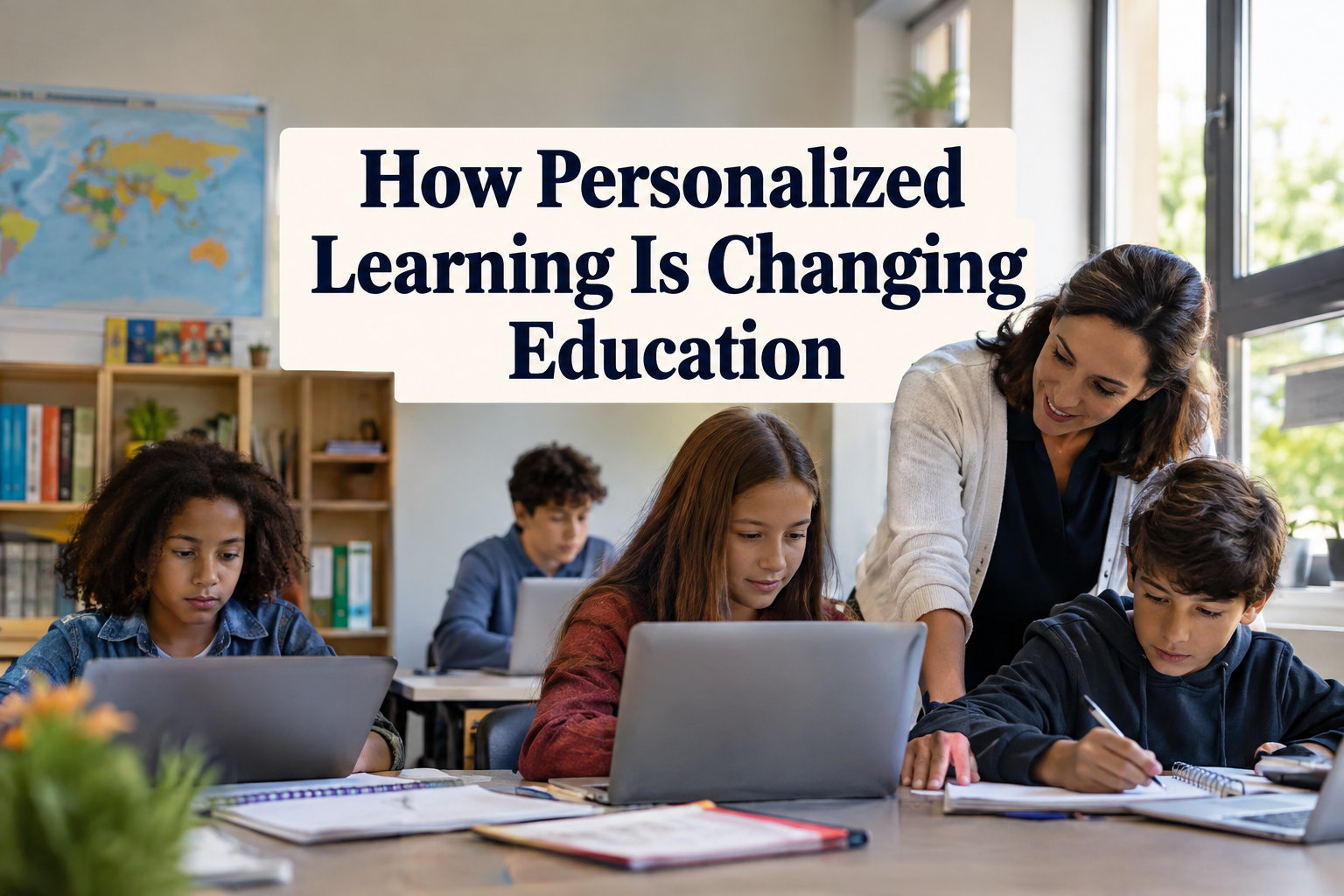
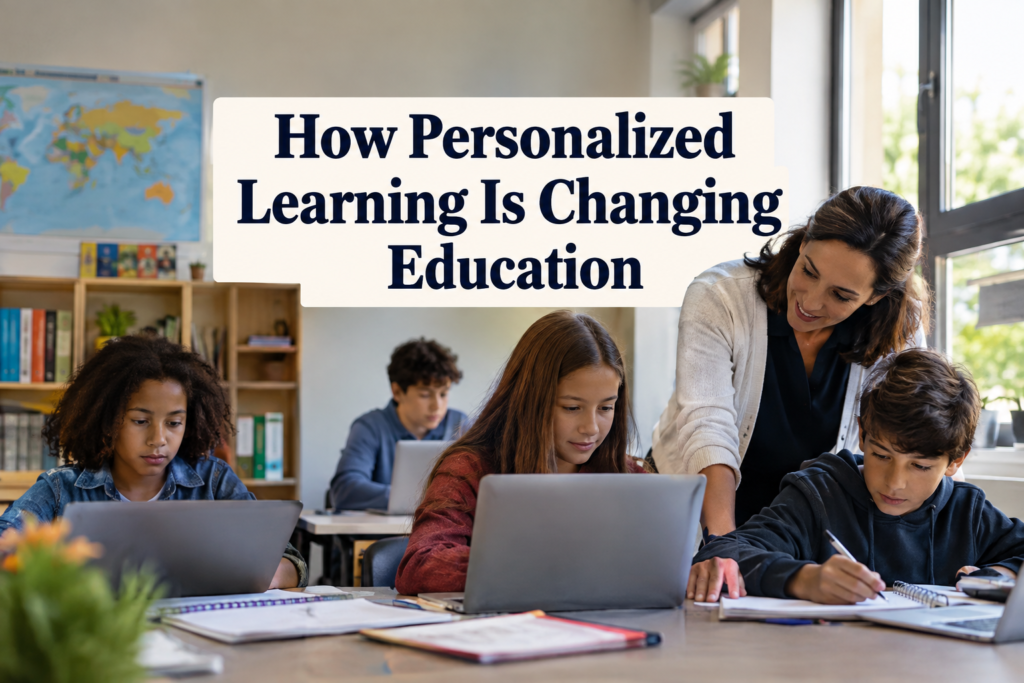
The teacher is still responsible for explaining concepts, planning lessons, answering questions, and supporting students. However, the teacher may spend less time delivering the same lecture to everyone and more time guiding individuals or small groups.
For example, while some students work independently on an activity, the teacher may sit with a small group that needs extra support.
Later, the teacher may work with advanced learners who are ready for a more challenging task.
This type of classroom requires careful organization, but it allows the teacher to respond more directly to student needs.
The role of the teacher becomes closer to that of a mentor, guide, and learning designer.
Personalized Learning Can Increase Student Engagement
Students are often more interested in learning when they feel that the material is connected to their needs or interests.
Personalized learning can support this by giving students more choices.
For example, a teacher may allow students to choose a topic for a research project.
One student may choose environmental science. Another may choose technology. Another may be interested in health.
All students can still practice the same important skills, such as research, writing, critical thinking, and presentation.
The difference is that they are applying those skills to topics they find meaningful.
Choice can create a stronger connection between the learner and the lesson.
When students feel involved in decisions about their learning, they may become more responsible for their progress.
Learning Data Can Help Teachers Identify Problems
Personalized learning often depends on regular information about student performance.
Teachers can collect this information through quizzes, class discussions, assignments, observations, projects, and digital learning systems.
This information can reveal patterns.
A student may be performing well overall but repeatedly making mistakes in one specific area.
For example, a learner may understand basic algebra but struggle whenever negative numbers are involved.
Without detailed assessment, this problem could remain hidden.
With better learning data, the teacher can identify the exact weakness and provide targeted practice.
This is one of the strongest advantages of personalized learning. Support can become more specific instead of general.
Personalized Learning Supports Different Learning Needs
Students have different educational needs.
Some may need additional explanations. Others may require more challenging activities. Some students may learn more effectively through diagrams, demonstrations, discussion, reading, or hands on practice.
Personalized learning can make classrooms more flexible for these differences.
For example, a teacher explaining the water cycle may use several resources.
Students could read a short explanation, watch an educational video, study a diagram, complete an experiment, or discuss the process with classmates.
Providing different learning options can help students understand the same idea through multiple approaches.
However, effective personalized learning should not simply place students into fixed categories. A student may prefer one method for a particular topic and another method for a different subject.
The goal is flexibility, not labeling.
Students Can Take More Responsibility for Learning
Personalized learning also encourages students to become active participants in their education.
Instead of waiting for the teacher to control every part of the learning process, students may learn how to set goals, track progress, choose activities, and reflect on their performance.
For example, a student may create a weekly learning goal.
At the end of the week, the student can review what was completed and decide what needs additional practice.
These habits are useful beyond school.
Adults regularly need to organize tasks, learn new skills, solve problems, and manage their time.
Teaching students how to understand their own learning process can therefore prepare them for future education and employment.
Personalized Learning Can Make Assessment More Useful
Traditional education often depends heavily on final examinations.
Exams are still important, but personalized learning encourages teachers to use assessment throughout the learning process.
A short quiz can help identify misunderstandings.
A classroom discussion can show whether students can explain a concept in their own words.
A project can demonstrate whether students can apply knowledge to a real situation.
These assessments help teachers understand what students know before the final exam arrives.
This makes assessment more useful because it becomes part of learning rather than simply a method of giving grades.
Students can receive feedback, correct mistakes, and try again.
That process can lead to deeper understanding.
Personalized Learning and Artificial Intelligence
Artificial intelligence is beginning to play a larger role in personalized education.
AI based educational systems can analyze student responses and provide learning activities that match their current ability.
For example, a language learning platform may notice that a student repeatedly struggles with certain grammar rules.
The system can then provide additional practice focused on those areas.
AI tools may also help generate practice questions, explain concepts in different ways, or provide immediate feedback.
This can be useful because students do not always have to wait for the teacher to review every small activity.
However, artificial intelligence must be used carefully.
Students still need human teachers who understand emotions, motivation, classroom relationships, and personal circumstances.
Technology can identify learning patterns, but teachers provide judgment, encouragement, and human understanding.
The strongest educational systems are likely to combine technology with skilled teaching rather than treating them as competitors.
Personalized Learning Can Support Independent Learning
Modern education increasingly requires students to learn independently.
This is especially important in higher education and professional life.
Personalized learning can help students develop this ability.
Students learn how to identify what they understand and what they still need to practice.
They may learn how to search for suitable learning resources, ask better questions, and evaluate their own progress.
These abilities make students less dependent on constant instruction.
An independent learner can continue learning even when a teacher is not immediately available.
This skill is becoming more important because knowledge and technology are changing rapidly.
People may need to learn new skills several times during their careers.
The Importance of Feedback in Personalized Learning
Feedback is essential for effective personalized learning.
Students need to know what they are doing well and what needs improvement.
Useful feedback should be clear and specific.
For example, telling a student that an essay is weak does not explain much.
A more useful comment would explain that the introduction is clear but the main argument needs stronger evidence.
Specific feedback gives the learner a clear direction for improvement.
Digital systems can provide immediate feedback for some activities, but teacher feedback remains extremely important for complex tasks.
Writing, creativity, communication, and critical thinking often require human judgment.
The combination of quick digital feedback and detailed teacher guidance can create a stronger learning experience.
Challenges of Personalized Learning
Personalized learning has many advantages, but it also creates challenges.
One major challenge is teacher workload.
Creating different learning activities for many students can require significant planning.
Teachers also need training to use educational technology effectively.
Another challenge is access to technology.
Some schools have modern computers, reliable internet connections, and advanced educational software. Other schools may have limited resources.
If personalized learning depends too heavily on expensive technology, students from less wealthy communities could be left behind.
Privacy is another concern.
Digital learning platforms may collect information about student performance and behavior.
Schools need clear policies to protect student data.
Technology should support education without creating unnecessary risks.
Personalized Learning Should Not Remove Human Interaction
Education is not only about completing lessons.
Students also learn through conversations, friendships, teamwork, debate, and interaction with teachers.
For this reason, personalized learning should not become isolated learning.
Students may follow different learning paths while still participating in group activities.
Collaborative projects can teach communication, cooperation, leadership, and problem solving.
These skills are difficult to develop through individual digital activities alone.
The goal should be balance.
Students need personalized support, but they also need a strong learning community.
The Future of Personalized Learning
Personalized learning is likely to become more common as technology and educational research continue to develop.
Schools may increasingly use digital platforms to track progress and recommend suitable learning activities.
Teachers may have more detailed information about student understanding.
Students may receive more flexible learning paths and greater control over how they complete certain tasks.
Classrooms may also become more focused on mastery.
Instead of moving forward simply because a certain amount of time has passed, students may progress after showing that they understand important concepts.
This could change how courses, assessments, and learning schedules are designed.
However, successful personalized learning will depend on careful implementation.
Technology alone cannot improve education.
Schools still need skilled teachers, strong leadership, good learning materials, fair access to resources, and clear educational goals.
How Personalized Learning Benefits Teachers
Personalized learning is often discussed from the student perspective, but teachers can also benefit.
Better information about student progress can help teachers use classroom time more effectively.
Instead of guessing which students need support, teachers can identify specific learning gaps.
This makes small group instruction easier to organize.
Teachers may also be able to provide advanced activities for students who have already mastered the basic material.
In this way, personalized learning can help teachers support both struggling learners and high performing students within the same classroom.
Personalized Learning Encourages a Growth Mindset
Another important benefit of personalized learning is its connection with continuous improvement.
Students can see learning as a process rather than a simple division between success and failure.
A student who does not understand something today may understand it after additional practice.
This message is important.
Difficulty does not always mean inability.
Sometimes it simply means that a learner needs a different explanation, more practice, or additional time.
Personalized learning can make these adjustments possible.
When students see their own improvement, they may become more confident in their ability to learn.
Conclusion
Personalized learning is changing education by making learning more flexible, responsive, and focused on individual progress.
Instead of assuming that every student should learn the same material in exactly the same way, personalized learning recognizes that students have different strengths, needs, interests, and learning speeds.
Technology is making this approach easier by helping teachers track progress, provide targeted practice, and offer different learning resources.
At the same time, teachers remain central to the learning process.
Their guidance, judgment, encouragement, and understanding cannot simply be replaced by software.
The future of education will probably involve a combination of strong teaching, useful technology, regular feedback, student choice, and flexible learning pathways.
Personalized learning is not about creating an entirely separate education system for every student.
It is about creating enough flexibility so that more students have a realistic opportunity to understand what they are learning and continue improving.
As schools continue exploring new teaching methods, personalized learning may become one of the most important ideas shaping modern education.
Its greatest strength is the simple principle behind it.
Students learn differently, and education becomes more effective when those differences are recognized.