
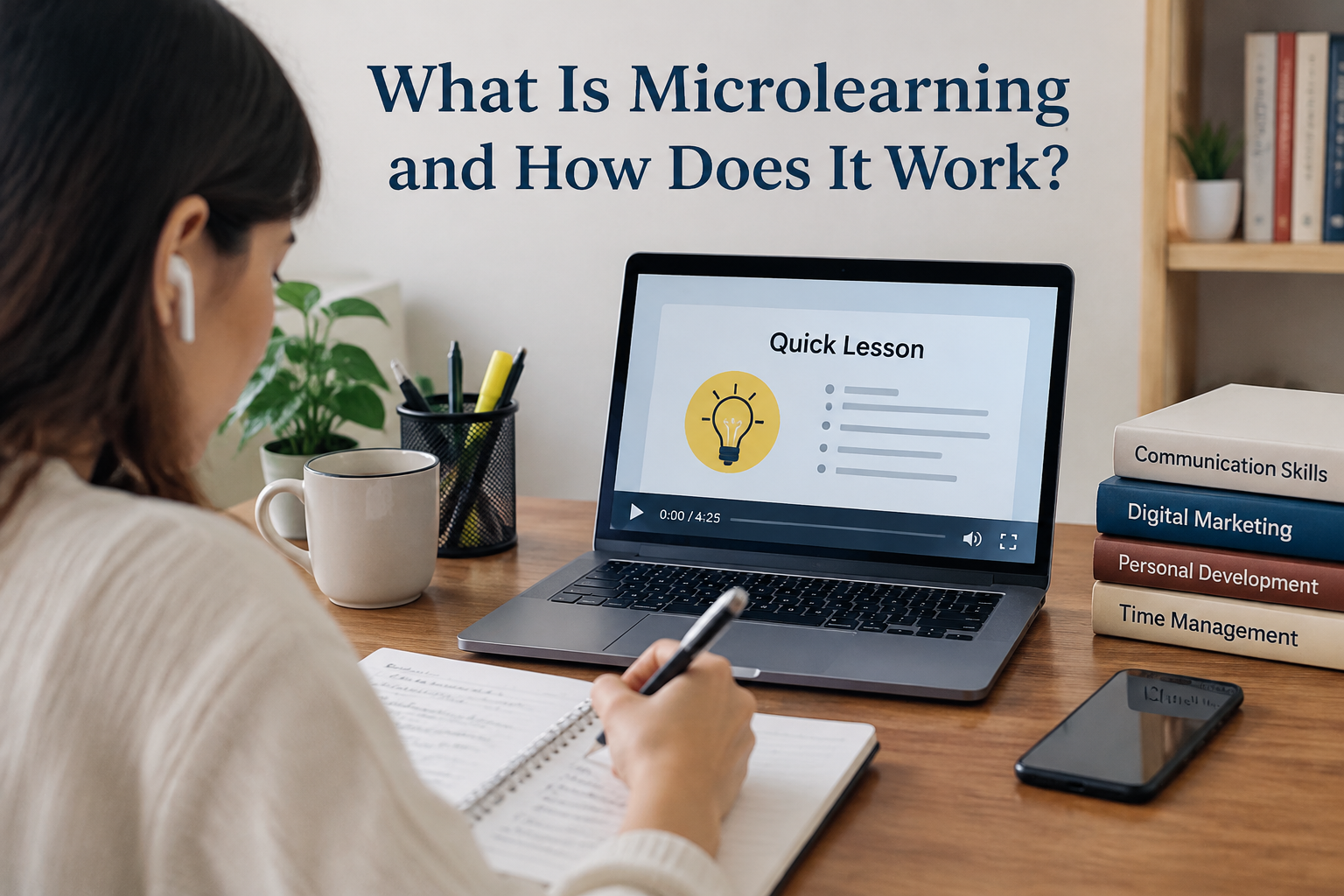
Learning does not always have to mean sitting with a book for several hours or attending a long lecture. In many situations, people learn better when information is divided into smaller and more manageable parts. This idea is at the heart of microlearning.
Microlearning is an approach in which a learner studies a small amount of information at one time. Instead of trying to understand a complete topic in one long session, the learner focuses on one concept, skill, question, or task.
I find this approach interesting because it matches the way many people already learn in daily life. We watch a short explanation, read a small section, answer a few questions, and then continue later. When this process is planned carefully, it can become an effective learning method.
Microlearning is now used in schools, universities, professional training, online courses, workplace learning, and even personal skill development. Its popularity has increased because people often have limited time and need flexible ways to learn.
In this article, I will explain what microlearning is, how microlearning works, why it can be useful, where it is commonly used, and what learners should keep in mind when using this method.
What Is Microlearning?
Microlearning is a learning method that delivers information in short and focused learning units.
Each unit usually covers one specific idea or skill.
For example, instead of studying an entire chapter about computer programming in one sitting, a learner might complete several short lessons. One lesson may explain variables. Another may explain loops. A third may focus on functions.
The learner studies one small topic at a time.
This makes the learning process easier to manage.
Microlearning content can take many forms. It may include a short article, a brief video, a few flashcards, a simple quiz, an infographic, a small practical activity, or a short audio lesson.
The important point is not only the length of the lesson. The lesson must also have a clear purpose.
A short lesson that tries to teach ten different ideas is not really effective microlearning. A good microlearning lesson normally focuses on one learning objective.
How Does Microlearning Work?
Microlearning works by breaking a larger subject into smaller learning pieces.
A learner studies these pieces one at a time.
For example, imagine that someone wants to learn basic financial literacy.
A traditional course may include a long lesson covering budgeting, saving, debt, investment, and financial planning.
A microlearning course may divide the same subject into separate lessons such as:
- What is a personal budget?
- How to track monthly expenses
- The difference between needs and wants
- How emergency savings work
- Understanding simple interest
- Understanding compound interest
- Basic ideas about investment
Each lesson can be completed separately.
The learner does not need to process the entire subject at once.
This smaller learning structure can reduce mental overload and make it easier to concentrate on the main idea.
The Main Idea Behind Microlearning
The main idea behind microlearning is simple.
Learn less information at one time, but focus on it carefully.
When too much new information is presented at once, learners may struggle to remember important details.
Shorter lessons can help learners concentrate on one concept before moving to the next.
Microlearning also encourages regular learning.
Instead of studying for three hours once a week, a learner may study for ten or fifteen minutes every day.
This creates frequent contact with the subject.
Regular learning can be especially useful when the learner also reviews older information from time to time.
Why Microlearning Has Become Popular
One reason microlearning has become popular is that modern learners often have busy schedules.
Students have classes, assignments, family responsibilities, and other activities.
Working professionals may have meetings, deadlines, travel, and personal commitments.
Finding one or two uninterrupted hours for learning may be difficult.
Finding ten minutes may be much easier.
Microlearning gives learners the opportunity to study during smaller periods of free time.
A person may complete a short lesson before work, during a study break, while commuting on public transport, or in the evening.
Digital technology has also helped microlearning grow.
Learning platforms, educational apps, smartphones, and online courses can easily deliver short lessons.
This makes learning available in many different places.
Common Types of Microlearning
Microlearning does not use only one format.
Different formats can be used depending on the topic and the learning goal.
Short Videos
A short educational video may explain one concept in a few minutes.
For example, a science video may explain how evaporation works.
Another video may explain condensation.
Instead of combining the entire water cycle into one long lesson, the learner studies each process separately.
Flashcards
Flashcards are a simple example of microlearning.
One side may contain a question or keyword. The other side contains the answer or explanation.
Flashcards are often used for vocabulary, formulas, definitions, historical dates, and technical terms.
Mini Quizzes
A short quiz with three to five questions can help learners check their understanding.
Quizzes can also encourage learners to recall information instead of simply reading it again.
Infographics
An infographic can present important information visually.
It may contain diagrams, short explanations, key statistics, or steps in a process.
This format can be useful when learners need a quick overview.
Short Reading Lessons
A short article or a small section of a textbook can also be used as microlearning.
The important thing is that the reading focuses on one clear topic.
Practical Tasks
Microlearning can also involve action.
For example, a learner studying spreadsheet software may be asked to practice one function.
A language learner may write five sentences using a new grammar rule.
A design student may practice one drawing technique.
These short activities help learners apply what they have studied.
Microlearning and Attention
One advantage of microlearning is that it may be easier to maintain attention during a short lesson.
Long learning sessions can be tiring, especially when the topic is difficult.
After studying for a long time, learners may start reading without fully understanding what they are reading.
A shorter session can feel more manageable.
The learner knows that the lesson has a limited scope.
This can encourage greater concentration.
However, short lessons alone do not guarantee attention.
A learner can still become distracted during a five minute lesson.
The learning environment, motivation, difficulty of the material, and teaching quality also matter.
Microlearning works best when the learner actively focuses on the task.
Microlearning and Memory
Microlearning can support memory when it is combined with regular review.
Suppose a student learns ten new vocabulary words today.
Tomorrow, the student reviews those words and learns five more.
Several days later, the student reviews them again.
This repeated contact gives the brain more opportunities to retrieve the information.
In contrast, studying a large amount of information once and never reviewing it may lead to rapid forgetting.
Microlearning can therefore work well with methods such as spaced repetition and retrieval practice.
The learner studies a small amount, recalls it later, and continues reviewing it over time.
Microlearning and Spaced Repetition
Microlearning and spaced repetition are different ideas, but they can work together.
Microlearning refers to studying in small learning units.
Spaced repetition refers to reviewing information at increasing intervals.
For example, a student may learn a group of scientific terms today.
The student may review them tomorrow, again after three days, and later after one week.
Each review session can be short.
This combination can make study sessions easier to manage while still giving learners repeated exposure to important material.
Microlearning and Retrieval Practice
Retrieval practice means trying to remember information without immediately looking at the answer.
Microlearning can include small retrieval activities.
For example, after watching a short lesson, the learner may answer three questions from memory.
Another option is to close the book and explain the main idea in simple words.
The learner can also write a short summary without checking the notes.
These activities make microlearning more active.
Instead of simply consuming information, the learner tries to recall and use it.
Microlearning in Schools
Schools can use microlearning as a supporting strategy.
A teacher may introduce a difficult concept through a short explanation before moving to a longer classroom activity.
Students may also use short review lessons after class.
For example, a mathematics lesson may be divided into small topics.
One lesson may focus on understanding a formula.
Another may focus on solving a simple example.
A third may focus on applying the formula to a word problem.
Breaking the lesson into parts may help some students understand the sequence more clearly.
Microlearning should not necessarily replace complete classroom teaching.
Some subjects require discussion, practice, problem solving, laboratory work, reading, and deeper explanation.
Microlearning is often most useful as part of a larger learning system.
Microlearning in Universities
University students often study complex subjects.
For this reason, microlearning may be useful for reviewing important concepts.
A medical student may review one medical term at a time.
An engineering student may study one formula and its application.
A business student may review one management concept before an exam.
A computer science student may practice one programming technique.
These small learning activities can be completed between longer study sessions.
Microlearning can also help students prepare for lectures by introducing important terms before class.
When students already recognize the main concepts, they may find the full lecture easier to follow.
Microlearning in Workplace Training
Microlearning is widely used in workplace training because employees often cannot leave their normal responsibilities for long periods.
A company may provide short lessons on workplace safety, software use, customer service, communication, cybersecurity, or company procedures.
For example, instead of giving employees a two hour cybersecurity lecture, a company may provide several short lessons.
One lesson may explain strong passwords.
Another may explain phishing emails.
Another may explain suspicious links.
A later lesson may explain secure file sharing.
This allows employees to learn gradually while continuing their normal work.
Microlearning for Learning New Skills
Microlearning can also be useful when learning practical skills.
Imagine that a person wants to learn photography.
Instead of studying everything about photography at once, the learner may focus on one concept each day.
Day one may cover aperture.
Day two may cover shutter speed.
Day three may cover ISO.
Day four may cover composition.
Day five may involve taking several photos and comparing the results.
This method makes the skill feel less overwhelming.
The learner gradually builds knowledge through small steps.
Benefits of Microlearning
Microlearning offers several possible benefits when it is designed properly.
It Can Make Learning Feel Manageable
A difficult subject can become easier to approach when it is divided into smaller sections.
Instead of thinking about an entire course, the learner focuses on one lesson.
It Can Fit Into Busy Schedules
Short lessons can be easier to include in daily routines.
A learner may study for ten minutes even when a full study session is not possible.
It Can Support Regular Study
Because lessons are short, learners may be more willing to study frequently.
Regular learning can create stronger study habits.
It Can Make Review Easier
Small lessons can be reviewed individually.
A learner can return to the exact topic that needs more practice instead of repeating an entire course.
It Works Well on Mobile Devices
Short videos, quizzes, flashcards, and articles can be accessed easily on smartphones and tablets.
This makes microlearning suitable for flexible learning.
It Can Encourage Active Learning
Microlearning activities can include questions, tasks, reflection, and practice.
These activities can turn a short lesson into an active learning experience.
Limitations of Microlearning
Microlearning is useful, but it is not suitable for every learning situation.
Some subjects require deep study.
A learner cannot fully understand a complex subject only by watching several unrelated short videos.
Long reading, detailed explanation, extended practice, and discussion are sometimes necessary.
For example, learning advanced mathematics requires more than memorizing formulas.
Students need time to understand relationships, solve difficult problems, make mistakes, and develop reasoning skills.
Similarly, learning to write well requires repeated practice, feedback, editing, and careful reading.
Microlearning can support these activities, but it may not replace them.
The Risk of Oversimplification
Another limitation is oversimplification.
When lessons are made very short, important details may be removed.
This can create the impression that a complex subject is easier than it really is.
A good microlearning system should therefore connect short lessons to a broader learning structure.
Learners should understand how individual topics relate to one another.
The goal should be to simplify the learning process without oversimplifying the subject itself.
How to Create Effective Microlearning
Effective microlearning starts with a clear learning objective.
Before creating a lesson, ask one question:
What should the learner understand or be able to do after completing this lesson?
The answer should be specific.
For example, instead of saying, “Learn about digital marketing,” a better objective would be, “Explain the difference between organic and paid website traffic.”
The lesson can then focus on that single objective.
The content should be clear, focused, and easy to follow.
Unnecessary information should be removed.
At the end of the lesson, the learner should have a way to check understanding.
This may include a question, quiz, example, reflection, or practical activity.
How Students Can Use Microlearning
Students do not need special software to use microlearning.
A textbook can be divided into smaller study sections.
For example, instead of saying, “I will study chemistry tonight,” a student can create smaller goals.
The student may decide to understand one reaction, learn five terms, solve three questions, and review one diagram.
These smaller tasks provide clearer direction.
Students can also create short study notes.
Each note can focus on one concept.
Flashcards can be used for important terms.
Practice questions can be grouped by topic.
Short review sessions can be scheduled throughout the week.
This approach makes studying more organized.
How Long Should a Microlearning Lesson Be?
There is no single perfect length for every microlearning lesson.
The lesson should be long enough to explain the topic clearly but short enough to remain focused.
Some lessons may take three minutes.
Others may take ten or fifteen minutes.
The learning objective matters more than following an exact time limit.
A lesson should not be shortened so much that the explanation becomes incomplete.
The goal is focused learning, not simply fast learning.
Microlearning and Online Education
Online education is well suited to microlearning.
Digital platforms can organize courses into small lessons.
Learners can complete one section and then continue later.
Progress can be saved automatically.
Quizzes and review activities can be added between lessons.
Online platforms can also recommend lessons based on the learner’s previous performance.
For example, if a learner struggles with one topic, the platform may provide another short explanation or practice activity.
This can make digital learning more flexible.
Microlearning and Personalized Learning
Microlearning can also support personalized learning.
Different students may need different lessons.
One student may already understand basic concepts and need advanced practice.
Another student may need additional explanation of the fundamentals.
When learning is divided into small units, it becomes easier to choose lessons based on individual needs.
Learners can spend more time on difficult topics and move more quickly through familiar material.
This can make the learning experience more relevant.
A Simple Example of Microlearning
Suppose a student wants to learn about photosynthesis.
Instead of studying everything at once, the topic can be divided into smaller lessons.
Lesson one explains why plants need sunlight.
Lesson two explains the role of chlorophyll.
Lesson three explains how plants use carbon dioxide.
Lesson four explains how water is involved.
Lesson five explains the production of glucose and oxygen.
Lesson six includes a diagram review.
Lesson seven contains five practice questions.
Each lesson is connected to the same larger topic.
The student gradually builds a complete understanding.
This is a good example of how microlearning can turn a complex subject into a sequence of manageable learning steps.
Is Microlearning Better Than Traditional Learning?
Microlearning and traditional learning should not always be treated as competing methods.
They can support each other.
Traditional lessons can provide depth, explanation, discussion, and broader understanding.
Microlearning can provide short explanations, review, practice, and reinforcement.
For example, a teacher may give a full classroom lesson and later provide short review activities.
A student may read a complete chapter and then use flashcards to remember important concepts.
A professional may attend a training workshop and later receive short refresher lessons.
The best approach often depends on the subject, learner, and learning goal.
Final Thoughts
Microlearning is a learning approach that divides information into small, focused units. Each lesson normally has a clear objective and can be completed in a relatively short period of time.
The method works by reducing the amount of new information presented at one time. Learners can focus on one concept, review it, practice it, and then move to the next topic.
Microlearning can be used through short videos, flashcards, quizzes, reading sections, infographics, audio lessons, and practical activities.
It is especially useful for review, workplace training, vocabulary learning, skill development, online education, and busy study schedules.
However, microlearning should not be viewed as a replacement for all forms of deep learning. Complex subjects still require longer periods of reading, discussion, practice, reflection, and problem solving.
I see microlearning as a practical way of organizing learning rather than simply making lessons shorter. When small lessons are connected to clear goals and combined with regular review and active practice, they can make the learning process more manageable and easier to continue over time.
For students and lifelong learners, the main lesson is simple. You do not always need to study everything at once. Sometimes, understanding one important idea at a time is a better way to make steady progress.