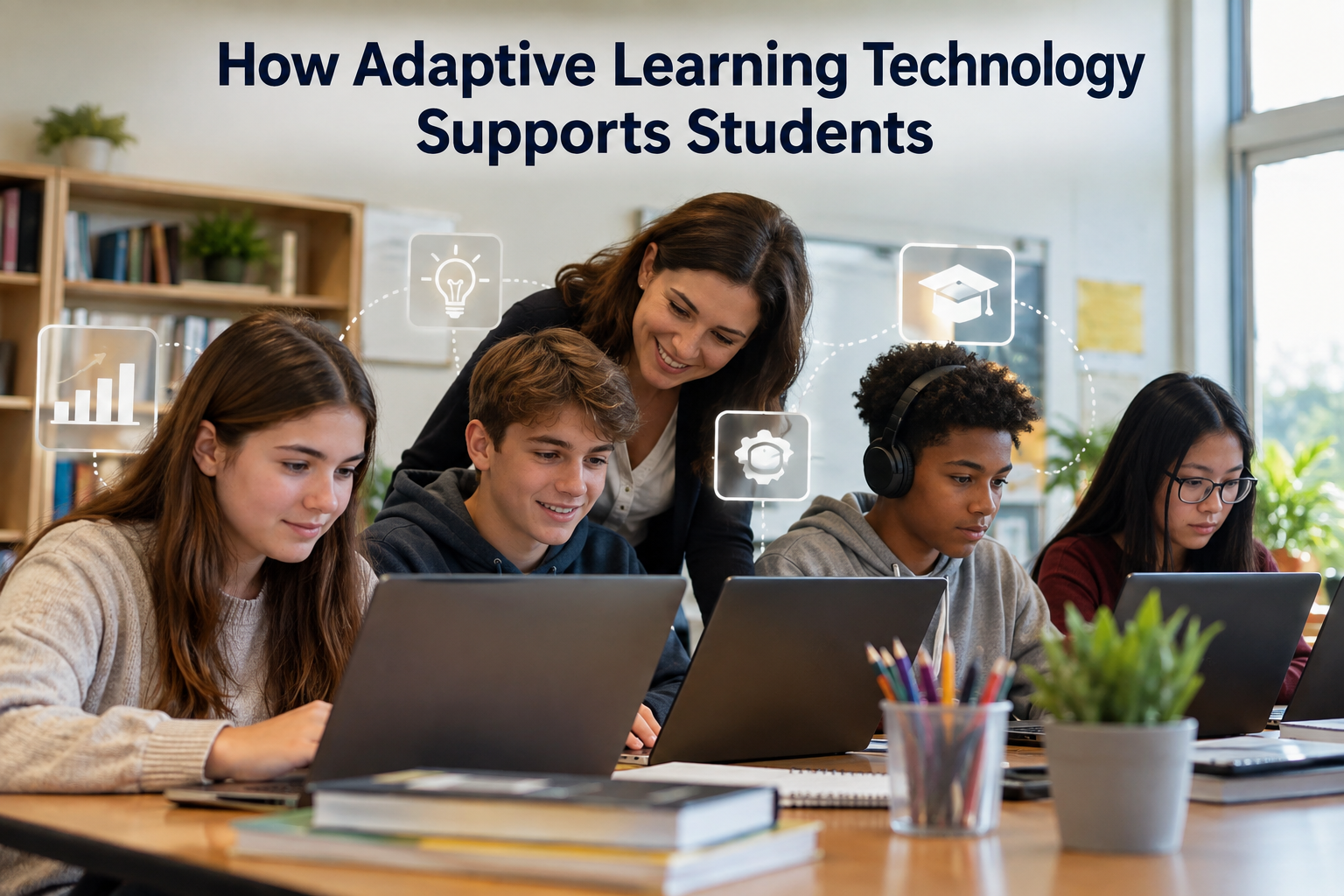
Technology has changed the way students study, practice, communicate, and access information. One of the most useful developments in modern education is adaptive learning technology. Unlike traditional digital learning systems that present the same content to every student, adaptive learning technology adjusts lessons according to the needs, progress, and performance of each learner.
I have read about different teaching methods and educational technologies, and adaptive learning stands out because it focuses on individual learning needs. Every student learns differently. Some students understand a topic quickly, while others need more explanation, more examples, or additional practice. Adaptive learning technology helps address these differences by creating a more personalized learning experience.
This article explains how adaptive learning technology supports students, how it works, where it is useful, and why it is becoming an important part of modern education.
What Is Adaptive Learning Technology?
Adaptive learning technology is a digital learning system that changes the learning experience based on a student’s performance.
The system observes how a student answers questions, how quickly the student completes activities, and where the student makes mistakes. It then uses this information to adjust the next lesson, activity, or question.
For example, imagine that two students are studying mathematics.
The first student understands fractions very well but struggles with decimals. The second student finds fractions difficult but understands decimals easily.
A traditional digital course may give both students the same lessons in the same order.
An adaptive learning system can provide more practice with decimals to the first student and more practice with fractions to the second student.
This makes learning more focused and relevant.
How Adaptive Learning Technology Works
Adaptive learning technology usually works by collecting information about a student’s learning progress.
When students complete activities, the system records their responses. It may look at correct answers, incorrect answers, completion time, repeated mistakes, and improvement over time.
The system then analyzes this information and adjusts the learning path.
If a student performs well, the system may introduce more advanced material.
If the student struggles, the system may provide easier explanations, additional examples, revision activities, or more practice.
The goal is not simply to make learning easier. The goal is to provide an appropriate level of challenge.
Students should not feel bored because the material is too simple. At the same time, they should not feel overwhelmed because the material is too difficult.
Adaptive Learning Supports Individual Learning Needs
One of the greatest benefits of adaptive learning technology is personalization.
In a classroom, a teacher may have twenty, thirty, or even more students. It can be difficult to provide completely different lessons to every learner during every class.
Adaptive technology can help by giving students different activities based on their individual needs.
A student who already understands a concept can continue to the next topic.
A student who needs more support can spend additional time practicing the same concept.
This creates a learning experience that is more suitable for each student.
Students Can Learn at Their Own Pace
Students do not always learn at the same speed.
Some students need more time to understand new information. Others learn quickly and are ready to move forward.
Traditional lessons often follow a fixed schedule. The class may move to the next topic even if some students have not fully understood the previous one.
Adaptive learning technology can reduce this problem.
Students may be able to spend more time on difficult topics without feeling pressured to keep up with everyone else.
Students who progress quickly can continue without waiting for the rest of the class.
This flexibility can make learning more comfortable and productive.
Adaptive Learning Can Identify Knowledge Gaps
Sometimes students continue studying without realizing that they have missed an important concept.
A small misunderstanding in one topic can create larger problems later.
For example, a student who does not fully understand multiplication may struggle when learning division, fractions, or algebra.
Adaptive learning systems can help identify these gaps.
When the system notices repeated mistakes, it can return the student to earlier material.
The student may receive additional explanations and practice before moving forward.
This can strengthen the student’s foundation and reduce future confusion.
Students Receive Immediate Feedback
Feedback is very important in learning.
When students make mistakes, they need to understand what went wrong.
Traditional homework may not be checked until the next day or even later. By that time, students may have forgotten how they approached the question.
Adaptive learning platforms can often provide immediate feedback.
If an answer is incorrect, the system may explain the mistake or provide a hint.
This helps students correct misunderstandings while the topic is still fresh in their minds.
Immediate feedback can also make practice more meaningful because students are not simply guessing whether their answers are correct.
Adaptive Learning Encourages Active Participation
Students learn more effectively when they are actively involved in the learning process.
Adaptive learning systems often include interactive questions, short exercises, quizzes, simulations, and problem solving activities.
Instead of only reading information, students are regularly asked to respond.
Their responses influence what happens next.
This can make students feel more involved because their learning path changes according to their actions.
Active participation can also help students remember information more effectively than passive reading alone.
It Can Reduce Student Frustration
Learning becomes frustrating when students repeatedly face material that they do not understand.
If a lesson is too difficult, students may lose confidence.
Adaptive learning technology can respond to this problem by adjusting the difficulty level.
If a student struggles with several questions, the system may provide simpler examples or review earlier concepts.
The student can then rebuild understanding step by step.
This gradual approach may reduce frustration and help students feel more capable.
It Can Also Reduce Boredom
Learning can be frustrating when it is too difficult, but it can also become boring when it is too easy.
Students who already understand a topic may lose interest if they must continue completing basic exercises.
Adaptive systems can recognize strong performance and provide more challenging activities.
This keeps advanced students engaged while allowing them to continue learning at an appropriate level.
Balanced difficulty is one of the important strengths of adaptive learning technology.
Adaptive Learning Can Support Student Confidence
Confidence often grows when students see improvement.
Adaptive learning systems can show students their progress through scores, levels, completed activities, or learning goals.
When students notice that they are improving, they may feel more motivated to continue.
They can also see that mistakes are part of the learning process.
Instead of seeing failure as the end of learning, students can receive another explanation and try again.
This approach can encourage persistence.
Teachers Can Understand Student Progress Better
Adaptive learning technology does not only support students. It can also provide useful information to teachers.
Many systems include dashboards that show student performance.
Teachers may be able to see which students are progressing well, which topics are causing difficulty, and which students need additional support.
This information can help teachers make better instructional decisions.
For example, if many students are struggling with the same concept, the teacher may decide to explain the topic again during class.
If only a few students are having difficulty, the teacher can provide more focused support.
Teachers Can Spend More Time Helping Students
Teachers often spend a large amount of time checking assignments and identifying student difficulties.
Adaptive learning tools can automate some routine assessment tasks.
This does not replace the teacher.
Instead, it can give teachers more information and more time to focus on meaningful interaction with students.
Teachers can spend more time explaining complex ideas, answering questions, supporting struggling learners, and encouraging classroom discussion.
Technology can handle some repetitive tasks while teachers focus on the human side of education.
Adaptive Learning Can Support Different Subjects
Adaptive learning technology can be used in many subject areas.
Mathematics is one common example because students can practice questions at different difficulty levels.
It is also useful in language learning.
A student learning English may receive vocabulary exercises based on previous mistakes.
Another student may receive grammar practice or reading activities.
Science platforms can provide questions based on the student’s understanding of concepts.
Some systems can also support subjects such as computer science, business, history, and test preparation.
The main principle remains the same.
The system adjusts learning activities according to student performance.
Adaptive Learning Helps With Revision
Revision is an important part of learning, but students do not always know what they should revise.
They may spend too much time reviewing topics they already understand while ignoring weaker areas.
Adaptive learning technology can make revision more focused.
The system can identify topics where the student has made mistakes and provide additional practice.
It can also bring back older material after some time to check whether the student still remembers it.
This approach can make revision more efficient.
Students Can Develop Greater Independence
Adaptive learning can also help students become more independent learners.
Students can often use adaptive platforms without waiting for direct instructions from a teacher.
They can complete activities, receive feedback, and continue progressing on their own.
This encourages students to take more responsibility for their learning.
Independent learning is an important skill because students will continue learning throughout school, university, work, and daily life.
Adaptive Learning Technology Supports Online Education
Online education has become an important part of modern learning.
However, online courses can sometimes feel impersonal because many students follow the same recorded lessons and activities.
Adaptive learning technology can make online education more personalized.
Students can receive different learning paths based on their performance.
This creates a more individual experience even when students are studying remotely.
For online learners, this can be especially useful because they may not always have immediate access to a teacher.
It Can Be Useful for Large Classes
Large classes can create challenges for teachers.
It may be difficult to identify every student’s strengths and weaknesses during a short lesson.
Adaptive learning systems can collect information from many students at the same time.
This can help teachers understand the overall performance of the class.
Students can also receive personalized practice even when the teacher cannot work individually with everyone.
For schools with large classes, this can be a useful form of additional support.
Adaptive Learning Can Improve Practice Quality
Practice is important, but simply completing many questions does not always lead to better learning.
The quality of practice matters.
Students should practice areas that need improvement.
Adaptive systems can select questions based on the student’s previous answers.
A student who struggles with a concept may receive more questions related to that concept.
A student who has already mastered the topic can move to something more difficult.
This makes practice more purposeful.
Students Can See Their Strengths and Weaknesses
Understanding personal strengths and weaknesses is an important learning skill.
Adaptive learning platforms often provide progress reports.
Students can see which topics they understand and which areas require more work.
This information can help students make better study decisions.
Instead of saying, “I am bad at mathematics,” a student may discover that the real problem is only one specific area, such as fractions or equations.
This makes the problem easier to address.
Adaptive Learning Can Support Different Learning Levels
Students in the same classroom may have very different levels of knowledge.
Some may be working at an advanced level, while others may need additional support with basic concepts.
Adaptive learning technology can offer different learning experiences without separating students completely.
Each student can work on tasks that match their current level.
This can help teachers support a wider range of learners in one classroom.
Data Can Help Improve Learning Decisions
One important part of adaptive learning is data.
The system collects information about student performance and uses it to make learning decisions.
This can help educators understand patterns that may not be obvious during normal classroom teaching.
For example, a teacher may discover that students understand a topic during lessons but struggle with it during independent practice.
This information can help teachers improve their teaching methods.
However, educational data should always be handled responsibly.
Student privacy and data security are important considerations.
Adaptive Learning Does Not Replace Teachers
There is sometimes concern that educational technology may replace teachers.
Adaptive learning technology is better understood as a support tool.
A computer system can analyze answers and provide practice, but it cannot completely replace the experience, judgment, encouragement, and understanding of a good teacher.
Teachers understand emotions, classroom relationships, creativity, motivation, and personal circumstances.
Technology can provide useful information, but teachers decide how that information should be used.
The strongest learning environment often combines technology with human guidance.
Challenges of Adaptive Learning Technology
Adaptive learning technology has many benefits, but it also has limitations.
Schools need suitable devices and reliable internet access.
Teachers and students need time to learn how to use the system.
Some platforms may be expensive.
The quality of adaptive learning also depends on the quality of the educational content.
A system cannot improve learning if the explanations and activities are poorly designed.
There are also concerns about student data and privacy.
Schools should understand how educational platforms collect, store, and use student information.
Technology should support learning without creating unnecessary risks.
Students Still Need Human Interaction
Learning is not only about completing activities on a screen.
Students also need discussion, communication, collaboration, creativity, and social interaction.
Adaptive learning should be one part of a wider educational experience.
Students should still have opportunities to ask teachers questions, work with classmates, participate in group projects, and discuss different ideas.
Technology is most useful when it supports these experiences rather than replacing them.
How Schools Can Use Adaptive Learning Effectively
Schools should introduce adaptive learning technology with clear educational goals.
The first question should not be, “Which technology should we buy?”
The better question is, “What learning problem are we trying to solve?”
A school may want to improve mathematics practice, support struggling readers, provide personalized revision, or help teachers identify learning gaps.
Once the goal is clear, educators can select a suitable platform.
Teachers should also receive proper training.
They need to understand how the technology works and how to use the information it provides.
Student progress should continue to be reviewed by teachers rather than depending only on automated systems.
The Future of Adaptive Learning
Adaptive learning technology is likely to become more advanced as educational software improves.
Future systems may become better at identifying learning patterns and providing personalized explanations.
Artificial intelligence may also help educational platforms generate different examples and activities for students.
However, the purpose of adaptive learning should remain simple.
Technology should help students understand ideas, improve their skills, and receive support when they need it.
The success of adaptive learning will depend on how carefully it is used.
Technology should serve education, not control it.
Final Thoughts
Adaptive learning technology supports students by creating a more personalized learning experience.
It can adjust lessons according to student performance, identify knowledge gaps, provide immediate feedback, and allow students to learn at their own pace.
It can help struggling students receive additional support while giving advanced learners more challenging activities.
Teachers can also use adaptive learning data to understand student progress and provide more focused help.
However, adaptive learning technology works best when it is combined with good teaching.
Students still need encouragement, discussion, creativity, collaboration, and human guidance.
Adaptive learning should not be seen as a replacement for teachers. It should be viewed as another useful tool that can help teachers and students work more effectively.
When used responsibly, adaptive learning technology can make education more flexible, focused, and responsive to the needs of individual learners.
Frequently Asked Questions
What is adaptive learning technology?
Adaptive learning technology is a digital educational system that adjusts lessons, activities, and questions according to a student’s performance and learning needs.
How does adaptive learning help students?
It helps students by providing personalized practice, identifying learning gaps, giving immediate feedback, and allowing learners to progress at their own pace.
Is adaptive learning useful for struggling students?
Yes. Adaptive systems can provide additional explanations and practice when students have difficulty understanding a topic.
Can advanced students benefit from adaptive learning?
Yes. Students who understand a topic quickly can receive more challenging material instead of repeating basic lessons.
Does adaptive learning replace teachers?
No. Adaptive learning technology supports teachers by providing data and personalized practice. Teachers remain important for instruction, motivation, communication, creativity, and student guidance.
What subjects can use adaptive learning technology?
Adaptive learning can be used in mathematics, science, language learning, reading, computer science, test preparation, and many other subjects.
Is adaptive learning useful for online education?
Yes. It can make online courses more personalized by adjusting the learning path according to each student’s progress.
What are the main challenges of adaptive learning?
Common challenges include technology costs, internet access, teacher training, data privacy, and the quality of educational content.
Can adaptive learning improve student confidence?
It can support confidence by giving students suitable challenges, showing progress, and allowing them to correct mistakes through additional practice.
Why is adaptive learning important in modern education?
Adaptive learning is important because students have different strengths, weaknesses, learning speeds, and educational needs. Personalized technology can help schools respond to these differences more effectively.