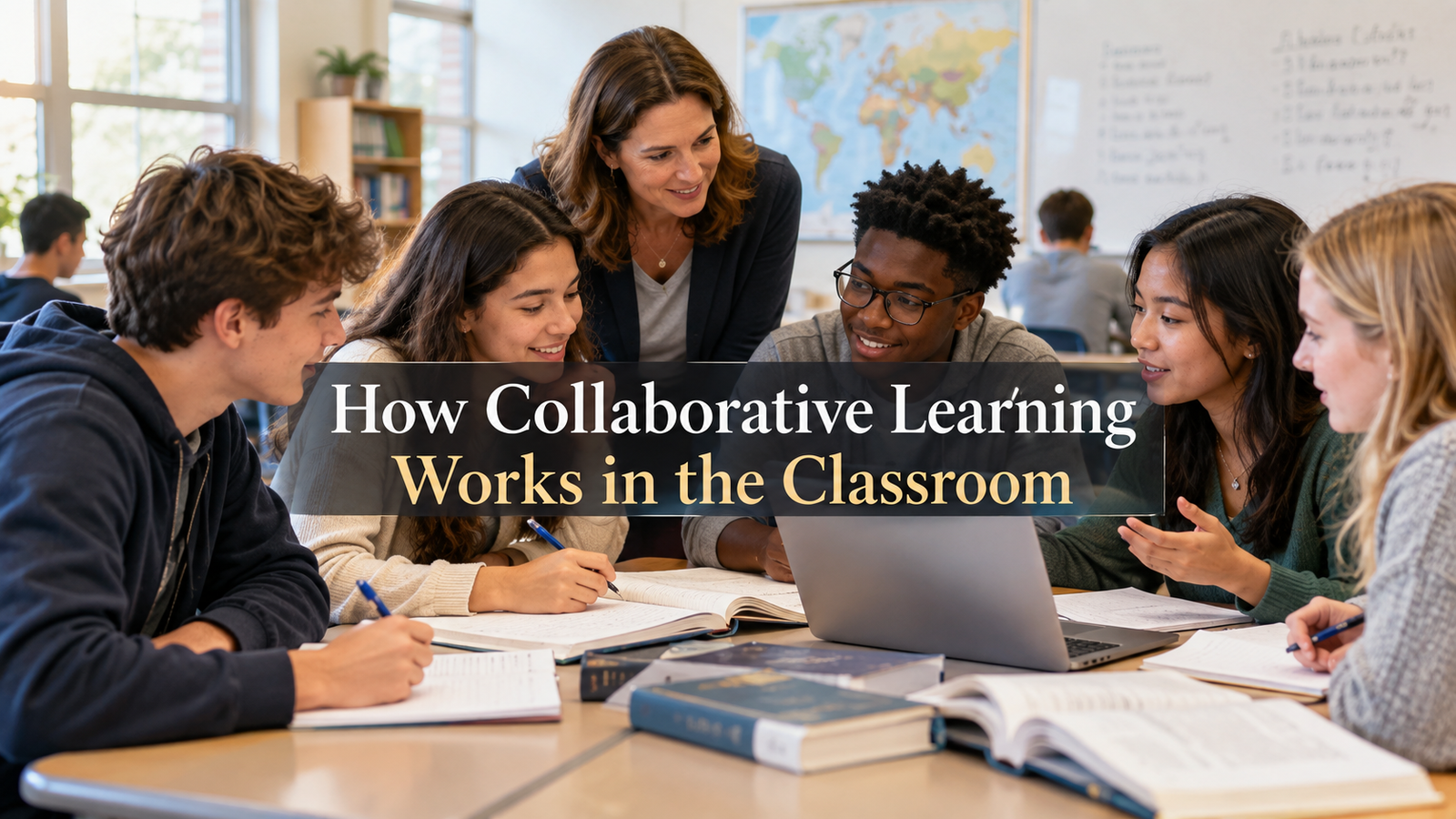
Collaborative learning is one of the most practical ways to make classroom learning more active, social, and meaningful. Instead of students only listening to a teacher and completing individual work, collaborative learning gives them opportunities to work together, discuss ideas, solve problems, and learn from one another.
When I first started reading about collaborative learning, one thing became clear to me. It is not simply about putting students into groups. A successful collaborative classroom requires planning, clear goals, shared responsibility, and guidance from the teacher.
In a well managed classroom, collaborative learning can improve communication, understanding, confidence, and problem solving skills. It can also make lessons more interesting because students become active participants in the learning process.
This article explains how collaborative learning works in the classroom, why it is important, what teachers do during group activities, and how students benefit from learning together.
What Is Collaborative Learning?
Collaborative learning is an educational approach in which students work together to complete tasks, solve problems, discuss ideas, or achieve a shared learning goal.
The main idea is simple. Students can often understand a topic better when they explain their thinking, listen to others, ask questions, and compare different points of view.
For example, instead of asking every student to solve a problem alone, a teacher may divide the class into small groups. Each group can discuss the problem, suggest possible solutions, and then explain its final answer to the class.
During this process, students are not only learning the subject. They are also practicing communication, teamwork, listening, reasoning, and decision making.
Collaborative learning can be used in almost every subject, including science, mathematics, language, social studies, business, technology, and arts.
How Collaborative Learning Works in the Classroom
Collaborative learning usually starts with a clear learning objective.
The teacher first decides what students should learn from the activity. After that, students are given a task that requires cooperation, discussion, or shared problem solving.
Students may work in pairs or in small groups. In some activities, every group member has a different responsibility. In others, the whole group works together on the same task.
The teacher observes the groups, answers questions, provides support, and makes sure that students remain focused on the learning goal.
At the end of the activity, students may present their work, compare answers, reflect on their learning, or complete an individual assessment.
This structure helps ensure that group work is connected to real learning rather than becoming an informal conversation.
The Teacher Sets a Clear Learning Goal
A collaborative activity works best when students understand what they are expected to achieve.
Before starting group work, the teacher should explain the purpose of the activity.
For example, the goal may be to understand a scientific process, analyze a story, solve a mathematical problem, compare historical events, or design a small project.
Clear goals help students stay focused.
If the instructions are unclear, some students may become confused while others may start discussing unrelated topics. This can reduce the educational value of the activity.
A good teacher usually explains the task, expected outcome, time limit, and rules before students begin working together.
Students Are Organized Into Groups
The next step is creating groups.
Group size can affect how well collaborative learning works.
Small groups are often effective because every student has more opportunities to participate. A group of three to five students may be easier to manage than a large group.
Teachers can create groups in different ways.
Sometimes students are grouped randomly. In other situations, teachers may create balanced groups based on learning needs, communication styles, or academic strengths.
The purpose is not to label students. The goal is to create a group structure that allows everyone to contribute.
Good group formation can encourage students to learn from classmates with different ideas and abilities.
Each Student Has a Role
One common problem with group work is that one student may do most of the work while others remain passive.
Collaborative learning tries to prevent this by creating individual responsibility.
Teachers may assign roles such as group leader, note taker, presenter, researcher, timekeeper, or question manager.
These roles help students understand what they need to do.
For example, one student may record the group’s ideas while another explains the final answer. Another student may check whether the group has completed every part of the task.
Roles can be changed regularly so students develop different skills.
This creates a more balanced learning experience.
Students Discuss Ideas Together
Discussion is one of the most important parts of collaborative learning.
When students explain an idea to someone else, they often have to think more carefully about what they understand.
A student may believe that he or she understands a topic until another group member asks a question. That question can reveal confusion and encourage deeper thinking.
Students may also hear explanations that are different from the teacher’s explanation.
Sometimes a classmate uses simpler words or a familiar example that makes a difficult idea easier to understand.
This is one reason collaborative discussion can support learning.
Students Learn by Explaining Concepts
Explaining a concept is a powerful learning activity.
When students teach an idea to another student, they must organize their thoughts and use clear language.
This process can strengthen understanding.
For example, imagine that students are learning about the water cycle.
One student may explain evaporation, another may explain condensation, and another may describe precipitation.
By combining their explanations, the group develops a complete understanding of the topic.
The students are not simply memorizing definitions. They are actively using knowledge.
Students Solve Problems Together
Collaborative learning is especially useful for problem solving.
A difficult problem may have several possible solutions.
When students work together, they can suggest different approaches and examine the strengths and weaknesses of each idea.
For example, during a mathematics lesson, one student may solve a problem using a formula while another may use a diagram.
The group can compare both methods.
This teaches students that learning is not always based on one fixed way of thinking.
It also encourages flexibility and logical reasoning.
The Teacher Becomes a Facilitator
In a traditional classroom, the teacher may spend most of the lesson explaining information.
During collaborative learning, the teacher’s role changes.
The teacher becomes a facilitator.
Instead of providing every answer directly, the teacher guides students through the learning process.
The teacher may move around the classroom, observe discussions, ask questions, correct misunderstandings, and support groups that are struggling.
For example, instead of saying, “Your answer is wrong,” the teacher may ask, “What evidence supports your answer?”
This encourages students to think more deeply.
A good facilitator helps students discover answers without completely taking control of the activity.
Collaborative Learning Encourages Active Participation
One major advantage of collaborative learning is that students become more active.
In a lecture based lesson, students may listen quietly for a long period of time.
Some students remain focused, but others may lose concentration.
Collaborative activities require students to speak, listen, write, analyze, and respond.
This active involvement can help students stay connected to the lesson.
It also creates more opportunities for students to use what they are learning.
Learning often becomes stronger when students actively work with information rather than only hearing it.
It Helps Students Develop Communication Skills
Classroom learning is not only about academic knowledge.
Students also need communication skills.
Collaborative learning gives students regular opportunities to express opinions, ask questions, explain ideas, and listen respectfully.
These skills are valuable in education and later in professional life.
Students learn how to disagree politely, clarify misunderstandings, and build on another person’s idea.
For example, instead of saying, “You are wrong,” a student may learn to say, “I understand your point, but I think there may be another explanation.”
This type of communication supports healthy discussion.
It Builds Teamwork Skills
Teamwork is important in many workplaces and real world situations.
Collaborative learning introduces teamwork skills inside the classroom.
Students learn that successful group work requires shared effort.
They may need to divide responsibilities, manage time, support other members, and make group decisions.
These experiences can help students understand how cooperation works.
They also learn that personal responsibility affects the whole group.
If one student does not complete an assigned task, the entire project may be affected.
This can teach accountability.
Collaborative Learning Can Improve Confidence
Some students are uncomfortable speaking in front of the entire class.
Small group learning may feel less stressful.
A quiet student may be more willing to share an idea with three classmates than with thirty students.
Over time, participation in small groups can increase confidence.
Students may gradually become more comfortable asking questions, presenting ideas, and taking leadership roles.
Teachers can support this process by creating a respectful environment where mistakes are treated as part of learning.
Students Learn From Different Perspectives
Every student brings different experiences, knowledge, and ways of thinking to the classroom.
Collaborative learning allows these differences to become educational resources.
One student may notice a detail that others missed.
Another may suggest a creative solution.
A third student may connect the lesson to a real life situation.
When students compare perspectives, they can develop a broader understanding of the topic.
This is especially useful in subjects that involve interpretation, analysis, or debate.
Collaborative Learning and Critical Thinking
Collaborative learning can support critical thinking because students are often required to explain and defend their ideas.
They may need to answer questions such as:
Why do you think this answer is correct?
What evidence supports this idea?
Is there another solution?
What are the advantages and disadvantages?
How does this example connect to the lesson?
Questions like these encourage students to move beyond memorization.
They start analyzing information, comparing ideas, and making reasoned decisions.
Examples of Collaborative Learning Activities
There are many ways teachers can use collaborative learning.
One common method is think pair share.
In this activity, the teacher asks a question. Students first think individually. Then they discuss their ideas with a partner. Finally, some students share their answers with the class.
Another method is group problem solving.
Students receive a problem and work together to develop a solution.
Teachers can also use peer teaching.
In peer teaching, students learn a topic and then explain it to classmates.
Group projects are another example.
Students may create a presentation, report, model, poster, experiment, or research project together.
Classroom discussions, case studies, debates, and group investigations can also support collaborative learning.
The Importance of Individual Accountability
Group learning should not mean that students can avoid responsibility.
A strong collaborative activity includes individual accountability.
This means every student is responsible for learning the material.
Teachers can support individual accountability in several ways.
They may ask each student to complete a reflection, answer questions individually, explain part of the group project, or complete a short quiz after the activity.
This helps the teacher see whether every student has understood the lesson.
It also reduces the possibility that some students will depend completely on stronger group members.
Challenges of Collaborative Learning
Collaborative learning has many benefits, but it can also create challenges.
Some groups may have personality conflicts.
One student may dominate the discussion.
Another student may remain silent.
Students may disagree about responsibilities.
Some students may focus more on social conversation than on the task.
Teachers must manage these problems carefully.
Clear rules, well designed tasks, time limits, and individual accountability can reduce many difficulties.
Teachers should also observe group behavior and provide support when necessary.
How Teachers Can Make Collaborative Learning More Effective
Good planning is essential.
Teachers should choose activities that genuinely require collaboration.
If a task can easily be completed by one student, group work may not add much value.
The activity should encourage students to exchange ideas, solve problems, or combine different contributions.
Instructions should be simple and clear.
The teacher should also explain what successful collaboration looks like.
Students may need guidance on listening, turn taking, disagreement, decision making, and responsibility.
These social skills improve with practice.
Classroom Environment Matters
Collaborative learning works best in a classroom where students feel safe sharing ideas.
Students should understand that questions and mistakes are part of the learning process.
If students are afraid of embarrassment, they may avoid participating.
Teachers can create a supportive classroom by responding respectfully to different opinions and encouraging students to do the same.
A positive classroom environment makes collaboration more meaningful.
Technology and Collaborative Learning
Technology can also support collaborative learning.
Students can work together using shared documents, online discussion boards, digital presentations, virtual whiteboards, and educational platforms.
For example, several students can contribute ideas to the same online document.
They may work together even when they are not sitting at the same table.
However, technology should support the learning goal rather than becoming the main focus.
A simple discussion can sometimes be more useful than using several digital tools.
The best choice depends on the activity.
Collaborative Learning in Large Classrooms
Teachers may think collaborative learning is difficult in a large classroom.
It can be challenging, but it is still possible.
Students can work in pairs instead of large groups.
Teachers can provide short tasks with clear instructions.
Group leaders can help organize activities.
The teacher can also use structured discussion methods that make classroom management easier.
The key is to keep activities simple enough to manage while still giving students meaningful opportunities to interact.
How Collaborative Learning Supports Different Learners
Students learn in different ways.
Some understand ideas by reading.
Others learn more effectively by discussing or explaining concepts.
Collaborative learning provides another pathway for understanding.
Students who struggle with written explanations may understand a topic when a classmate explains it using everyday language.
Students with stronger understanding can also benefit because explaining ideas can deepen their own knowledge.
This creates a learning environment where students can support each other while still developing individual skills.
Collaborative Learning Versus Traditional Group Work
Collaborative learning and traditional group work may look similar, but there is an important difference.
In basic group work, students may simply sit together and complete a task.
In collaborative learning, the task is designed so that interaction itself contributes to learning.
Students are expected to discuss, explain, question, solve, and reflect.
The teacher also creates structures that encourage participation from everyone.
This makes collaborative learning more intentional.
Assessing Collaborative Learning
Assessment can include both group performance and individual learning.
A teacher may evaluate the quality of the final group project.
At the same time, students may complete individual questions or reflections.
Teachers can also assess teamwork skills such as participation, communication, preparation, and cooperation.
Peer assessment may sometimes be used, but clear guidelines are important.
Assessment should focus mainly on whether students achieved the learning objectives.
Why Collaborative Learning Matters Today
Modern education increasingly focuses on skills that students can use beyond the classroom.
Students need subject knowledge, but they also need communication, problem solving, teamwork, creativity, and adaptability.
Collaborative learning provides opportunities to develop these skills naturally during lessons.
It also reflects many real world situations.
In workplaces, people often solve problems as teams. Scientists collaborate on research. Engineers work with designers. Healthcare professionals coordinate with colleagues. Businesses rely on teams to make decisions.
Learning how to work productively with others is therefore an important educational skill.
Final Thoughts
Collaborative learning works in the classroom by turning students from passive listeners into active participants.
Students work together, discuss ideas, solve problems, explain concepts, and learn from different perspectives.
The teacher remains important, but the role changes from being the only source of information to becoming a guide who supports the learning process.
When collaborative learning is carefully planned, students can develop stronger academic understanding as well as communication, teamwork, confidence, and critical thinking skills.
However, simply placing students into groups is not enough.
Successful collaborative learning requires clear goals, meaningful tasks, shared responsibility, individual accountability, and teacher support.
From what I have learned while reading about different teaching approaches, collaborative learning is most effective when cooperation has a clear educational purpose.
Students should not work together only because group activities are enjoyable. They should work together because discussion, explanation, and shared problem solving help them understand the subject more deeply.
That is what makes collaborative learning a valuable classroom strategy.